EOS gathered one of the biggest crowds on the first day of formnext powered by tct to usher in a “new era of manufacturing” with a new machine dedicated to automated mass production.
Addressing the entire ecosystem, the company highlighted advancements in hardware, software and materials to increase value across the whole process chain but the biggest announcement was the EOS P 500 designed for the production of polymer parts on an industrial scale. The system offers the lowest cost per part at 30% less than the EOS P 396 and builds twice as fast thanks to a dual-laser system and new re-coater. It benefits from a modular architecture which means users can choose a specific configuration depending on their application, and streamlines pre- and post-processing steps including pre-heating and cool down of exchangeable frame which take place outside of the system.
Though a production-targeted machine, Tobias Abeln, CTO, explained that today we are in the pre-production phase and moving into production. Tobias claimed, “We are transforming from prototyping to production” and how we need automation, integration, scale and repeatability in order to drive this further. With a huge buzz around production and lots of interested parties focussed on the machine, the EOS P 500 has already been somewhat validate by its first confirmed customer, Materialise, which was also announced this morning.
With the new system, users can process materials up to 300°C with the EOS P 500 – making it possible to manufacture polymer material classes such as PA6, PBT, PET, PPS, PEKK and opening up applications in the mobility and automotive sector or for electronic components. The EOS P 500 is an open platform so companies are able to develop additional materials such as BASF, Evonik and most recently Arkema.
New software solutions are also enabling this new solution including EOSCONNECT, a new product which gathers machine and production data in real time, and the updated EOSPRINT 2 which optimises build parameters.
Speaking about the growth of the company, EOS explained that it took the firm 20 years to reach its first 1,000 sales followed by a further 1,000 in the following five years, two years for the next, and now expects another 1,000 in the next 12-18 months - a total of 3,000 machine installations shared evenly between the company’s metal and polymer products.
Echoing the message from the industry, EOS said “we cannot do this alone” and partnerships are integral in continuing the growth of the company. In addition to innovation in-house, EOS has teamed with industry partners including Siemens, Authentise, SAP and DyeMansion - all of which could be found nearby on the show floor - to cover everything from design to post-processing. Plus through its AM Ventures business, it is growing the industry by investing in new start-up technologies.
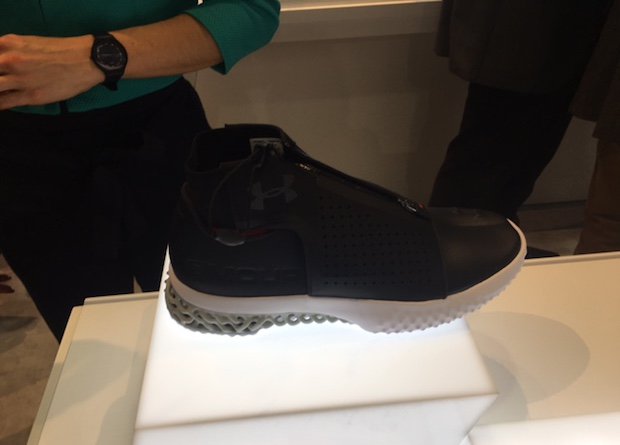
As CEO Dr. Adrian Keppler explained “It’s not about the machine, it’s about applications which create the value” and one application which drew plenty of attention on the booth was the ArchiTech shoe from Under Armour. The collaboration sees EOS polymer technology applied to the production of midsoles for a high performance running shoe whereby up to 100 pieces can be produced per build.
Visitors to formnext this week can find out more on booth 3.1 G50 at Messe Frankfurt.