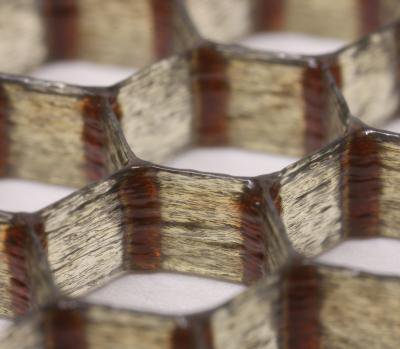
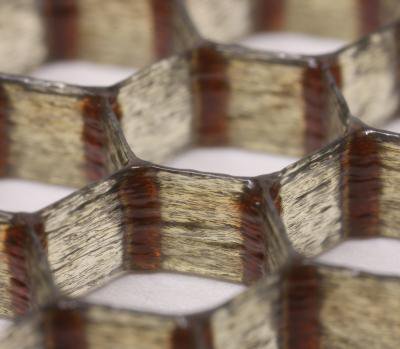
An old friend of those who took 'DT' at school, balsa wood has been given the 3D-printing treatment.
On wind farms across Europe and the US, the turbines' sleek blades are filled with the decidedly low-tech material, chosen for its light weight and durability. Ecuadorian balsa wood, however, is expensive and natural variations in the grain can impede precision, which is necessary when constructing turbine blades.
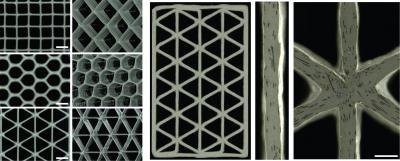
However, scientists at the Harvard School of Engineering and Applied Sciences (SEAS) and the Wyss Institute for Biological Inspired Engineering have developed a cellular composite material of never-before-seen light weight and rigidity. Researchers say this new material mimics and improves on balsa and even the best commercial 3D-printed polymers and polymer composites on the market.
Wind turbine blades are getting larger, with some near to meeting the wingspan of an Airbus A380, and so they must be engineered to operate with practically no maintenance for decades, which is why scientists have been working towards an improved sandwich construction material.
In a paper published in Advanced Materials, principal investigator Jennifer Lewism Hansjörg Wyss Professor of Biologically Inspired Engineering at Harvard SEAS, explained: "By moving into new classes of materials like epoxies, we open up new avenues for using 3D printing to construct lightweight architectures. Essentially, we are broadening the materials palette for 3D printing.
"Balsa wood has a cellular architecture that minimises its weight since most of the space is empty and only the cell walls carry the load. It therefore has a high specific stiffness and strength. We've borrowed this design concept and mimicked it in an engineered composite."
Alongside former postdoctoral fellow Brett Compton, Lewis develops epoxy resins that feature silicon carbide 'whiskers' and discrete carbon fibres that are very strong thanks to the deposition of fillers.
The resulting material is as rigid as wood and between 10 and 20 times stiffer than 3D-printed polymers.
Researcher Lorna Gibson, a professor of materials science and mechanical engineering at the Massachusetts Institute of Technology and one of world's leading experts in cellular composites, said: "This paper demonstrates, for the first time, 3D printing of honeycombs with fibre-reinforced cell walls. This marks an important step forward in designing engineering materials that mimic wood, long known for its remarkable mechanical properties for its weight."
Compton added: "Eventually, we will be able to use 3D printing technology to change the degree of fibre filler alignment and local composition on the fly."
The research could have significant knock-on effects in different industries such as automotive, where lighter materials may hold the key to achieving fuel economy standards. Indeed, one estimate stated that shedding 110 lbs from each of the one billion cars on the road around the world would result in up to $40 billion in yearly fuel savings.