
TCT's 'A Day in the Life of...' series has been primarily launched for college and university alumni to better understand what career opportunities in additive manufacturing (AM) are available to them. Throughout the series, TCT will spend time with a host of AM professionals to communicate what their day-to-day tasks are, what kinds of teams they work within, what they have learnt on the job, and how they got to where they are today. In this instalment, Vasia Papadopoulou of additive manufacturing OEM Stratasys explains the role of an Additive Manufacturing Engineer.
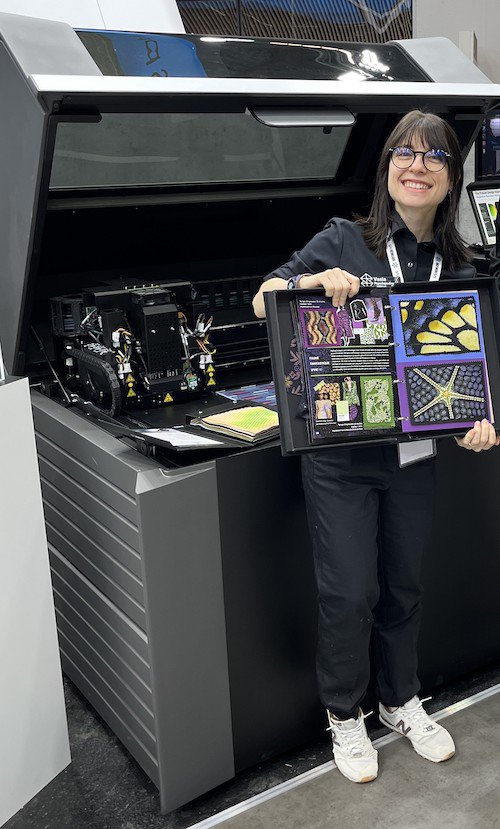
Vasia Papadopoulou lives life on her own terms and stands by her choices.
Her short career so far is punctuated by a series of decisions that have led her to a company, a city and a country that she didn’t expect to arrive at.
And in her role as AM Engineer at Stratasys’ Additive Manufacturing Center in Baden-Baden, Germany, each task is met with an inspiring attitude.
As you’ll learn, Vasia is not faced with many assignments that don’t whet her appetite, but even on the rare occasion she is, her standard response is one of the utmost professionalism.
“I find another way to think about it, I change my mindset and then it gets meaning,” she tells TCT.
She draws the line at the time it takes for her computer to process a particularly complex software task, but Vasia's approach to her work is an enlightening one.
A generic job title at probably the largest additive manufacturing company in the world, you would be forgiven for thinking there isn’t an interesting story to tell about Vasia's role. You’d be wrong - an example being Vasia thinks she might be the only employee at Stratasys with this job title - but forgiven all the same.
“When we get the role, we start to shape it from the beginning,” she says. “We have the base, and then form it and shape it to ourselves and how we like it. My job is not everywhere, I create it as I like it and as I enjoy it. I wish that more people would understand that and make their job fun. Put their hobbies into the job.”
Q. What kind of people are perfect for a job like yours?
VP: People who like to be technical but also have great imagination. I will not put any limits here. Being an additive manufacturing engineer can have everything.
A TYPICAL DAY
So what has Vasia made of the AM Engineer role she started in January 2023?
Hired to primarily oversee quality control in a Stratasys benchmarking centre, she quickly took it upon herself to support efforts across the wider workflow. As a team, those working in this facility are supporting customers in bringing their ideas to fruition, helping with the design of parts that may be suitable for additive manufacturing, and returning sample prints based on the parameter sets they’re working with.
“I like being a part of all stages through this workflow,” Vasia says. “From the conceptualisation with the customer, the introduction to printing, the operation of the machines, 3D design and also quality control. And then also helping the customer implement additive manufacturing to their own production.”
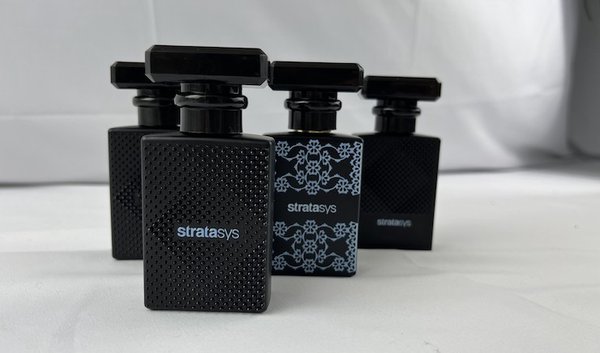
It is impressive, then, that Vasia even has time to discuss her role.
Today, as she does every day, she arrived at the facility before 7am. Such is the volume of benchmarking requests received at this centre, several prints will be left to run over night, and Vasia likes to arrive as early as possible so that she can promptly update the customers of their progress when they log on.
“When the people wake up and start asking, ‘Where’s my benchmark, how did it go?’ I have to be sure that the machine ran and is still running without any issues.”
This is top of the priority list for the resident quality control specialist. Second on that list is coffee – “It’s a must. Without coffee, the clocks don’t move.” – and then she can begin to respond to those client emails. By now, her colleagues have arrived, had their morning coffee and cleared their respective inboxes too. Vasia will therefore start a communication and exchange session with the rest of the team, allowing them to catch up on the progress and status of prints that were under somebody else’s supervision.
Then, the clock will probably need some more encouragement, so another coffee it is. Vasia will now begin to liaise with colleagues internationally, connecting with customers via the sales team, and also touching base with marketing staff ahead of the next trade show – Vasia is one of several Stratasys engineers who might help out with new designs for sample parts. Another group of staff Vasia will make sure to connect with on a regular basis is the regional technical engineers. This, she sees, is an opportunity to offer her feedback as a user of Stratasys machines to the people who are looking to address any bugs or glitches.
Since Stratasys likes to open its doors to prospective customers, Vasia might also find herself hosting tours of the facility from time to time, while she is always willing to continue conversations with customers at trade shows like Formnext.
“Most people that participate in these shows try to find new stuff, ‘What did this competitor do or what’s new regarding materials?’ What I do is talk to people, customers, and see what the needs are in the industry at the moment and try to figure out how additive manufacturing can offer solutions to those problems.”
Q. Why should somebody want to work in the 3D printing space?
VP: I think it's the technology of the future. Many companies have realised that. In ten years, I think that it's going to be implemented and integrated in every production [environment]. From this side, it's very meaningful to get into 3D printing.
THE ROLE BEYOND THE TITLE
“The main concept, from how I see it, is bringing ideas to life,” Vasia says of her role.
That goes beyond just getting a part to come out of the other end of the printer, but to make steps towards the realisation of a business case for additive manufacturing. It is less about what’s possible with 3D printing, and more about what’s sensible to 3D print.
Vasia is one of a team of five at the Additive Manufacturing Center in Baden-Baden, reporting up to the Manager of the entire facility. Her designated role is to oversee quality control, making sure that each benchmark is ready to be sent on to customers.
This is an important step of the process since additive manufacturing is a relatively new technology and, chances are, there is no standardised process for the part requests coming through to the Additive Manufacturing Center. The process implemented at this facility is the work of Vasia.
“The whole system is something that I built up,” she tells TCT. “I created the whole process and the pamphlets that we sent to the customers with information about the printing parameters, along with a quality control checklist.”
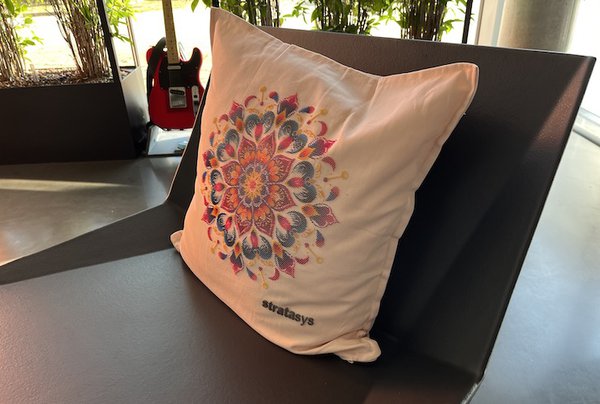
To ensure these benchmarks can be as informative as possible to the customers, Vasia is in constant contact with the application engineering and sales department. This process, Vasia considers, is essential. But she is also willing to carry out work that is not considered essential per the terms of her employment.
One example is Vasia's completion of the Customer Service Engineer training for PolyJet technology that Stratasys offers to staff. It means that Vasia can now fix machines up to a specific level, calibrating systems and addressing minor problems that shouldn’t require the expertise of a designated maintenance engineer. It has proved a helpful skillset to have when working on-site with machines at the Additive Manufacturing Center and with customers who are new to 3D printing.
When time opens up, Vasia is also keen to keep track of industry news through the various media outlets serving the industry, and she will regularly return to a list of ideas she has: working on the designs of parts and printing them to see how they turn out.
Q. If you could give your younger self some career advice?
VP: Try to bring your hobbies into your job as soon as possible, and keep them there, and always try to reach higher, because anything is possible. I never imagined that I would be hired by Stratasys, to be honest. I did this on a whim and here I am.
THE PATHWAY
Vasia has always had a creative mind, which is what set her on the path towards a job as an additive manufacturing engineer. She doesn’t think creativity is crucial to this kind of job, but it definitely makes it more fun. The ability to have an idea in your head in the morning and a part in your hand by the end of the day never wears thin, and in fact, only serves to keep the creative juices flowing.
Communication has always been another of Vasia's strengths and one again she gets to utilise regularly; with colleagues when working on the latest benchmark assignment, and with customers when articulating the findings.
Vasia takes communication one step further as a multi-linguist. Her interest in languages is a key reason she’s now based in Germany.
Over ten years ago now, she commenced her studies at the Aristotle University of Thessaloniki, picking up a diploma in Mechanical Engineering in 2019. She then had a couple of freelance and internship mechanical design and engineering roles in Greece, before finding work at the Centre for Research & Technology Hellas.
Having completed a 3D printing course at university and through the small world of additive manufacturing in Greece, she was headhunted for a role at the Centre for Research & Technology Hellas, who were in the process of building out a 3D printing lab. As a Mechanical Design Engineer, her role here was to test materials and parameter sets across a range of 3D printing technologies as part of a series of research efforts.
What followed was a short stint at a Greek start-up before the opportunity at Stratasys presented itself. While progressing steadily in her career, Vasia had been learning Japanese and German in her spare time. She was not ignorant of the job opportunities this could open up to her, but equally, it wasn’t always in the plan to move her life to Germany.
Stratasys, though, was looking for somebody just like Vasia. And Vasia thought, “Maybe this works for me, let’s try it.”


