

Artec 3D unveils the latest updates to its 3D data capture and processing software, Artec Studio 20 (AS20). The all-in-one software solution already offers 3D scanning, photogrammetry, reverse engineering, and quality inspection processes, but has now received further upgrades. Creating faster, fully automated, and customised data processing pipelines, the new Workflows are ideal for digitalisation, design iteration, and bulk product analysis.
These upgrades will have positive consequences across Artec’s 3D scanning range. With Live Scan Decimation, the Artec Spider II is more efficient, while the Artec Micro II is enhanced with the HD Mode and 3-axis scanning. Additionally, refined masking in AI Photogrammetry delivers ultra-realistic, artefact-free 3D models. Said models require minimal editing for CGI, VFX, forensics, and more.
“Our last release turned Artec Studio into a complete package, with practically anything a user could need to capture a 3D model,” said Art Yukhin, CEO of Artec 3D. “Artec Studio 20 raises the bar in every way possible. Workflows allow users to customise and automate repeat tasks for bulk processing. Our hardware and software are also faster, better integrated, and easier to use – in a way that delivers meaningful ROI benefits for customers across industries.”
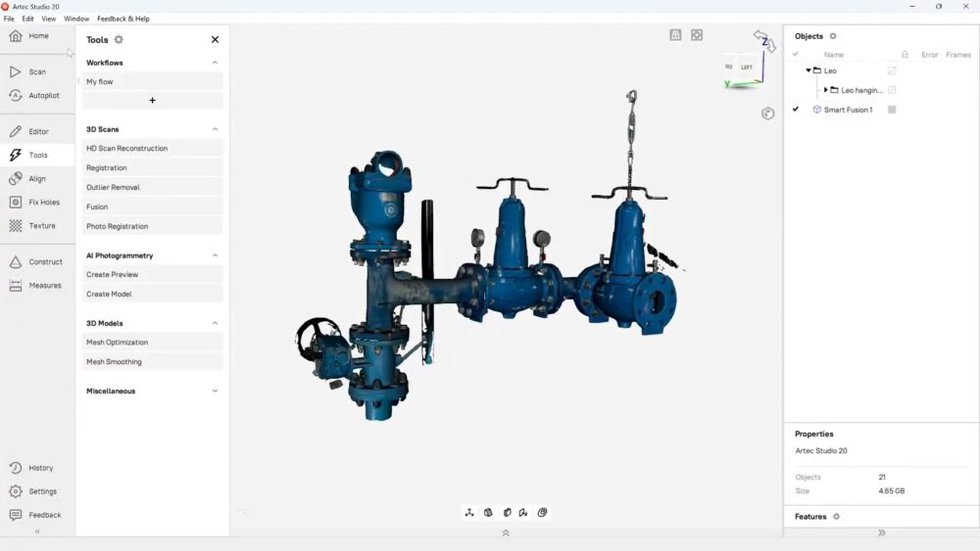
Customisable workflows
Tailored workflows for specific applications can be created by queuing algorithms and running them, taking captured data and turning it into a 3D model with one click. Workflow automation makes this process up to 70% quicker. The software solution allows parameters to be adapted to different data sets; however, settings don’t need to be configured each time. This is perfect for repeat tasks, helping to eliminate human errors, improve repeatability, and enhance quality assurance.
Upgraded 3D scanning
The AS20 hosts a variety of upgrades for Artec 3D’s 3D scanning portfolio, from the Artec Spider II offering Real-time Fusion, previously an Artec Leo exclusive, to users being able to turn high-resolution data captured by the Artec Spider II into lightweight 3D models. The integrated Autopilot works to further streamline these steps with Improved Reconstruction, delivering more complete datasets for realistic, watertight models.
Meanwhile, the Artec Micro II also benefits from a series of enhancements. With HD Mode, users can boost fine-detail capture, picking up four times more data points with each scan. The Micro II also delivers greater surface coverage due to its 3-axis integration, which allows the solution to capture the most complex, obscured areas and recreate entire objects.
The Artec Point receives upgraded visualisation with two times faster data capture and a more intuitive scanning experience. Both the Artec Leo and the Artec Ray II gain Fusion setting redesign and workflow automation. With the latter now able to access Street View and all-new Panoramas.
Photogrammetry powered by AI
AS20’s AI Photogrammetry continues to go from strength to strength with refined masking in AS20 allowing for realistic, artefact-free 3D models. Additionally, masking for texturing ensures objects don’t blur into the background. While multi-camera support expedites photogrammetry data capture for drones, smartphones, handycams, and DSLR cameras. Users receive the best frames with sharp image prioritisation. Finally, GPU Memory Optimisation helps settings fit the user’s hardware needs, ensuring that AI Photogrammetry reconstructs models with peak efficiency.
Improved integration
AS20 benefits from better integration with third-party software. ZEISS Inspect's advanced analysis tools are easier to access via a new interface that improves exporting and enables scripting for automation. Enhanced USD file support improves AS20’s functionality for CGI & VFX users. Additionally, RCP file support has been added, offering compatibility with BIM platforms like Autodesk Revit.
Users can now optimise data for downstream processing with distance and intensity export filters. Finally, AS20 features various UI improvements, like enhanced tools and scanning panels designed for intuitive navigation and control.


