

When I was in high school, my friend had a maths tutor who told her if she wanted to play guitar, she would first need a good understanding of numbers. We both scoffed. Maths?! We were going to be rockstars, not rocket scientists!
Fast forward to today, I'm at Formnext, very much not a rockstar, but sitting down with fashion designer Brigitte Kock, who is wearing a fabulous 3D printed bucket hat and telling me all about the crucial role of maths in her creative process.
In a Frankfurt exhibition hall, populated by grey powders and suits, it's the most vibrant conversation I've had all week. No offence to turbine blades and the like.
Under Variable Seams, the Dutch designer has made a name for herself creating modular wearables using 3D printing and parametric design. When we meet, she's days away from attending a photoshoot to fill the pages of her first book; part how-to guide, part behind the scenes of Kock's design process - the fundamentals of which, is numbers. Perhaps Mr. Maths Tutor was onto something.
"In fashion design, if you draw a pattern for someone personally, you would have to follow steps in order to build a 'basic block'," Kock recalls of her early entry into digital tools for fashion. "And there's a lot of different measurements. When I looked at it, I was like, wait a second, this is actually just a mathematical formula. And it's really fascinating because in the fashion industry, they follow all those steps every single time you make a garment for someone, which is very time-consuming. You could literally put the whole thing in a software and do it in seconds. I was like, why don't we have that?"
Kock knew she could take those principles and apply them to mass customisation; creating perfect-fit garments, tailored to the wearer, when they want them, and with less material waste. She started looking at 3D knitting ("Not that much room for innovation".), 3D weaving ("At that time, the only things I could find about it were that you had to build the machine yourself. Love this, watching the space, not for me".), and eventually landed on 3D printing. She started small, designing lingerie, and printing on a desktop polymer extrusion system.
"I've been doing this for maybe eight years now. To this date, technically, my most difficult project is still that one because I spent a full year with two other people to actually code it in a non planar way," Kock says of that first project. "So you could literally put in your body measurements and then everything else was coded. No slicing, no nothing. And it was printing, weaving the yarns, almost. It would have a special infill. And that was really fun. But it also took me one year to find out that people don't actually want to wear 3D printed underwear! So, that's kind of the realism of it."
The challenge was the material. Ever since the famous 3D printed dress by Michael Schimdt and Francis Bitonti, which enveloped Dita Von Teese in a black SLS garment studded with Swarovski crystals, 3D printed fashion has largely taken the form of embellishments and rigid art pieces shaped around the body or chain mail-like structures that interlock to create movement. Kock admires Nervous System, the design duo that established a system to take any three-dimensional shape and turn it into a flexible structure - most famously, the 3D printed 'Kinematics' dress - but Kock, who studied Material Futures at Central Saint Martins, believes not a lot has shifted since then.
 Laura Griffiths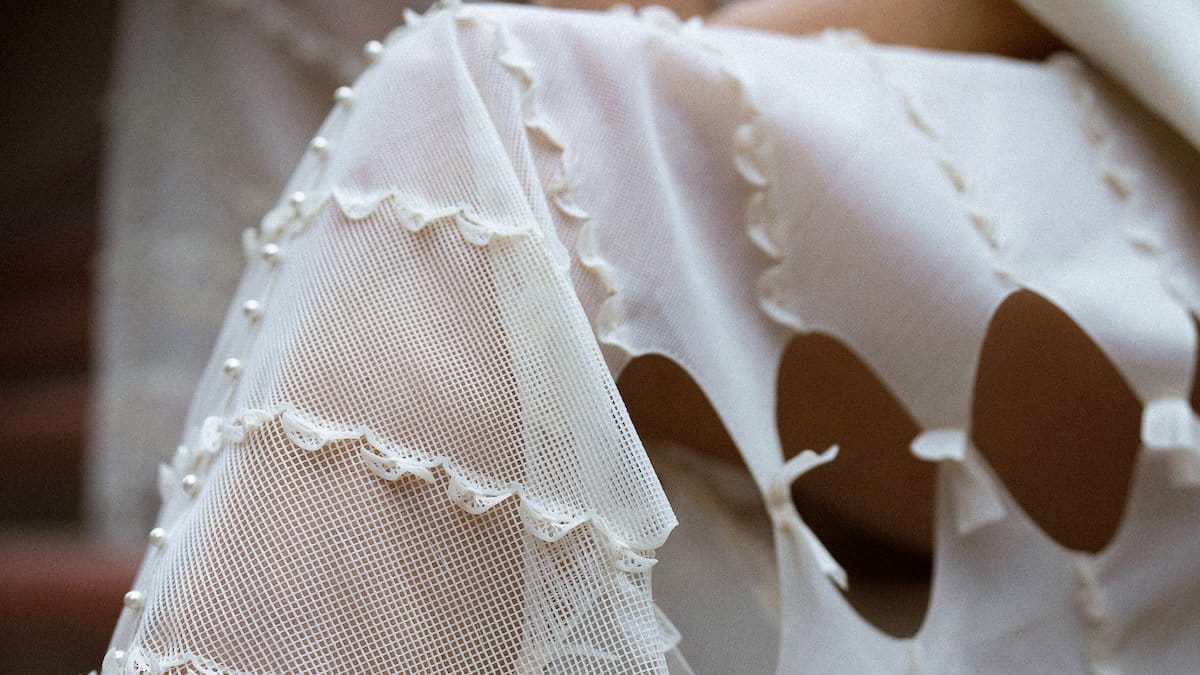
"I think it's still the same," Kock assesses of the acceptance of 3D printing in fashion. "I think people were like, 'great gimmick'. It was more of an art piece and I think now - because at least the 3D printers are actually in your house - people start thinking, 'what else can I make with this that I would use?' So I think now the expectation is 'this is something I can do. Something I can use.' But the material still isn't there."
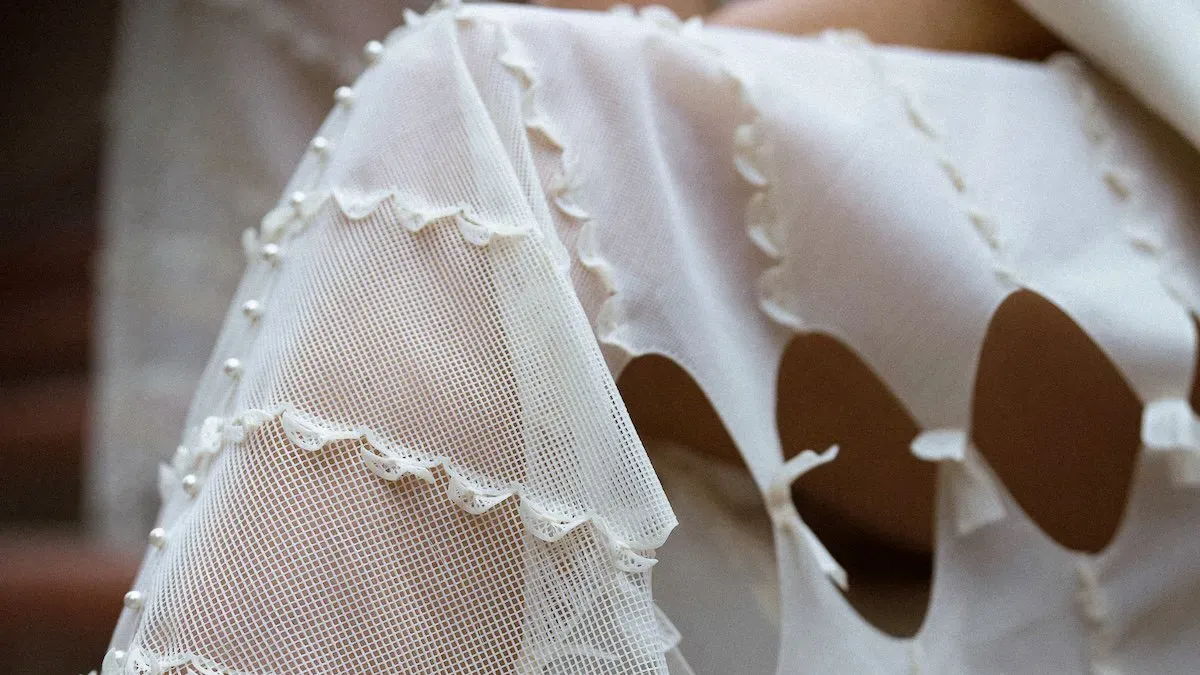
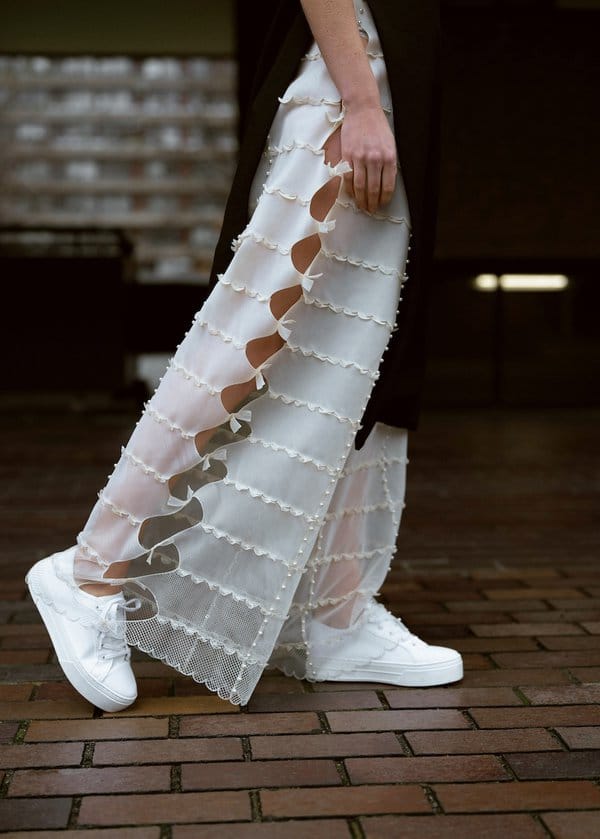
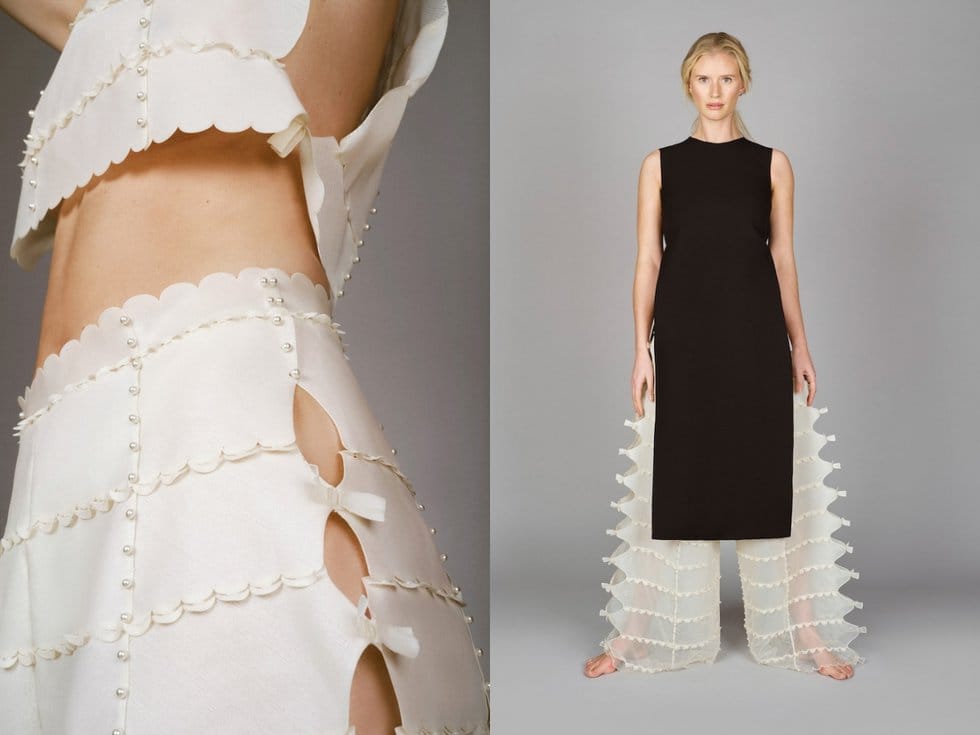
There are signs of change, however. Through Variable Seams, Kock worked with material science company Balena to co-create a collection of flexible, ready-to-wear 3D printed garments. The pieces were made from Balena's BioCir Flex3D filament, a bio-based, compostable material with a rubber-like texture, sustainably sourced from castor beans and polysaccharides, and printed on standard desktop FDM systems. The set looks like it's made from white lace and unlike those stiff architectural forms, it flows like textile.
"I absolutely love working with companies that are pretty far removed from what I'm doing."
Kock is intrigued by new materials opportunities, particularly those in silicone 3D printing. Her next stop after our meeting was a trip to the Prusa Research booth, which was demonstrating a new plug-n-play toolhead for the Original Prusa XL, developed in partnership with startup Filament2. The toolhead features a precision mixing nozzle designed to print with 2-part liquid materials, starting with real, heat-resistant silicone. Materials advancements such as these, particularly on accessible machines like Prusa's, Kock believes, are key to making 3D printing a more viable clothing production method.
"I think it's gone from pieces of art to nice things to have, but maybe not to wear comfortably - statement pieces. I hope that it's going to go towards, this is the way that we can produce it ourselves and actually wear it."
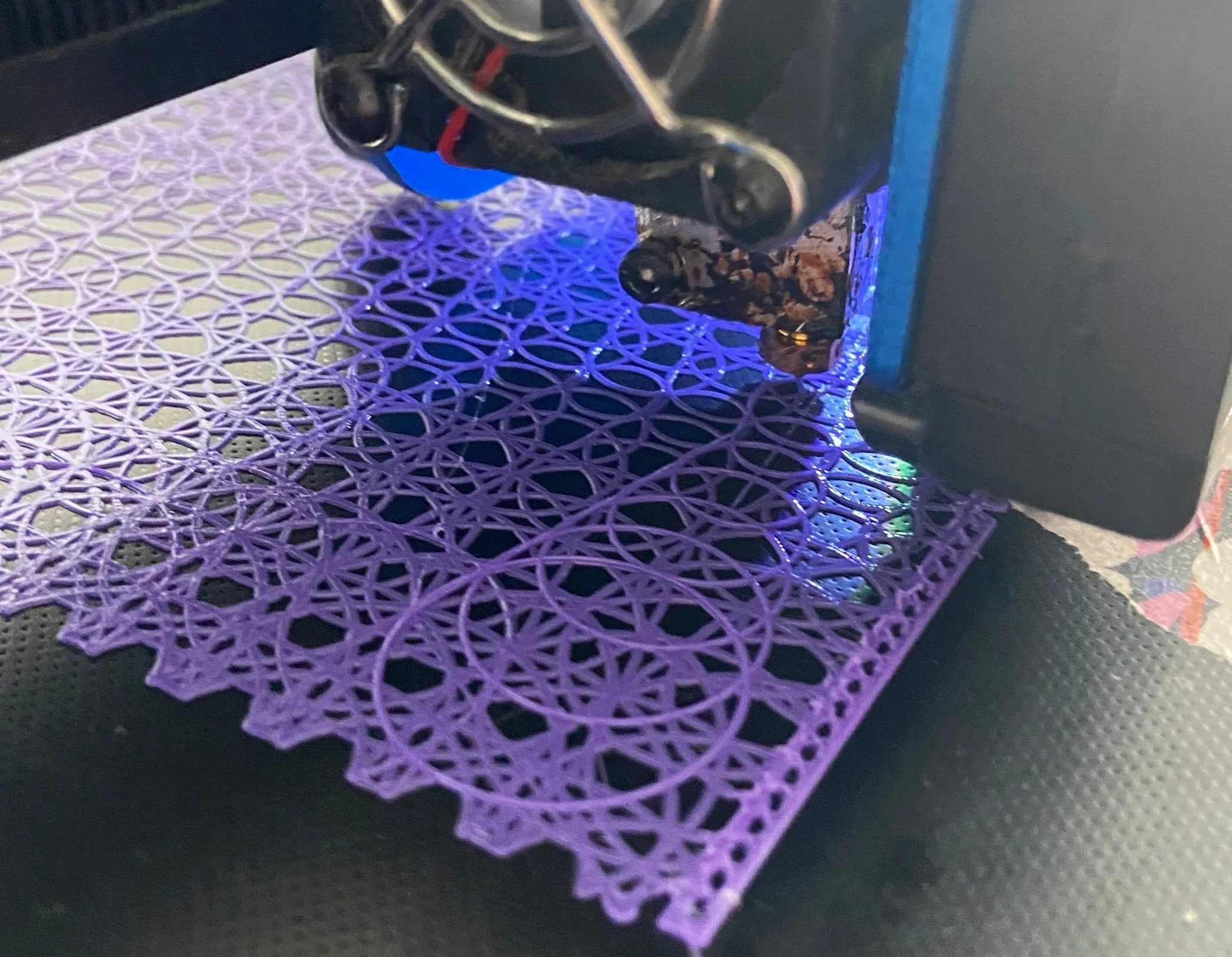
Kock is already wearing it. The bucket hat she's sporting today is the 10th version she has designed - she describes the project as "a love/hate relationship". The material is incredibly thin and while it is plastic, it does move like fabric. She opens up her laptop to Grasshopper - her favourite place to work - to show me a fully parametric design, which can be manipulated to fit different widths and sizes to create the perfect fit and function. For her first iteration, she started out with a lace-like pattern as the base 'textile' and shared it with her followers.
"Some people were commenting like, 'this isn't suitable for rain and it isn't suitable for blocking out sun, so why are you making this?' And I was like, 'fashion, obviously!'"
No problem, though. Kock just went back into the project, tweaked the design and made a closed version. But make no mistake, this isn't 3D printing for the sake of it. Kock is a firm believer in the potential for 3D printing as an enabler of more localised and responsible supply chains, and products that are customised to the wearer's unique form and style.
"I think that's a vision for the future that I would like to make real or work towards. And part of that is sustainability, part of that is also bringing manufacturing much closer again."
A couple of weeks before our conversation, Kock posted a video to Instagram of one of her 3D printed bags, originally created for Halloween. Using Google's Gemini AI assistant, Kock prompted the platform to adapt her original 2D line art into a version that was a little less spooky. The design was hers, the prompts were hers, the conversion from 2D to 3D was all hers. The AI just did what was asked, and the output looked good. Doing this parametrically, Kock said, would have taken an additional two weeks. But people were not happy.
"It's really fascinating to see that. I'm really curious, I guess, how it's going to be used in the future for more creative industries. Because at the moment there's a lot of heat on it, but it's such a powerful tool."
Kock is positive about AI in some ways, but cautious in others, acknowledging that we don't yet really know what the technology means for a lot of industries, particularly creative ones. But, like 3D printing - which has also faced its share of hesitation when it comes to digitising creativity - Kock is choosing to meet new technologies with curiosity.
"I think, for me, being keen on combining technology for fashion, this is just one technology."
Kock clicks and drags around her laptop screen with ease - playing with shapes and sizes and rejigging numbers. But it's taken a lot of work to get here. Learning how to code is not easy, and everything she does has been self-taught, so Kock knows first-hand how difficult this stuff is to communicate and learn. That's something she also wants to change.
"I realised, if I want to reach a lot of people and build this through social media, I needed to just make something simple, easy to understand, easy for people to try out themselves."
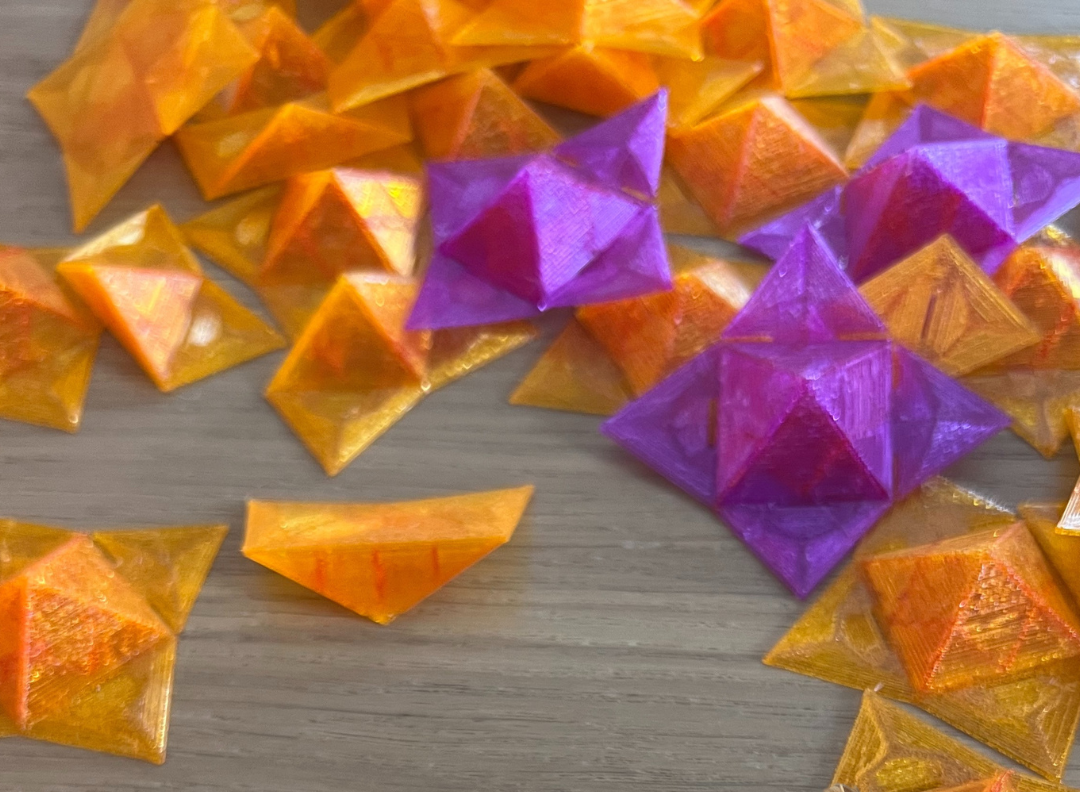
It's why she's creating a book based on this modular DNA. Each chapter will feature a design methodology and a project idea. She sees modular fabrics as "puzzle pieces" which can be easily assembled and reconfigured to create something new - a concept which lends itself to not just creativity but circularity, too. Actively sharing her process on social media, Kock offers free tutorials on how to print fabric without 3D modelling skills, and has shared a step-by-step guide for creating a modular 3D printed wallet as part of Elegoo's 'Elegoo with Her' mentorship programme, designed to support women to learn 3D printing skills. Each of these tutorials function as a starting point, and Kock says she loves seeing how others interpret her designs with new twists.
"Sometimes people send me messages of what they made with it. And I'm like, it's really nice, why didn't I think of that?!"
So far, Kock has used her building blocks to make skirts, tops, bags, dresses, accessories and more. Shoes are very much on her vision board, and she recently worked with another designer to develop a pair of 3D printed boots - it turns out not every piece is ripe for a 3D transformation just yet. Though, if Kock has her way, that won't be true for long.
"My dream goal is to make every single clothing item to make a full wardrobe."


