

It’s past midnight on September 1st, 2022 and Sam O’Leary is sat in his office with a beer in hand. The company he has been leading for the last two years has just formalised a deal with one of the world’s biggest technology leaders, which, by the following January, will acquire over 92% of its shares at a value of €622 million. It’s an exhausting day but a good one.
“This was a fantastic opportunity for the industry and an even better opportunity for our company,” O’Leary reminisces of Nikon’s acquisition of SLM Solutions, speaking just a few feet away from that same spot at the company’s headquarters in Lübeck, Germany. “We found the right people to take this technology forward and to take this industry forward. Three years have flown by.”
In that time, the company has rebranded, adopting the Nikon name and golden yellow, shipped its 1,000th 3D printer, and commenced manufacturing of its machines in the US – just in time for, not because of, O’Leary clarifies, President Trump’s tariffs policy. He describes the last year as ‘interesting’ and the backing of the Japanese technology giant as ‘very beneficial’, solidifying O’Leary’s summation that Nikon SLM Solutions is a technology company producing manufacturing solutions, that just happen to be additive.
“When I go and look at a lithography machine in Japan, I think, ‘Geez, what we do is really simple,’” O’Leary says of Nikon’s influence. “This is incredibly complex, and having that structure, that foundation, that technology mindset is really a unique and wonderful combination. It drives the trust, it drives the stability, and it drives the comfort that this is not a one- or two-year project.”
The future is very much on O’Leary’s mind. He isn’t interested in looking back. He’s bored of having the same conversations, and he doesn’t buy into the negativity that has consumed the additive manufacturing industry over the last few years either. When the loudest noises coming from the sector were preoccupied with volatile markets and the arduous path to industrialisation, Nikon SLM, he claims, was just getting on with it.
“I’ve seen this technology really move from R&D, from niche applications, from cool things into mainstream,” O’Leary explains. “I was at an industry event yesterday. One of the questions was, ‘When will additive become truly industrialised and mainstream?’ And my answer was, ‘It has, you’ve just been left behind talking about it.’ The true industrialized use cases, the true production cases, guess what? People don’t necessarily want or need to shout about them because they’re busy applying them. Making money and making components.”
The evidence is all here. As we walk along the upper level of Nikon SLM’s Lübeck facility, which provides an aerial view of its production floor, there are six large-format NXG XII 600 systems being prepped for customers, and another stack of sealed crates of various sizes packed with smaller machines that have been hand-built and tested, ready for shipping to their new homes in manufacturing facilities around the world.
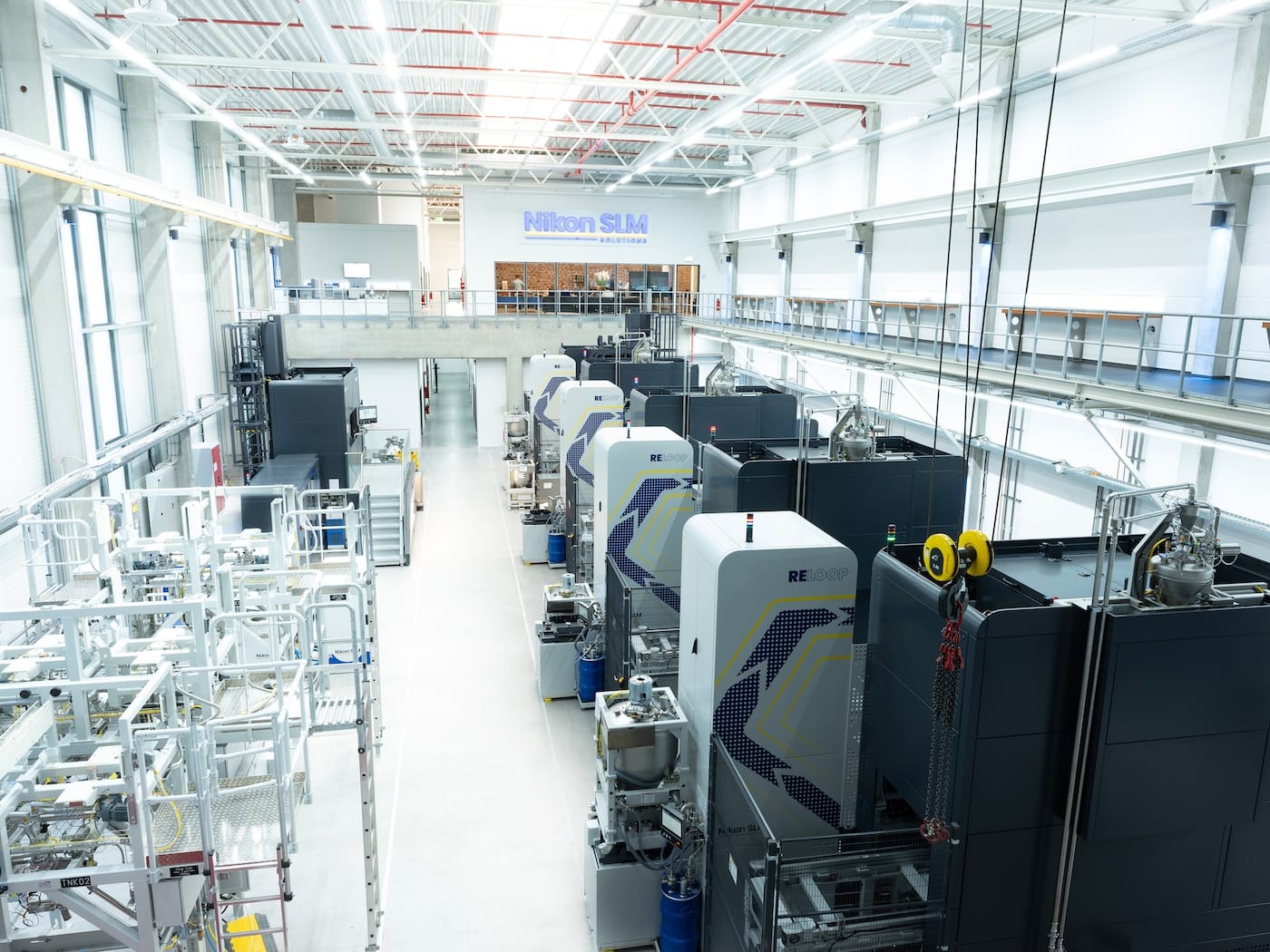
The 12-laser NXG is now considered to be Nikon SLM’s flagship system. So much so, it just hosted its first NXG user group meeting. Officially, 50 have already been sold, though O’Leary says the real number is actually higher. But despite being coveted by the likes of Collins Aerospace, Sintavia and GKN Aerospace, which have each installed multiple units, the NXG wasn’t an overnight success story.
“People laughed,” O’Leary recalls of the machine’s launch in 2020. “People text me and said, ‘This is a rendering, this will never work.’ But we were confident enough, and dare I say, arrogant enough, to know that if we could provide a solution that solved a problem, there [was] a market for it. And that’s the way we look at every piece of R&D. Can we drive something for tomorrow that doesn’t exist today?”
The NXG is an evolving product. Since its launch, it’s gotten faster, new materials have been added, and it’s gotten bigger – the NXG 600E version, which came about through a $5.2 million US Air Force Research Laboratory contract in 2022, features an extended 1.5m Z-axis, giving it one of the largest powder bed build volumes on the market.
“Large-format additive manufacturing,” O’Leary says, “is day to day for us.”
The last time O’Leary featured in a TCT Magazine cover story he talked about AM’s ability to “implement out-of-this-world ideas.” When he talks about applications today, he’s much more interested in the down to earth. We walk past a gallery of parts, and he casually name-checks acetabular cups and optimised automotive parts as though they’re the most routine objects in the world, including the well-documented, generatively designed brake calliper printed for Bugatti.
“The only people that I’m interested in proving things to are our customer base, the ones that exist today and the ones that will exist tomorrow.”
“When I first joined this company, I thought, ‘Yeah, this is a cool application,’” O’Leary shares. “Now I think it’s the most uncool application because it is low volume, it is everything that’s wrong with the focus of this technology.”
He brings out a rocket demonstration part from his office, which exposes all of the complex lattices and geometries that AM affords, but O’Leary much prefers to talk about the nondescript bracket that forms part of the seat structure of an everyday car, and is produced by the tens of thousands. It isn’t the most striking example of additive manufacturing to look at, but it’s cheaper than conventional manufacturing and can only be produced with AM.
“To me, this is way cooler than the Bugatti brake calliper,” O’Leary enthuses. “It encompasses everything that the industry has been pushing forward for the last two decades. You never lose the love of looking at cool applications. It’s beautiful technology, and it’s beautiful engineering. But there has to be this pragmatic mindset of making sure it matters.”
O’Leary began his career in conventional manufacturing, working on 3-, 4-, 5-axis machining centres. He spent seven years at GE – he was there when GE tried to buy SLM back in 2016 – moving from its GE Power segment to its dedicated AM business. But his first interaction with AM technology was as a customer back in 2008, while working at a company in the UK making aftermarket products for Rolls Royce industrial gas turbines. A shortage of fuel nozzles led to a meeting with The Welding Institute who, as O’Leary describes, had an old-fashioned powder delivery system which used a CO2 laser to melt metal particles as a method of repair.
“We had that solution as a temporary one, and then we actually started to 3D print fuel nozzles. And the cool thing is, this was years before the fun GE story came out. Of course, they were doing it with greater complexity at a greater scale, and we were just solving a very simple problem. But that’s how I fell into 3D printing.”
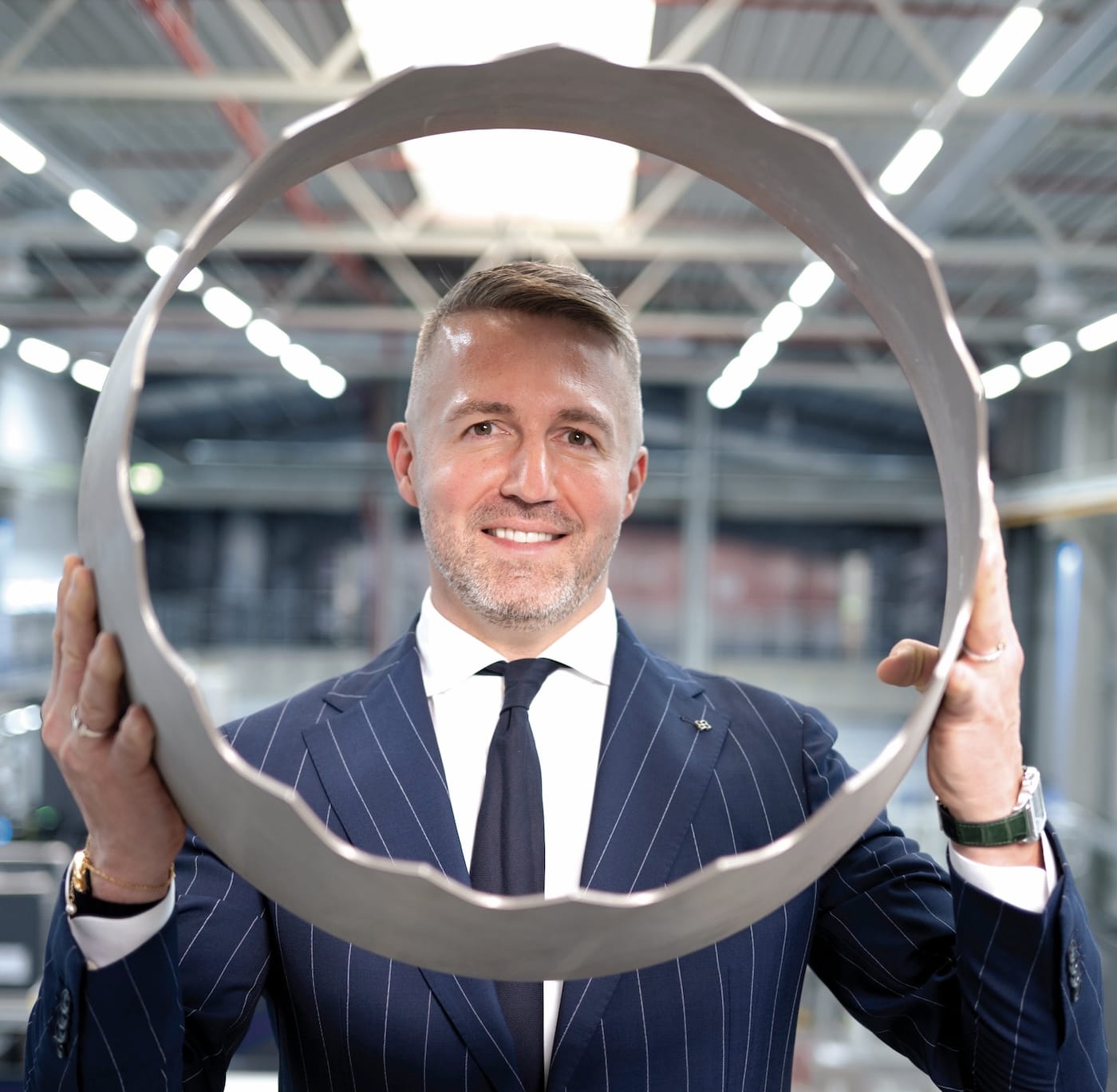
Today, he’s the kind of leader who high fives people as we tour around the building. He says ‘cool’ a lot but is careful about what he attributes it to. He seems unfazed by the recent eulogising of the AM industry. The hardest part of his job, he says, is deciding which projects go to R&D heaven each year.
“We’ve cut far more R&D projects than we’ve executed,” O’Leary admits. “Some of them are cool but they don’t necessarily solve the problem that needs to be solved. Focusing them onto the ones that really matter and that drive success is the most difficult part because I’m also an engineer who loves this technology at heart.”
O’Leary talks about ‘relentless innovation’, with a project ratio of four to one – the one being those that make it. Its guiding factors are speed and cost. I’m shown to a room I’m told not all Nikon SLM staff have access to, an engineer’s playground of sorts, featuring several pieces of hardware in varying states of readiness. It moves fast but doesn’t rush. The Adira technology, for example, based on the Fraunhofer ILT moveable process head technology the company acquired two years ago, is still undergoing development, and Nikon SLM is not making plans for some big trade show curtain drop any time soon.
“The only people that I’m interested in proving things to are our customer base, the ones that exist today and the ones that will exist tomorrow,” O’Leary insists. “We position this business to continuously be a few steps in front, and that’s what we’ll continue to do. I don’t think we need large product launches. I don’t think we need glitter shows. We need to work hard, we need to do stuff consistently, and we need to give a s**t about our customers and what matters to them. That’s it. I really don’t think it’s more complicated.”
"We value everybody that we compete with. We also value beating everybody that we compete with regardless of where they’re from."
There are 600 people working here in Lübeck. O’Leary estimates that close to half of its workforce holds an engineering degree. The average age of a Nikon SLM employee is 36. It takes a very Silicon Valley approach to putting candidates off during its recruitment process: essentially, if you want a 9-5 and no stress, this isn’t the place for you. But it works. For the last five years it has ranked in the top 5% of German employers. There are no colourful slides or bean bag chairs – though O’Leary, a Burnley Football Club fan who has the club’s badge pinned on his office door, says the football nets outside were his doing – but he believes the company has built an environment where intensity is balanced by fun.
“I always tell everybody here, ‘Don’t come to see me with good news. I’m not interested in good news,’” O’Leary shares of his ethos. “Even when we win a good deal, there is no celebration. That’s the job, this is what we’re here to do. We focus on the bad things. Launching the NXG XII 600 was incredible because of the teamwork that went into getting that product ready for launch. There was a sofa in my office, many nights people slept on that sofa to get a little bit of sleep to drive the thing forward.”
The NXG has allowed Nikon SLM to assert its dominance, even in the face of low-cost challengers coming from China. The last two quarterly reports from CONTEXT have singled out Nikon SLM as one of the only Western companies propping up sales in the industrial metal machine class (those priced above $100k), an otherwise challenged segment, with the company making the highest revenues from industrial metal PBF.
“We value everybody that we compete with. We also value beating everybody that we compete with regardless of where they’re from,” O’Leary says. “For me, the answer is simple. We sell machines and manufacturing capability. I want to sell a machine for the highest possible value we can sell it for. I have no ambitions to go into a strategy of competing for the lowest price of machine. However, I have a very strong ambition and day-to-day intensity on making sure that the total cost of ownership of our machine is better than anything else.”
He makes no excuses. Nikon SLM is not the cheapest. It’s not trying to be. He says it’s all about understanding the value and that’s more than just a price tag. It’s about the best possible economics of a component.
“You don’t buy a metal additive manufacturing machine with a three-month horizon. If you did, you would buy, very simply, whatever is the cheapest ticket price. You’re buying something that you’re going to depreciate for at least maybe 7 to 10 years, that is going to run a manufacturing program for maybe 20 years. That’s where I care about us providing the best value. If we don’t, then we lose, and it doesn’t matter who you lose to.”
The original sin of AM, it seems, is its desire to be cool. The industry continues to reckon with that early own goal, further exposed by the relentless capital raised over the last five years, hampered by overpromises and under delivery. Yet, it’s hard to dismiss the allure of, say, a rocket factory, and despite this tense backdrop and his desire to embrace the ‘uncool’, O’Leary is still unapologetically excited about the industry in which he sits.
“That’s life. It’s volatile and it’s unpredictable, but that’s what makes it fun. That’s what creates opportunity. I go to the coolest places on earth with the coolest customers on earth. And they all have beautiful problems to solve. Running any company is not easy. But I’m not going to complain about it because this is a great industry and a great environment and a great set of problems to solve.”
So what does the industry need to get better at?
“Focusing,” he offers, without pause. “There are so many companies thinking they can solve every problem. They want to be a Swiss Army knife. Don’t be a Swiss Army knife. Be a machete. Pick the problem you want to solve. Solve it and structure everything around solving it.”
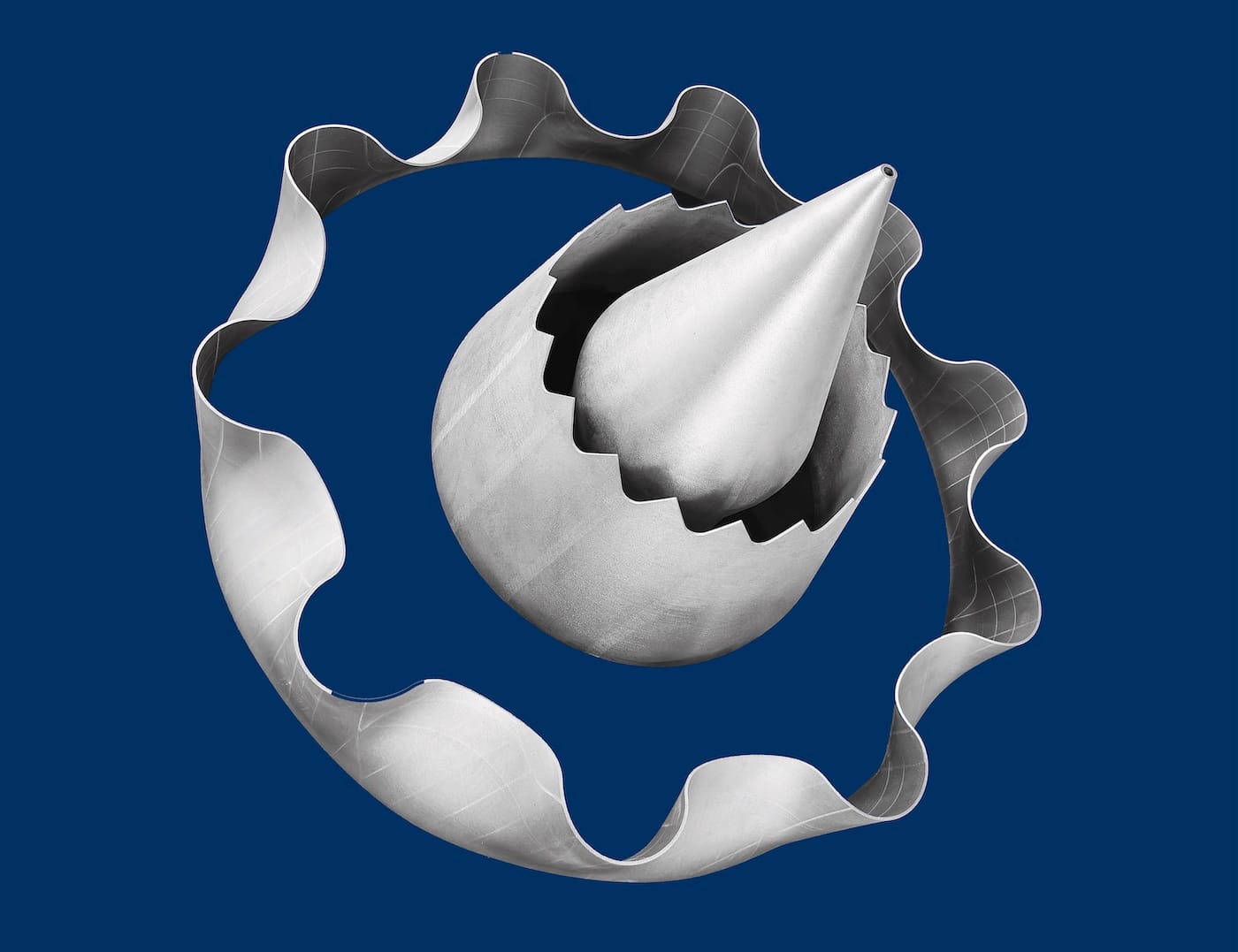
O’Leary won’t share what it looks like but claims he’s never been more excited by the company’s technology roadmap. If recent efforts are any sort of sign, ‘big’ will continue to be the theme. At the Paris Air Show, for example, Safran, which took delivery of its second NXG XII 600 earlier this summer, showcased a 3-ft turbine rear frame produced in just three weeks, down from 18 months, using SLM technology. Nikon SLM has also teased an upcoming ‘ultra-large format’ platform. It’s already sold two to California space company Rocket Lab but O’Leary hints that there are additional commercial agreements in place.
Aerospace remains a big market for Nikon SLM. Demand from defence is clear. Automotive and energy, too, and that custom is coming from not just marquee names but SMEs. Then there are emerging applications, like those in clean energy. It’s investing where it solves a problem, and ultimately, where it can make money.
“That’s the balance between being an incredible technology company and an incredible business. And it’s not something that this industry has typically done well.”
Ultimately, he’ll be the one in charge of seeing that through for the near future. Last year, Nikon SLM Solutions’ board decided unanimously to extend O’Leary’s leadership until March 2028. When he does allow himself a moment to reflect, he’s proud. He’s having a good time.
“What we do is meaningful. Our business here is indeed solving problems for the biggest, most technically mature companies on earth. And we’re solving wonderful problems for them. I’m not sure where you find something more fun than that.”


