

Earlier this month, MedCAD President and CEO Nancy Hairston embarked on a 5-day medical mission trip with the Christian Medical Association of Ukraine.
MedCAD had donated custom-made 3D implants and Hairston was keen to see the effect the devices were having. She accompanied four US doctors as they worked with local surgeons to reconstruct severe facial trauma with 100% custom implants created and donated by MedCAD.
The U.S. team in this “Vision for Ukraine” mission consisted of Dallas surgeon Dr. Jorge Corona, a world-class oculoplastic surgeon; Dr. Stuart Seiff, a San Franciso based surgeon, one of the world’s leading orbital reconstruction experts; Dr. Patrick Carpenter, a Bay Area microsurgeon specializing in complex flap reconstructions and Dr. John Frodel, a maxillofacial surgeon with 20 years of experience in combat injuries.
Below is Nancy’s first-hand account.
Day 1
We arrived in Kyiv today and went straight to the hospital to meet the hospital team, surgeons, and patients. We met patients who received our implants in previous mission trips, and one man in particular who was six months into his recovery. His left cheek bone and eye orbit were damaged, but he looks good, and he seems to be getting through it. He speaks exceptionally good English.
Many of the patients speak English, and communication is rarely a barrier. Whether through conversation or simple human gestures like hugs, their appreciation and resilience are unmistakable.
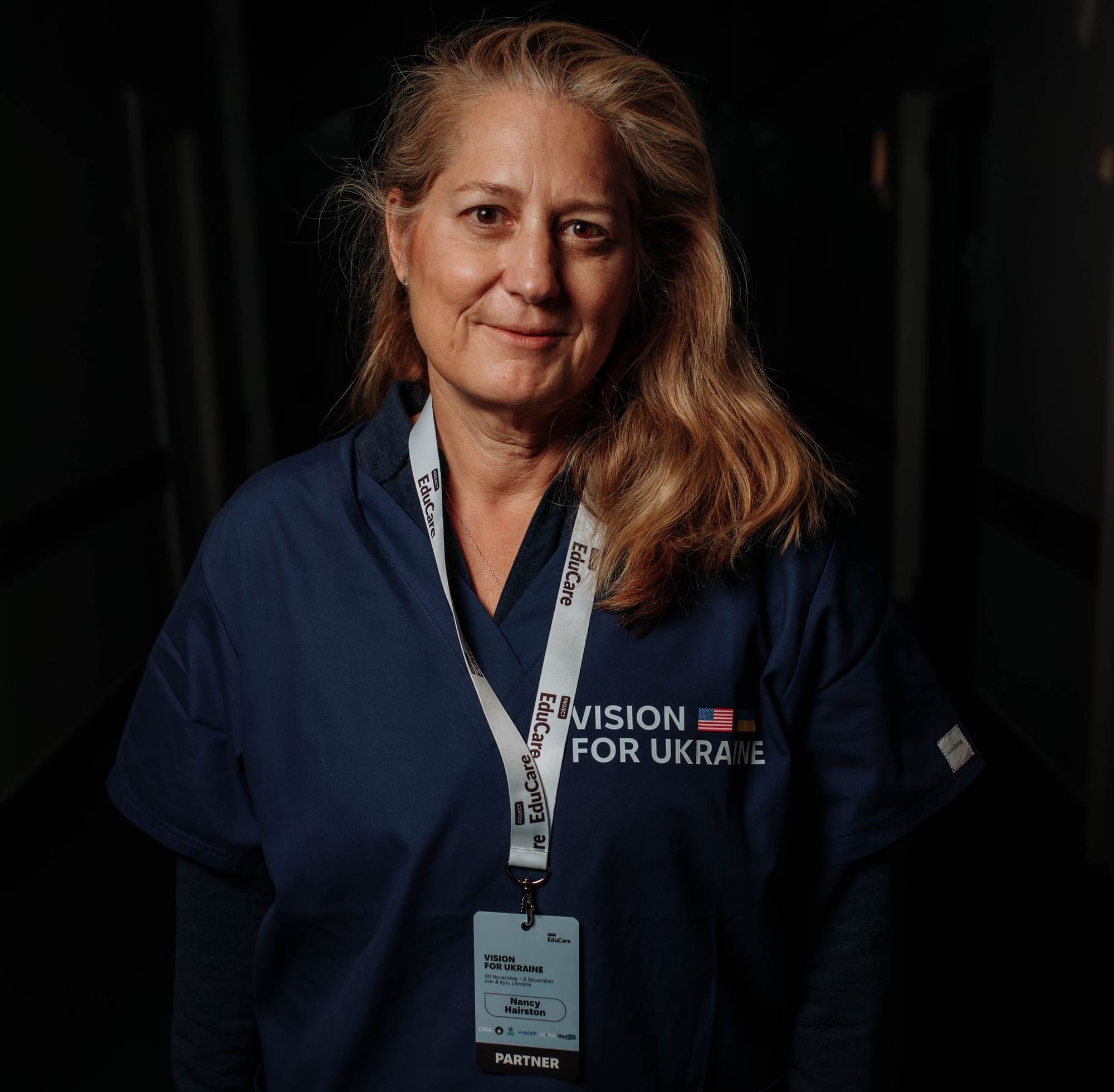
Even in war, so far, Kyiv feels like a normal city. People are walking around the city, the cafes are hopping with customers, and I have not seen a lot of devastation. But it’s not even 10 p.m. yet, and most of the bombings here happen early in the morning, well before dawn…
We are in a regional hospital, and it is not even a major one, but doctors Yurii Chepurnyl and Oleksandr Vasyliev are creating an especially important cranio-maxillofacial program here. They're doing so many cases a week, and they’re so talented and smart, it's just mind-blowing, …
There’s an orbital floor recipient here who speaks perfect English, so we had quite a talk. He used to be the Ukraine manager for an Italian shoe brand before he got drafted. He is blind in one eye and retired from the battle but grateful to be alive. I asked what’s next and he’s not quitting the fight; he plans to do logistics for the military.
It’s 1 am and no air alert yet, so I am hoping to go to bed and not have to go to the shelter in the basement of the building. I’m exhausted.
Day 2
Good evening from Kyiv! The last two days of surgeries and meeting previous MedCAD implant recipients have been successful. There are lots of good feelings and gratitude from these brave people!
These war injury cases are very different from what we work with daily. The blasts created problems with soft tissues and today was an extraordinarily complex case, a maxillary fibula flap reconstruction and an orbital floor condition. Patrick and Yurii performed an 8-hour surgery that was extremely complex, I won’t lie, but in the end, they were happy with the result.In the US, microvascular surgery for fibula connection is done with microscopes, but surgeons don't have them here. And so Patrick, a rock star young surgeon from San Francisco, performed the surgery with little loupes on his glasses. It was tough procedure, but Patrick’s already committed to coming back on the next mission, and he’s bringing surgical microscopes for the hospital.
We’re in the OR now, working on the orbital floor and the implant pretty much slid in. The patient has a functional eye and his vision will be saved. Kudos to MedCAD’s Dennis and the recon team on the design of these implants.
Going to the hospital, seeing these patients. It’s just… I mean the kind of injuries, it's heartbreaking. But on the other hand, everyone is upbeat. The whole team is like, OK, let’s roll up our sleeves and let's help these people. That's what we're here for, you know?
Tomorrow is another VERY big day with the mandible recon and cranial implant. Please send us some good vibes!
Day 3
As you walk through the hospital you see almost everybody is missing an eye. Or both eyes. The Russians send drones with grenades on them, and people are getting these blast injuries that blind them. Sometimes the explosion isn’t that close to them, but the pressure of the blast is ruining their eyes.
Then there's shrapnel. I was in the room when one of the surgeons pulled a foreign object from deep in a patient’s face; it was a piece of a silicon chip from a drone. It was so surreal.
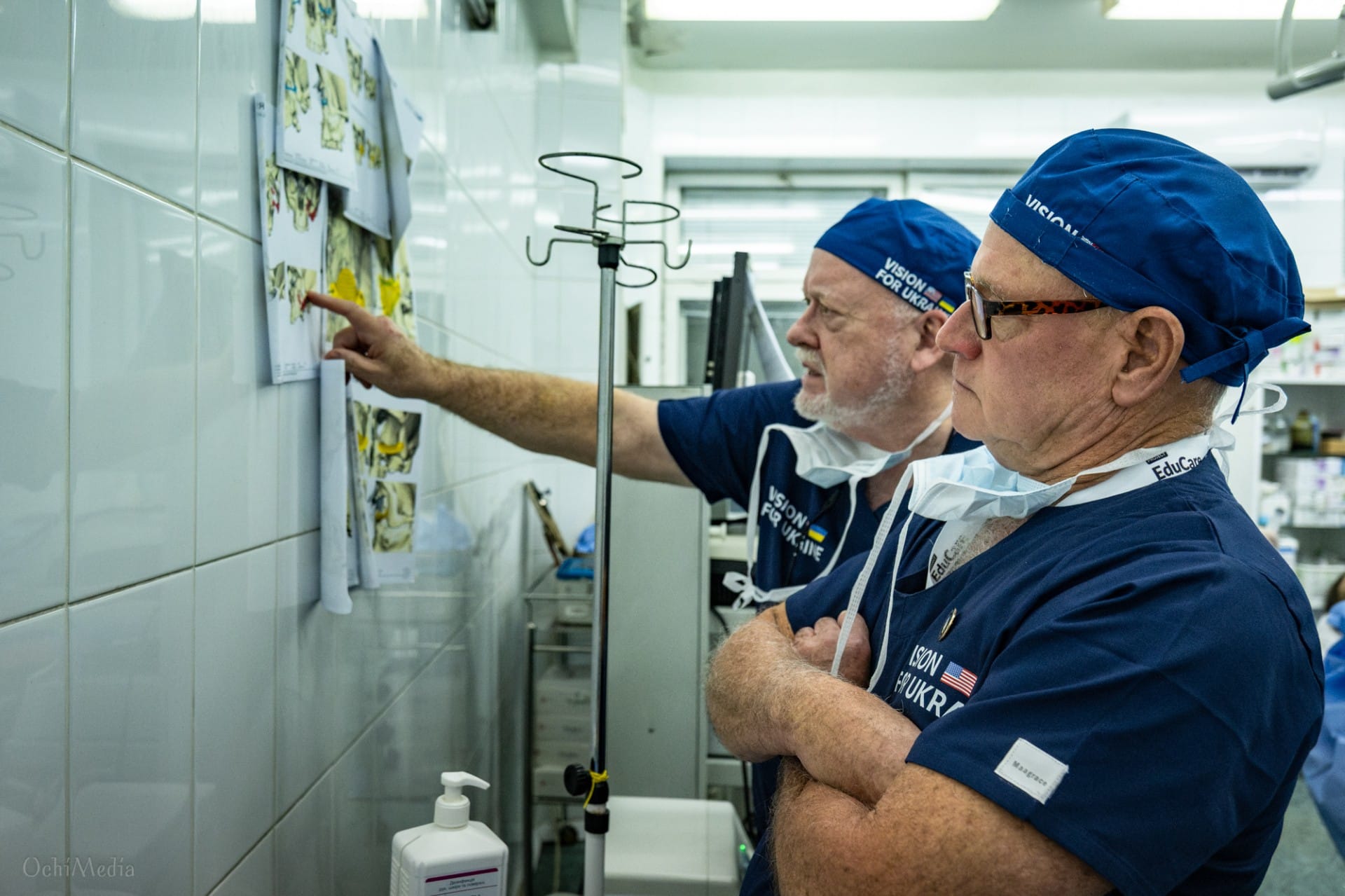
I mean, nobody's brought their ego here. It's been incredible to watch these surgeons, see them reading each other's minds. They’ll tell each other, “OK, John can you jump in and help out with the loss of tissue around the cheek area,” or “Jorge, scrub in and take a look at this nerve situation.” It's so cool to watch.
These Ukrainian doctors are so incredibly talented. They're doing so much trauma, and we're all learning from them. The collaboration is like choreography. The U.S. and the Ukrainian docs have done five missions together and only about as often as every six months, but it’s like a well-rehearsed ballet.
It’s incredibly gratifying to be a part of this amazing group of people here and caring enough to use their own time. They're doing ten surgeries right now and they'll be in the OR till 1 a.m. this morning again. They’re changing these people's lives, giving them hope, giving them a little bit of a better future. It’s the hope that fuels this team.
The surgeons keep saying that we're like a family, and that includes everybody at MedCAD, working from afar. We're all working for something much bigger than all of us.
Day 4
Day 4 from Kyiv—our last in the capital—and we are driving out tonight. No bombings while we were here, for which I am grateful. Orbital floor and Maxilla implants went well today, and they fit perfectly.
We’ve done three intense cases in the last three days, fibula reconstructions of the mandible and the maxilla. It's not just the bony anatomy that is affected by these injuries; it’s multiple complex systems. The blasts affect the vessels, and it takes tremendous skill for Patrick, the microvascular surgeon, to connect. The approaches have just been a little bit different than they would be ordinarily. In one case yesterday, there was so much scar tissue that they had to think on the fly and open up the face in an unconventional way. Nothing is straightforward.
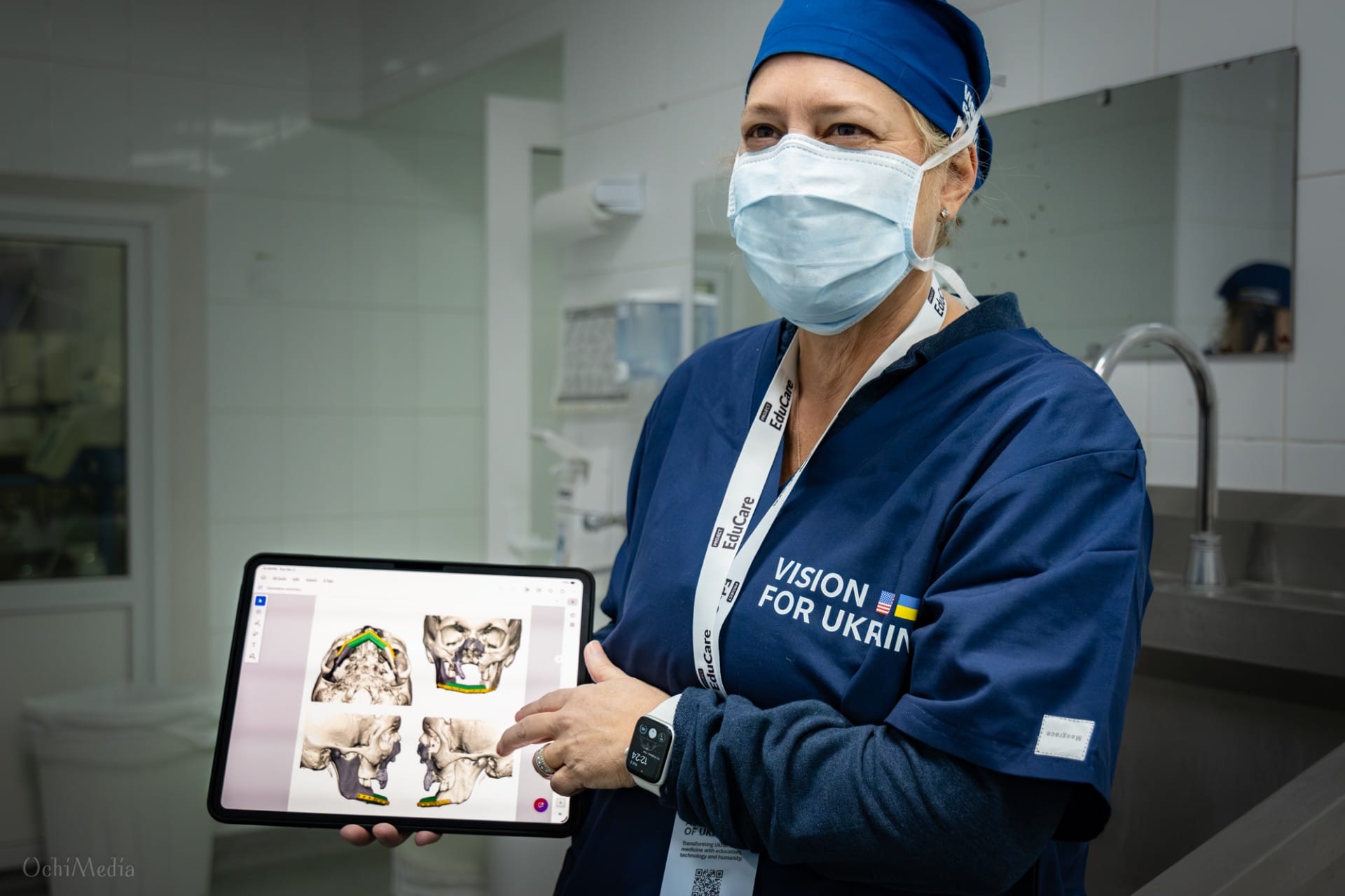
As a company, MedCAD is highly skilled at cancer reconstruction, but we don't do a ton of trauma so I’m learning a lot.
A patient we did yesterday had a crushed cheekbone. We had used his imaging to see where the fragments of the bones were when we made his implant, but when we got in the OR, we didn't even have to use the cutting guides because everything was already broken.
Day 5
We're in Lviv right now. It’s a beautiful old European town, like a movie set. The bombings, artillery and drones have been happening in Kyiv, but not so much here. But still, we just went to a restaurant that had basements that they use as a bomb shelter. People aren't living like they're in fear, but they are obviously living with daily stress.
Today we’re at a Children's Hospital because Jorge and Stuart are doing ocular plastic cases tonight. Many are congenital defects— they are complex cases for ocular plastics —and those kinds of defects don’t stop during wars.One of the children we saw was hurt in a bomb blast. He lost his legs and some fingers and suffered facial damage. He's just 16. I think we’ll probably do an implant for his facial injury. But you sit here and go, what is this all for? Why?
I mean, it's senseless. It's absolutely senseless.
A whole generation.
The message I want to send back is that these people are suffering, and any one of us can contribute in some small way. It can make more of a difference than you could ever imagine. And that is what we get the opportunity to do. I hope I get that message across to all of you and the staff in MedCAD. You know how proud I am of my team that we're able to do this. This is what we do every day in the United States, but you get to really feel it in a place like this. These people aren't living on the moon like our media tells us. We're all part of a global village, and when it comes to how we can help, Ukraine is just as close as Denver or Pittsburgh or Jacksonville or for wherever else we do surgical planning.We are making a difference. “We” meaning people in the United States, and these surgeons, and “we” meaning MedCAD. I just want everyone at the company—from the person segmenting to the case management to the person making the implant, to the person shipping it—to know that every single one of us is making a difference.


