

A monoblock moving-coil turntable cartridge that features an additively manufactured single-piece ceramic web-capsule has been awarded an iF Design Award 2025.
The ceramic web-capsule was developed and additively manufactured with Lithoz's Lithography-based Ceramic Manufacturing (LCM) technology by Steinbach AG in partnership with HiFiction AG.
HiFiction AG's “X-quisite VORO” monoblock moving-coil turntable cartridge is believed to be the first of its kind and is equipped with a zirconia web capsule that ensures the 'best possible resonance behaviour,' combining 'maximum rigidity with minimal sensitivity' to airborne sound.
The iF Design Award 2025 jury recognised the ceramic web capsule’s 'spectacular' design and 'innovative' material choice in combination with the cartridge’s 'revolutionary technical monoblock layout.' It was made possible with Lithoz's LCM 3D printing technology. Harnessing LCM, Steinbach manufactured the capsule as a support-free, single-piece item, while meeting the stringent mechanical and acoustic specifications required. There was also no post-processing required and the skeletonised, nature-inspired zirconia housing sits completely contact-free above the needle, without any joints or assembly, serving as a key aesthetic element in the design of the part.
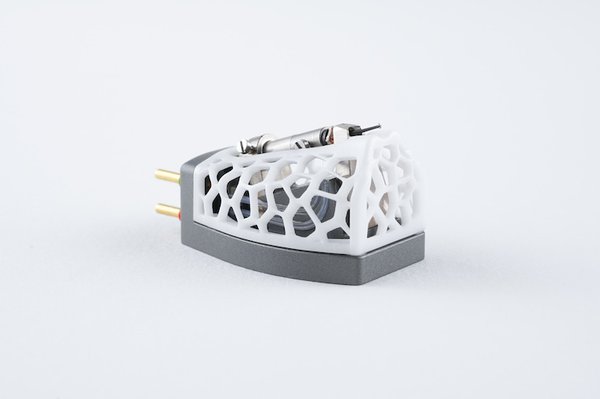
According to the partners, HiFiction AG’s stringent requirements ruled out conventional manufacturing methods, while metals and plastics failed to meet the 'envisioned sweet spot' between design, weight and sound behaviour' during the development phase. Lithoz's LCM process, meanwhile, is said to have provided the resolution and precision required. The ceramic component was designed for precise sintering, with the geometry defined to ensure stress-free production without the need for support structures. Due to the intricacy of nature-inspired design - external dimensions were measured at 17.70 x 21.90 x 11.45 mm, wall thicknesses at less than 1mm and tolerances within ± 50 µm - including cantilevered features and hard-to-reach internal surfaces, manual finishing was not an option.
Each component was produced with a layer thickness of 25 µm with 15 parts per build platform on average, which enabled economically viable small batch serial production of around 100 units.


