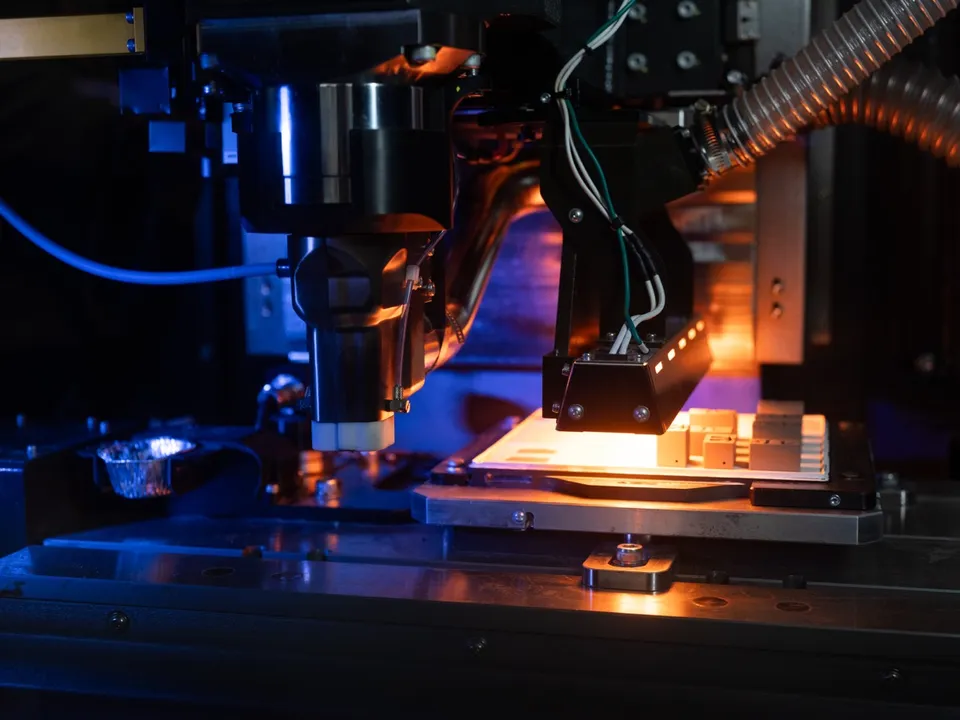
Honeywell is using 3D printing technology from Prodways to cut months off the development time for a next-generation family of turbofan engines.
The company is thought to be one of the first jet engine manufacturers to use ceramic 3D printed moulds to make turbine blades.
Turbine blades are typically made through an investment casting process which Honeywell says ‘only a few foundries in the world can handle.’ This process involves machining, extremely complex metal dies and tooling to create the ceramic moulds, which are then cast with a molten superalloy to form the blades.
Using the vat-based and high-resolution CERAM PRO 365 3D printing system, Honeywell is printing the moulds directly with ceramic slurry, reducing the lead time and costs associated with the first-stage high pressure turbine blades. The company installed the machine at its additive manufacturing centre in Phoenix in 2023.
“With the conventional investment casting process, it can take 1-2 years to produce the turbine blades needed for the development process,” said Mike Baldwin, Principal R&D Scientist. “Additive manufacturing lets us take the design, print the mould, cast it, test it, and get real numbers to validate our models – and the whole process takes just 7-8 weeks. If we need to tweak the design, we can change it electronically and get another blade in about six weeks.
“Additive manufacturing enables rapid prototyping and gives us greater flexibility to accelerate development, manage costs, and create the best possible product for our customers. Reducing development cycle time is our primary objective, but we also anticipate saving several million dollars in development costs compared to using the traditional blade casting process.”
“Our 3D printers are a perfect match for this use case,” added Michaël Ohana, Prodways Group CEO. “We can process ceramics slurries to build a large number of parts in a single day and deliver consistent manufacturing results at every print.”