

More and more metal additive manufacturing applications are now flying above us - in aeroplanes and spacecraft - helping to conserve resources, enhance performance, and reduce costs. It is particularly exciting to observe that, when used effectively, additive manufacturing can lead to significant savings.
At the German Aerospace Center's (DLR) Institute for Frontier Materials on Earth and in Space, we conduct research into AM of metals. One of our key advantages is that we do not need to look externally for component applications – they are readily available in-house at DLR. Our globally recognised partner institutes provide us with industry-relevant aerospace component challenges, allowing us to align our research directly with industrial needs, whether for aircraft engines or rocket propulsion systems.
Our material expertise and unique facilities, combined with our application-focused DLR institutes, enable a technology readiness level (TRL) range that is outstanding in the research landscape. From Laser Powder Bed Fusion in-situ studies at the synchrotron to material characterisation, additive build strategy development, and full component testing under real conditions, we handle every step in-house at DLR. This integrated approach allows us to achieve shorter development cycles - for instance, in a recent project, we developed an injector for space propulsion systems in just a few months, from material selection and qualification for the LPBF process to hot gas testing of various design iterations. For this we are cooperating with VDM Metals and used the new alloy VDM780 that has the potential of 100°C higher service temperature but maintaining the same level of AM processability like the widespread alloy IN718.
We are also leveraging additive manufacturing to help reduce space debris. By introducing tailored porous regions into AM components, we enhance their demisability during atmospheric re-entry, causing them to disintegrate more effectively. We've developed a method for creating this functional porosity and are working with leading international partners - such as the Von Karman Institute for Fluid Dynamics - to characterise these novel structures. In a future satellite mission, we reserved a spot to test these porous structures in an operational setting - during actual reentry into the Earth's atmosphere.
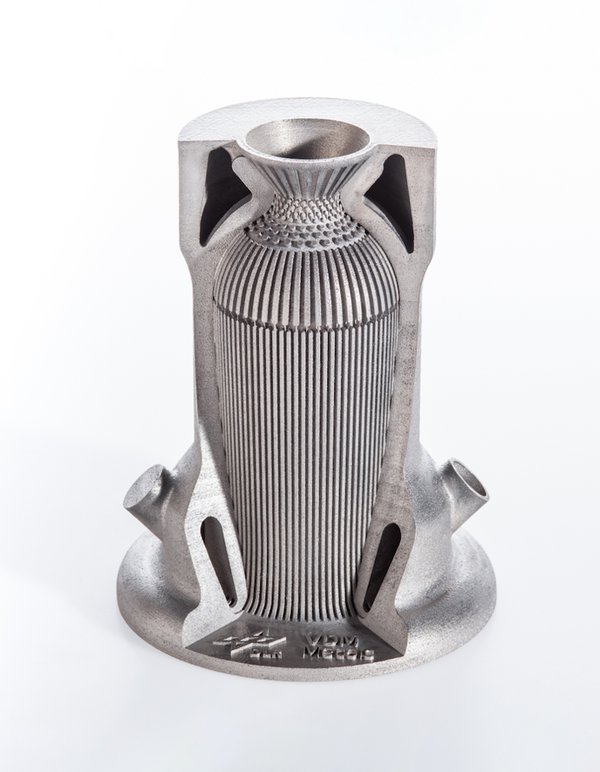
The next major milestone in AM for us is 3D printing on the International Space Station. Our goal is to manufacture a small metallic thruster suitable for in-space operation, directly in orbit. We will return the thruster back to Earth and subject it to hot gas testing. This effort will make a powerful contribution to space exploration while also advancing additive manufacturing on Earth, by providing unique insights into processing conditions and material behavior in space.
At the Institute for Frontier Materials on Earth and in Space, we advance metal AM - combining materials expertise, in-house applications, and unique testing to drive innovation from Earth to orbit.


