

Space Circling Aerospace Technology has successfully completed a 50-second hot fire test of its 85-ton-class QL-1 rocket engine, which features more than 20 3D printed critical components.
The aerospace company worked with BLT to additively manufacture parts for the thrust chambers, turbopumps and valves.
BLT is said to have been involved in the development of these components from the initial design phase, with the 3D printing OEM suggesting the parts ‘significantly enhance the engine’s overall performance and reliability.’
For the thrust chamber, which is the primary power source of a rocket engine, BLT utilised its BLT-S800, BLT-S515, BLT-S1000 and BLT-S450 to produce the nozzle extension, gas generator, body and oxygen inlet. These parts were targeted because traditional manufacturing methods cannot fabricate the complex internal flow channels that Space Circling Aerospace wanted to integrate, and additive manufacturing was also seen as an opportunity to eliminate welding and assembly processes from the workflow, which are not only time-consuming but can also introduce structural weaknesses. With AM, BLT has been able to able to integrate complex internal flow channels in a single build.
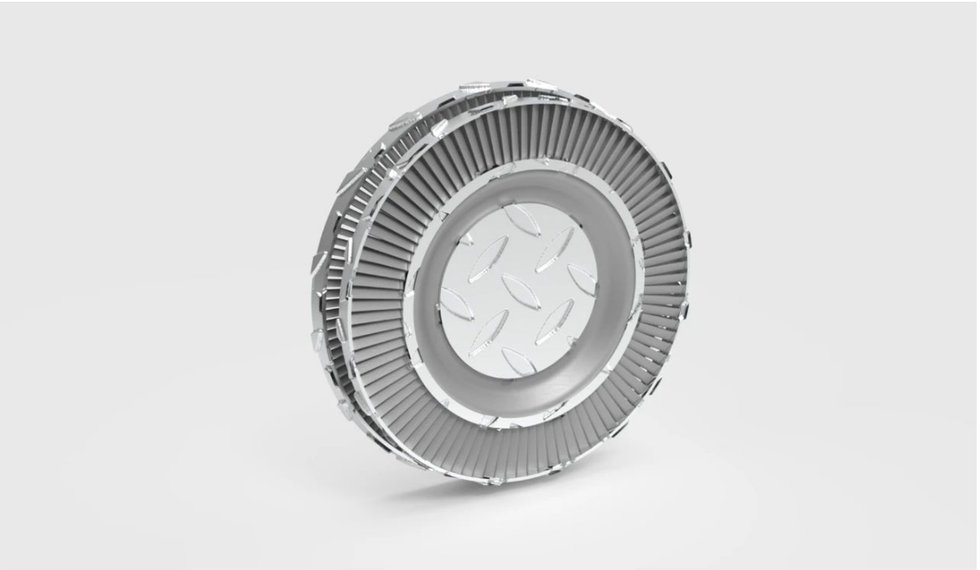
For the turbopump – what Space Circling Aerospace would describe as the ‘heart’ of the engine – BLT additively manufactured dual-stage impellers, turbine guide vanes, and fuel and oxidiser housings. The manufacture of these parts would traditionally require machining, electrode design, and electrical discharge machining, which the aerospace company suggests ‘hinders’ rapid design iterations. By using additive manufacturing to produce the two-stage impeller, BLT completed the job within 45 days – compared to a traditional production cycle of three months – and is said to have reduced costs by 75%. The 340 x 340 x 55 mm part was produced on the BLT-S450 machine in a single, integrated process.
A BLT press release read: “The collaboration between BLT and Space Circling Aerospace has enabled efficient, cost-effective production of key rocket engine components, contributing directly to the successful engine hot-fire test. This partnership highlights how advanced metal 3D printing can be seamlessly integrated into aerospace manufacturing, broadening its applications within the sector.”


