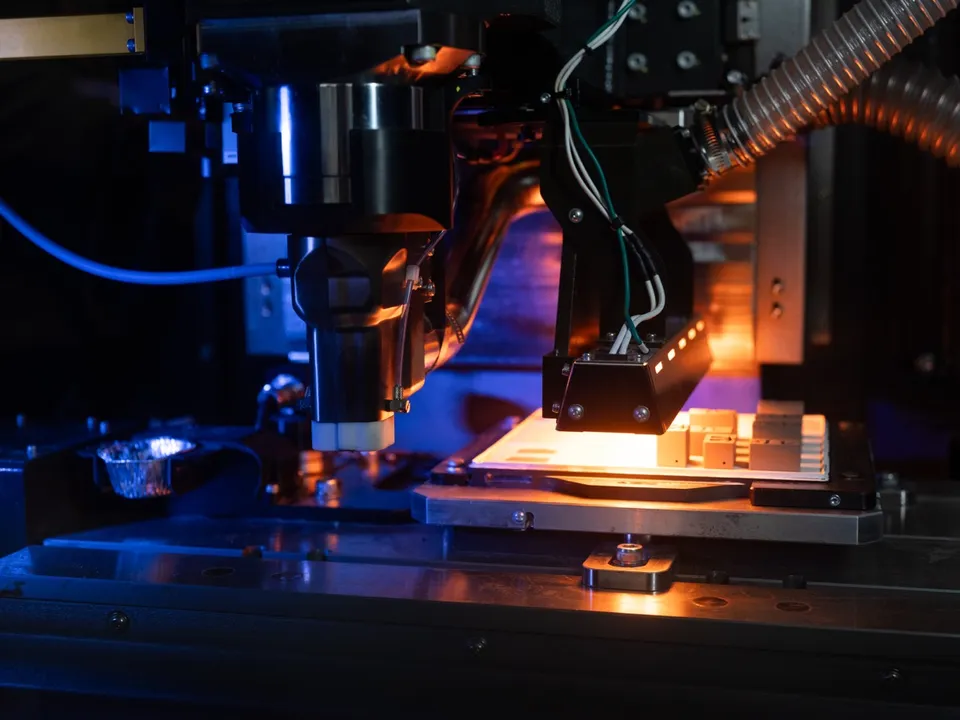
Ford Motor Company has leveraged SLA and SLS 3D printing technology from Formlabs to prototype a series of components in the development of its Electric Explorer vehicle.
The automotive giant was one of the first beta users of Formlabs’ Form 4, deploying the technology at its Ford Cologne facilities in Germany, where its engineers also have access to a Form 3L and Fuse 1+ 30W machine.
Among the parts to be prototyped with Formlabs 3D printing technology are a complex charging port, a cover for the charging port, a rearview mirror assembly, dashboard parts and exterior features. The company also 3D printed insert moulds for the injection moulding of two rubber components, required in the door handle design for their damping and insulation capabilities.
Ford Cologne is best known for assembling the Ford Fiesta model and, in line with Ford’s ambitions to sell exclusively electric vehicles (EVs) in Europe by 2030, has also entered the Explore model into serial production at the Cologne assembly plant. Adjacent to this factory, PD Merkenich serves as a development centre and is responsible for designing all passenger vehicles for the European market. PD Merkenich was using SLA 3D printing technology as early as 1994 and has since expanded its fleet to include FDM, SLS and metal 3D printing technologies.
The most recent 3D printer to be integrated into PD Merkenich’s operations is the Form 4, which Ford says is allowing engineers to fulfil more requests in under 24 hours.

“The Form 4 is very fast,” said Bruno Alves, Additive Manufacturing Expert and Tooling Specialist at Ford. “I think it is the best machine that I’ve seen until now in terms of speed. It’s really a very good upgrade compared to the previous models. It’s easier to operate, so it’s much easier for the operators in our workshop to learn how to work with the machine and get parts with good quality.”
“Working with Form 4, it’s really a game-changer,” added Sandro Piroddi, Supervisor of PD Merkenich’s Rapid TechnologyCenter at Ford. “The speed of the printer will change our workflow. We can deliver more parts, the throughput is higher. We are much more flexible if we have short-time requests. We can do these using Form 4.”
Formlabs’ Form 3L, meanwhile, has allowed Ford to prototype large components like exterior body parts, with the Fuse SLS technology enabling the testing of mechanical parts, such as the charging port cover.
“The Form 3L enables us to print big parts; for example, exterior body parts for the vehicle,” offered Alves. “We printed this mirror cap to validate a design. 3D printing is suitable for this application because it’s fast and we can have very good quality compared to mass production parts.
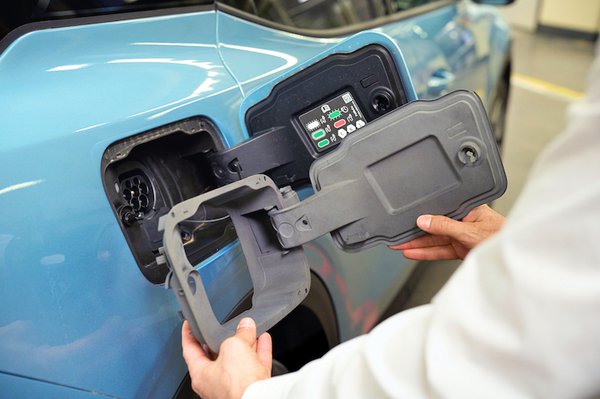
“For this charging cover, it was important to use SLS, based on the fact that we needed a functional part that would enable us to test the mechanisms. It’s a realty complex design that we are not able to produce in any worth way. We cannot mill this part. We cannot use injection moulding to just produce some samples. So, the best way is to print in a material that we can test physically.”
Having achieved this success with prototyping, Ford engineers also sought to combine the capabilities of 3D printing with injection moulding to produce crash test parts. These components must be made from the same material and process as in mass production, meaning the parts were always going to be manufactured with injection moulding. Ford saw the potential, however, in leveraging 3D printing for rapid tooling, producing the mould inserts for the rubber door handle assembly parts in weeks rather than months.
“We see a lot of potential using 3D printing inserts for injection moulding based on the fact that we can iterate the design very fast,” said Alves. “We print cavities in cores and then we can change them in the tool and inject the parts.
“Normally, external injection moulding will take maybe two to three months. Internally, using additive manufacturing, we can speed up the process to maybe two weeks, three weeks maximum. For this project, if we had to use external tools, it would have been much more time-consuming and we would not have been able to deliver the parts on time.”