

The EU’s European Green Deal (approved in 2020) spoke of a need to reduce transport emissions by 90% by the year 2050, compared to 1990 levels.
The Clean Sky 2 program is a research initiative funded by the European Commission and European aerospace industry. It is made up of key names in the industry, subject matter experts, and academic research bodies across Europe.
According to GE Aerospace, Clean Sky 2 is integrating, demonstrating and validating technologies capable of reducing CO2 emissions as well as nitrous oxide (NOx) and noise emissions by up to 30% compared to 2014 “state-of-the-art” aircraft. The initiative aims to develop a strong and globally competitive aeronautical supply chain in Europe.
In response to a Clean Sky 2 call for proposals in 2018, a consortium of Hamburg University of Technology (TUHH), TU Dresden (TUD), and technology company Autodesk, was selected to support GE Aerospace Advanced Technology (GE AAT) Munich for the design and manufacturing of a large-scale metal additive manufacturing component.
The component was to be known as the Advanced Additive Integrated Turbine Centre Frame (TCF) casing, or the MONACO project. After a few years of research, development, and engineering, the large-format TCF casing design using GE’s direct laser melting technology in nickel alloy 718 was recently unveiled to the consortium.
GE says that the metre-wide TCF casing is one of the largest additively manufactured parts produced for the aerospace industry. It is designed for narrow-body engines in which the part is approximately one metre or more in diameter. GE says that the single-piece design solution to produce this kind of large format engine hardware with no reduced cost, weight and manufacturing lead time gives a competitive business advantage.
“We wanted to reduce the weight of the part by 25% but also improve the pressure losses of the secondary air flow as well as a strong reduction in part count to improve maintenance,” said Dr. Günther Wilfert, GE AAT Munich’s technology and operations manager.
Read more: Deliveries of GE Additive metal binder jet Series 3 machine set to commence in 2023
Wilfert added: “The team can be proud of the results. With the final print of the full casing, they were able to prove the values. Those targets were achieved and surpassed. We were able to reduce the weight by 30% in the end. The team also reduced the manufacturing lead time from nine months to two and a half months, by approximately 75%. Over 150 separate parts that make up a conventional turbine centre frame casing have been consolidated into one single piece design.”
According to GE Aerospace, due to stringent requirements on airworthy hardware in the highly regulated aerospace industry, the number of approved vendors for casting and forging parts is very limited, which creates long lead times and high costs.
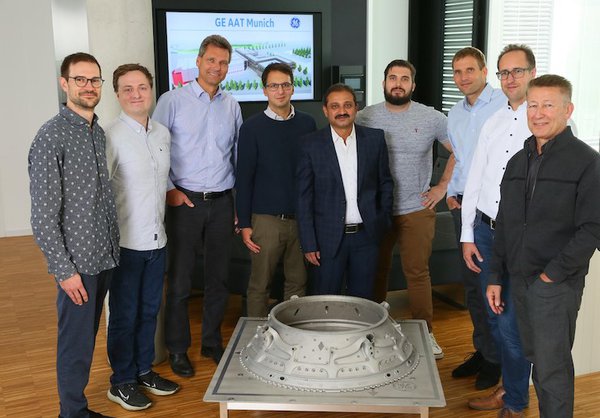
Ashish Sharma, an advanced lead engineer on the GE AAT team, said: “At first, the engineering almost seemed to be impossible, but by leveraging advanced additive technologies and pushing boundaries that stretched our limit, we have achieved a design that was only in our imagination and far away from a reality never thought of before.”
Sharma added: “Hamburg University of Technology has a GE Additive M2 machine installed on campus, and their expertise with prototyping was invaluable, while the team at TU Dresden was responsible for validation and building a dedicated test rig. Autodesk optimised the Design for Additive Manufacturing process, and finally GE Additive supported us by printing the part using its A.T.L.A.S machine.”
The team behind the project designed and manufactured a novel three-hole probe to measure pressure loss on the additive TCF casing, which demonstrated a reduction of around 90% in pressure drop compared to a conventional design, according to Thomas Ilzig, Eike Dohmen, and Sarah Korb, scientists from TUD.


