

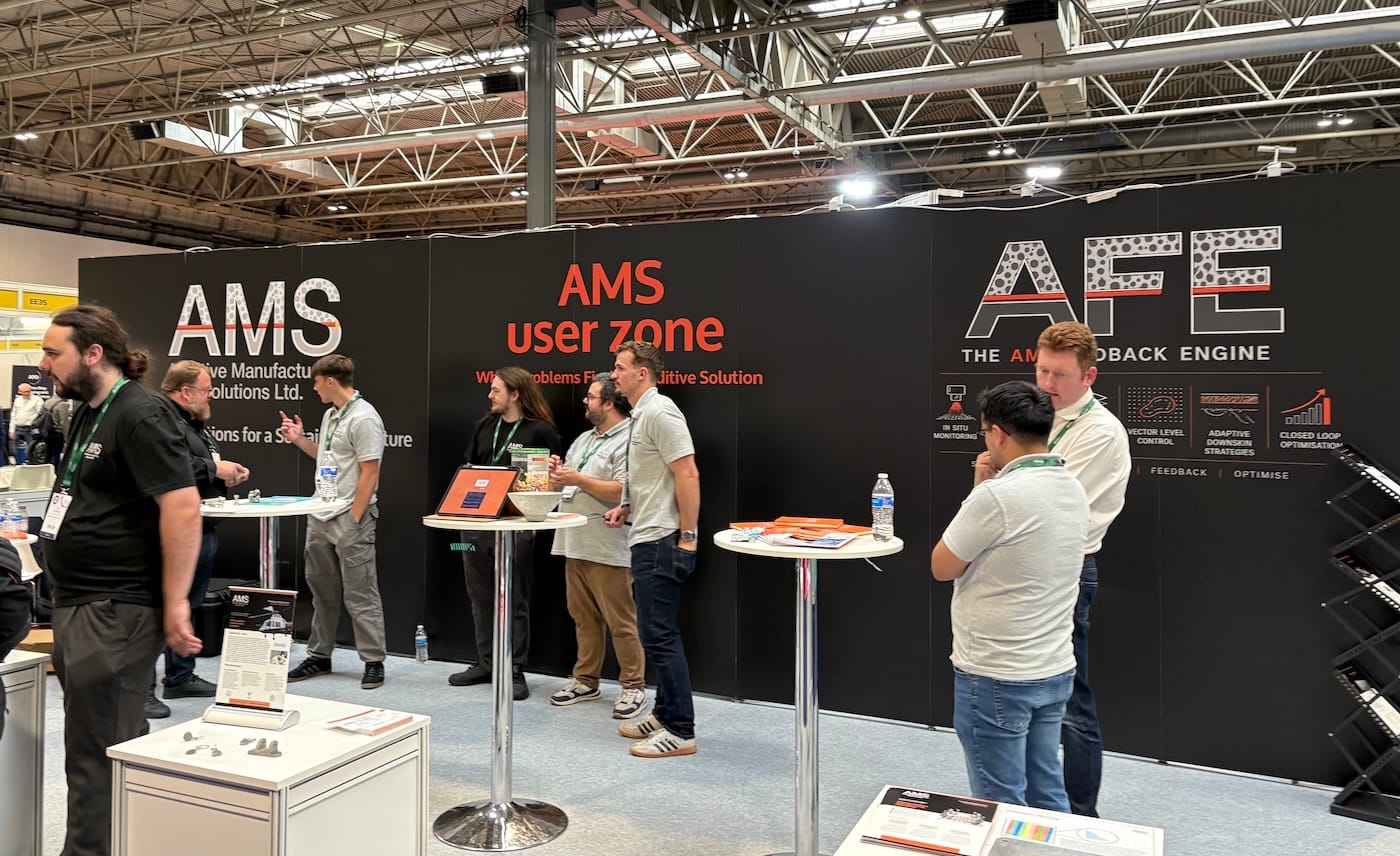
Additive Manufacturing Solutions (AMS) was in a prime spot at TCT 3Sixty last week - side by side with real users of additive manufacturing technologies sharing their production applications across defence, aerospace and more.
And that's also kind of where it sits within the UK's additive manufacturing landscape.
This year alone, the UK metal AM specialist has been awarded an America Makes project call with Lockheed Martin and ASTM to establish AM equivalency and interoperability between the U.S. Department of War and UK Ministry of Defense supply chains, focusing on laser powder bed fusion of critical parts. It has also enabled a world first by 3D printing a QinetiQ A109S helicopter bracket using titanium recovered from a decommissioned aircraft - its maiden flight acting as a symbol of what a more resilient and sustainable future for UK manufacturing could be. Its latest milestone, announced at TCT 3Sixty last week, adds another layer of resiliency to the UK's metal supply chain, through a partnership with AM 4 AM that aims to scale and industrialise HiperAl, a high-performance aluminium alloy specifically designed for additive manufacturing.
The partnership sees AMS become the exclusive UK production partner for HiperAl part production, which the company claims will create a clear pathway from material to industry, through a guaranteed European supply chain.
"We are backing that horse, I think it's fair to say," AMS CEO Robert Higham told TCT. "Over the last couple of years, the amount of conversations that have been very clear to us as a business, there is an opportunity for high-performance aluminium to enter the market and really dominate."
HiperAl powder is engineered for use in lightweight metal 3D printed parts across space, aeronautics and automotive lightweight applications. It's said to deliver best-in-class mechanical properties and crack-free parts with a 525 MPa yield strength, 550 MPa ultimate tensile strength, and 4% elongation at break.
"One of the big challenges with AM is availability of materials, and availability of materials that are processable, repeatably and consistently," Higham explained of the opportunity for HiperAl. "In the high performance aluminium world, there are options on the market. There are almost mythical options, like HRL 7A77, which are super challenging to get a hold of, very difficult to process. In the market between what's available in the mid- to high-performance and then very high-performance aluminium, the material cost is crazy. Why would you print high-performance aluminium if the cost is double the cost of titanium?"
Higham explained how the long build times associated with high-performance aluminium, and therefore, steep costs, have led more parts to be printed in titanium - not because it's the preferred material, but purely based on economics. This is where AMS believes HiperAl has a real opportunity.
"The material cost is significantly lower than high-performance aluminiums, and it's on a par with bulk-produced titanium," Higham continued. "Theoretically, at least for now in the early stages of development, the material performance will outperform or will match the high-performance aluminium world. In all the conversations we have in high-end automotive, in motorsport, sometimes in space, certainly in sectors of commercial aerospace, there is a gaping opportunity for high-performance aluminiums."
Another feature of HiperAl is that, while it requires heat treatment, it doesn't need to be put through a complex multi-step heat treatment, ageing and HIP process to deliver strong performance.
"What we want to be able to do is make make additive make sense," Higham continued. "So if the material cost is low and we can process it pretty quick, the part cost is low. If the part cost is low, it allows us to scale up and look at production. That's often the barrier, you're looking for very high-value products which can justify the high part cost. It's not a surprise, therefore, that in the last 10 years we haven't seen a big boom in scale of additive."
AMS is currently testing the material and plans to spend this summer working with select launch customers to develop optimised applications with real structural parts. Higham believes there are a lot of advantages to be found in automotive, where parts currently manufactured in AlSi10Mg could shave significant weight while adding performance benefits, and in aviation where lighter parts can deliver fuel savings and more environmentally friendly products.
"We're in a position where this could be an opportunity to make more effective products, more sustainable products, more European resilience, more cost effective parts," Higham said. "The knock-on effect of all of that means that it could enable the scale of AM parts in aluminium beyond what we've ever seen before."


