

Picture the scenario: a procurement lead is staring at a part that needs to launch in eight weeks, a mould tool that takes twelve of them, and a design that isn't quite frozen yet. A decade ago, there was one honest answer to that problem, and it involved a delay. Today there's a second option on the table, and increasingly, it's the one that gets picked.
The numbers back that up. Additive Manufacturing Research (AM Research) puts the market impact of additively manufactured parts at approximately $24.5 billion in 2025, and its AM Applications Analysis: Parts Produced 2025–2034 report forecasts that figure reaching $110 billion by 2034. Behind that trajectory is a simpler operational fact: the parts landing on additive machines today aren't test pieces waiting to be replaced by “real” production. Increasingly, they are the production.
For procurement and engineering teams, the interesting question is no longer whether the technology holds up. It's whether a given part clears three specific tests that determine if routing it to AM makes sense — and most organisations still aren't running all three checks before they decide.
Test one: Can it hold tolerance across a full batch, not just a hero sample
The question that used to end the conversation was consistency: would part 1,000 match part one closely enough to avoid a re-qualification headache? That question hasn't gone away, but the answer has changed shape.
What changed is the post-processing stack behind the machines. Vapour smoothing, controlled bead blasting, and dimensional inspection built into the workflow, rather than bolted on afterwards, now give powder bed fusion platforms batch-to-batch consistency in mechanical properties and surface finish that stands up to real qualification scrutiny. The one place it still trails injection moulding is surface finish on a strict like-for-like comparison, and on functional, end-use parts, that gap rarely touches the performance spec that determines sign-off.
The practical implication for anyone who owns qualification risk: ask your supplier for batch data, not a single sample report. If they can produce it as a matter of course, this test is passed, and you should move the conversation to cost and design, rather than lingering on whether AM “can” do the job.
Test two: Does the total-cost picture favour tooling, or just the piece-part price
Injection moulding wins on cost in this specific case: high volume, a design that won't change, a run that stays stable. That's still true, and material cost explains why — ABS costs around £1.70/kg, against a minimum of £51/kg for PA12 in MJF. At high volume, the mould's upfront cost spreads thin enough to absorb that gap. 3D printing has no tool to spread the cost over, so it pays the higher material price on every part, every time. The problem is, fewer and fewer manufacturers still fit that high-volume case, as customisation demand keeps growing.
That per-part number is only half the picture, though. Cutting a mould costs tens of thousands of pounds and takes up to twelve weeks. That's a bet on three things: the design won't change, the launch date won't move, and the volume will show up to justify the spend. If any of those three don't hold, you're carrying risk that a simple cost-per-part comparison won't show you. 3D printing avoids that bet altogether — changing the design just means updating a file, not cutting a new tool, and a run of a few hundred parts can ship in days instead of months.
So for companies with many product variants, tight launch deadlines, or smaller volumes spread across regions, this isn't really a question of "which costs less per part." It's a question of how much cash gets tied up and for how long — and that's the number to bring to a finance conversation, not just an engineering one.
Test three: Was the part designed for the process, or just ported into it
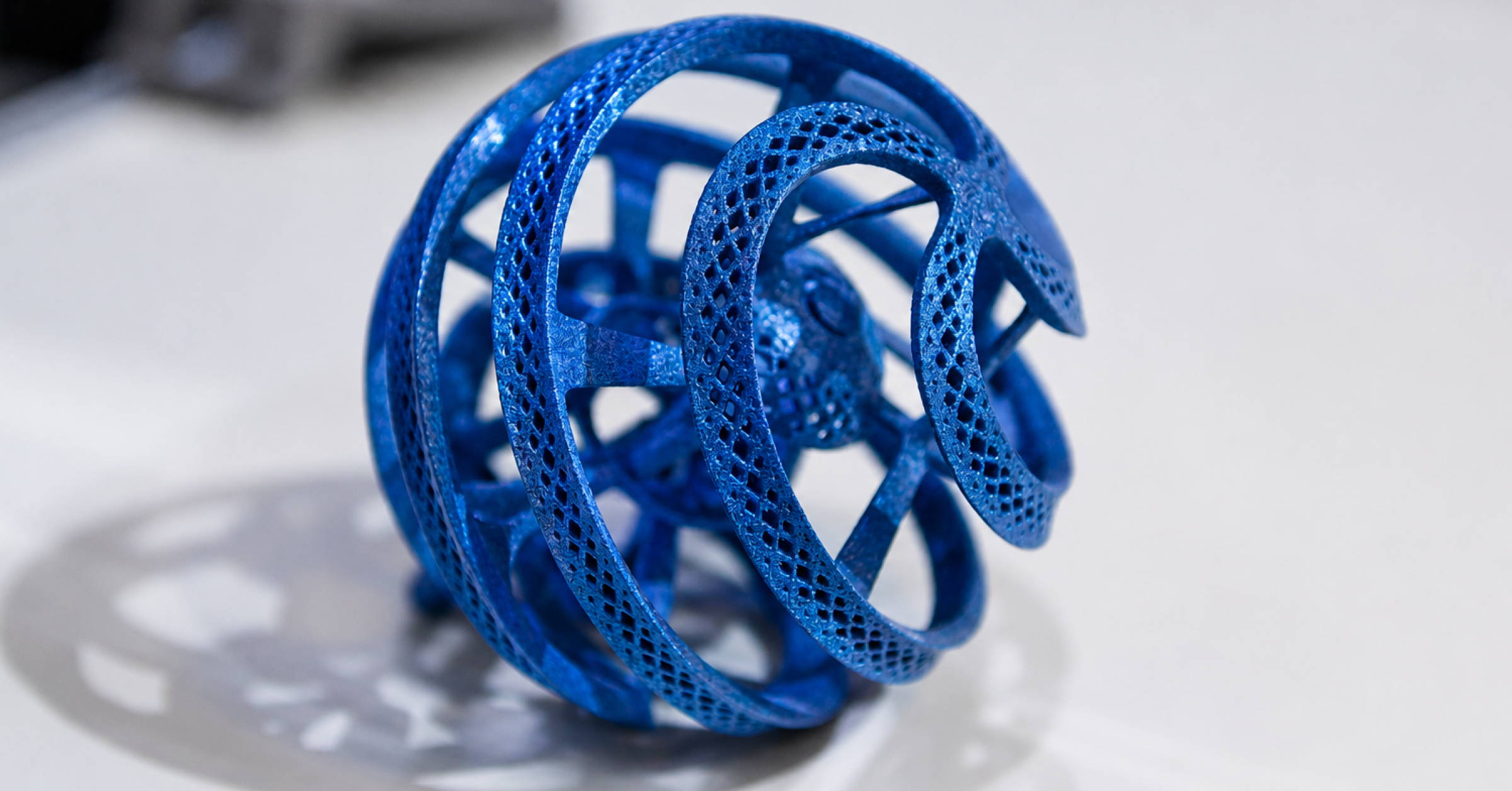
This is the test almost nobody passes on the first attempt, and it's where the most headroom remains. Additive's clearest advantage is geometric complexity: internal channels, undercuts, graded lattices, consolidated assemblies — geometries no mould tool could form or release.
Yet most parts arriving at AM machines today were designed for subtractive or moulded production and carried over largely unchanged, which caps the return before the first layer is even printed.
The gain shows up when a part is designed for the process from the start: consolidation, topology optimisation, load-path structures shaped around how the material behaves rather than legacy design rules inherited from moulding. Bone is the standard reference point for a reason — its lattice architecture beats an equivalent solid mass on strength-to-weight, and the same logic applied to an industrial bracket or housing produces efficiency gains that aren't marginal.
Closing this gap isn't a tooling problem or a software problem. It's a sequencing problem — DfAM principles need to sit at the concept stage of a design review, not get retrofitted after a legacy part has already failed a cost review in the form it was drawn in.
The filter to apply before your next sourcing decision
None of this means every part, every volume, every day. It means the default that used to route anything beyond a handful of units straight to injection moulding or CNC no longer holds automatically, and testing that assumption costs less than most teams expect.
A workable filter has three questions, matching the three tests above: can the supplier show batch consistency data rather than a single sample; does the total-cost comparison — tooling risk included, not just piece price — favour the conventional route; and was the part designed for AM or just carried over from a moulding-era drawing. A part that fails all three probably does belong on conventional tooling. A part that passes even one is worth a small pilot — no upfront commitment, just a direct cost comparison against the incumbent process at a set volume.
Go back to the procurement lead from the opening scenario, eight weeks from launch with mould tooling that takes twelve. The three tests don't settle whether AM is viable in the abstract — that debate is over. They tell them, part by part, whether their own supply chain is set up to use it: whether their suppliers hand over batch data without being asked, whether their cost models price in tooling risk rather than just piece price, and whether their design team is drawing for the process or just handing across what they already have. Most organisations will find the honest answer is “not yet, not consistently” — which is exactly the gap worth closing before the next launch date arrives.

Nikolaus Mroncz has over two decades of experience in advanced manufacturing and is Head of Sales Engineering at Xometry Europe, an AI-powered on-demand manufacturing marketplace.


