

Oak Ridge National Laboratory (ORNL) has developed a new high-temperature, 3D-printable aluminium alloy that it believes could ‘redefine standards for high-performance automotive and aerospace components.’
The DuAlumin-3D alloy has been developed within three years and is said to offer performance improvements that could potentially save billions of dollars in fuel costs. In addition to aluminium, the material contains cerium, nickel and zirconium.
ORNL was motivated to develop the alloy to address perceived performance limitations for technologies used in harsh environments, such as jet and car engines. Rather than accept lower performance and energy efficiency, or the higher costs of titanium, steel, nickel or cobalt, ORNL has sought to develop an aluminium alloy that maintains high strength at elevated temperatures.
Conventional high-strength aluminium alloys are often considered unsuitable for AM because of their tendency to crack as they cool down during AM processing. ORNL’s DuAlumin-3D alloy, however, is said to be resistant to process defects and boasts a high fraction of heat-resistant, strengthening particles that form at the nanoscale during printing. Such characteristics help to make the alloy suitable for printing complex geometries, such as heat exchangers and pistons, with ORNL suggesting it can maintain ‘desired mechanical properties up to 400°C.’
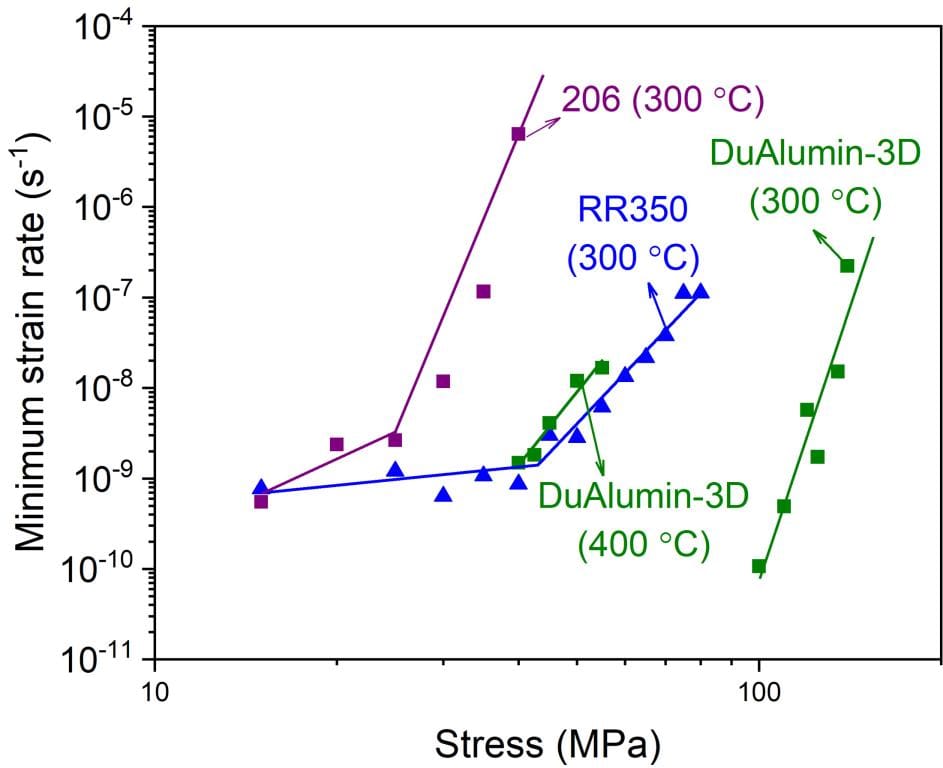
Other key performance metrics include a 99.9% density and excellent fatigue strength at 350°C. The alloy is also said to be half the weight and nearly six times more thermally conductive than titanium, meaning that, according to ORNL, Du-Alumin-3D could save hundreds of pounds per aircraft if used as a substitute for titanium in the manufacture of heat exchangers. Translating that to commercial aircraft fleets, that could translate to more than 50 million gallons of jet fuel saved annually, which would represent more than $120 million. Meanwhile, the organisation also says that replacing existing aluminium alloys with DuAlumin-3D could increase peak cylinder temperatures by 50–100°C. Combined with the flexibility of AM, ORNL believes this can open design opportunities that increase engine thermodynamic efficiency by up to 10%.
Last year, General Motors used Du-Alumin-3D in its Low Mass and High Efficiency Medium-Duty Truck Engine. Internally, ORNL researchers were able to print full-scale prototype automotive pistons after just three years of R&D. A combination of rapid X-ray computed tomography, advanced electron microscopy, mechanical testing, computational thermodynamics, and in situ neutron diffraction was used to accelerate the alloy design process. ORNL says this approach to alloy design can be generalised for accelerated research into other alloys for AM.


