

Snowbird Technologies has recorded significant cost savings with the additive manufacture of several components during RIMPAC 2026.
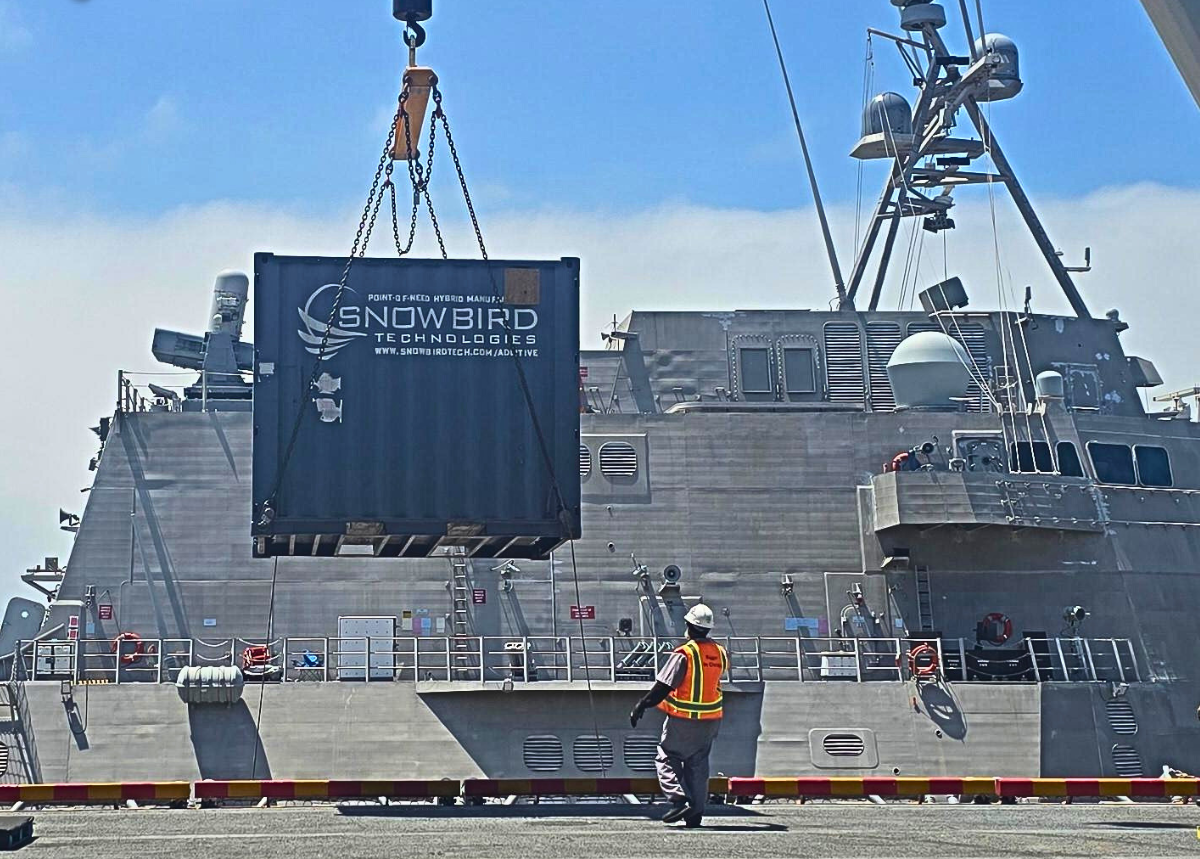
The company utilised its SAMM Tech deployable hybrid manufacturing system to print parts aboard the USS Essex and ashore at Schofield Barracks, Hawaii.
SAMM Tech produced the mission-critical parts using the Meltio Engine Blue and nitrogen supplied by an on-site generator. The deployment is said to have demonstrated the ability of SAMM Tech to manufacture replacement parts close to the point of need, while reducing reliance on traditional procurement and extended supply chains.
In comparison to those procurement and supply chains, four of the seven components manufactured by Snowbird are said to have delivered cost advantages. Among the components printed were oxygen tank brackets, drain caps, load test clamp components, turnbuckles, a 4-inch pipe flange, and an air pressure radio six-pack.
Twelve oxygen tank brackets were printed in an estimated 75 hours at a cost of $2,492, compared to an estimated OEM procurement cost of $9,624 from Pearl Harbour Naval Shipyard (PHNSY) and $10,224 to USS Essex. The load test clamp outer was printed in three hours for $101, compared with $420 from PHNSY and $455 to USS Essex, and the load test clamp inner was printed in nine hours for $289, compared with $420 from PHNSY and $455 to USS Essex. Finally, the Air Pressure Radio six-pack was printed in five hours for $154, compared with $624 from PHNSY and $654 to USS Essex. The test clamp outer represented a cost saving of 351%.
While not all of the parts bettered conventional techniques and workflows in terms of cost, Snowbird did note that they also reduced lead times. One part order, for example, avoided approximately 692 hours of procurement time with the use of SAMM Tech on location.
“RIMPAC provided an important opportunity to demonstrate expeditionary manufacturing in an operational environment,” said Karl Wojtkun, Vice President of Business Development at Snowbird Technologies. “The results validated not only the ability to print parts in austere environments, but also the potential to reduce procurement costs and supply delays when parts are needed immediately.
“RIMPAC reinforced the concept that the value of expeditionary additive manufacturing isn’t limited to whether a part can be printed. The larger opportunity is connecting digital part files, manufacturing, machining, inspection and sustainment capabilities so that the force can respond to parts requirements where and when they occur.”


