

Kidney and liver tissues have been successfully bioprinted in space for the very first time.
The biological tissues, which were produced on board the International Space Station (ISS) using Auxilium Biotechnologies' AMP-1 orbital 3D bioprinter, returned to earth on Mission AXLM-3 via SpaceX-34 last month.
Kidney, liver, and cartilage tissues were produced alongside 28 nerve repair implants, making it the first instance of three different tissue types being printed during a single spaceflight, and all on a single autonomous manufacturing platform.
The kidney and liver tissues were manufactured using cells and tissue designs from Wake Forest Institute for Regenerative Medicine (WFIRM). WFIRM’s Professor and Director Dr. Anthony Atala, MD said the success marks "an important step forward for regenerative medicine” while the uniform cell distribution achieved “points to real possibilities for manufacturing medical devices and tissues in space.”
Auxilium, a biotechnology and medical device company specialising in implantable therapies and space-based biomanufacturing, is behind the manufacturing platform that enabled tissue fabrication in microgravity. Jacob Koffler, PhD, MBA, CEO of Auxilium, told TCT that the findings show that space biomanufacturing can be repeatable, versatile, and scalable.
Koffler explained, “This milestone opens the door to a new way of developing regenerative medicine. By taking advantage of the unique conditions in space, researchers can create life science products that cannot be manufactured on Earth and, in many cases, produce them more quickly. That has the potential to accelerate the path from research to the clinic, bringing innovative therapies to patients sooner.”
The benefit of bioprinting in space is that it allows engineers to control the spatial distribution of cells in 3D, whereas, back on Earth, printing under gravity causes cells to sink. Carrying out this work in a microgravity environment means cells remain suspended and can be printed in specific layers to act like natural tissue architecture.
"Cell biology can progress faster in space," Koffler said. "When you manufacture tissue in space you can get a mature product faster than you would on Earth."
Another notable finding from this research is the potential to produce organoid tissue models that replicate the characteristics of human organs. These lab grown models are increasingly used by researchers and pharmaceutical companies to study diseases and new treatments, and there's a growing demand from regulatory bodies and researchers exploring human-relevant alternatives to traditional animal testing. For organoids used in space-based research projects like this, production would normally happen on Earth, but Auxilium says the ability to build them in orbit could provide researchers with greater access to experimental systems and would reduce dependence on launch schedules.
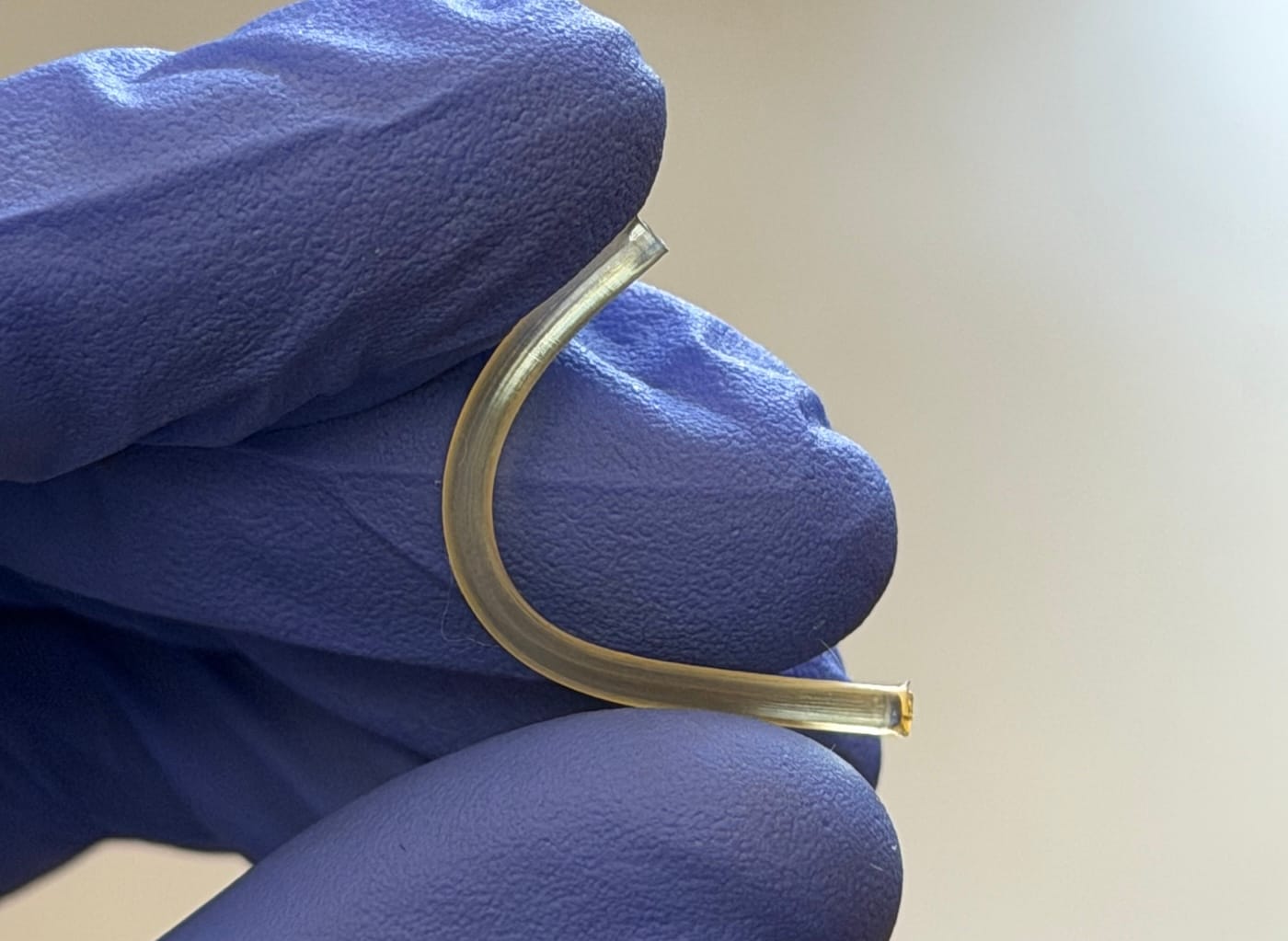
By demonstrating the ability to manufacture multiple tissue types in orbit, Auxilium says it is helping to establish the foundation for future space-based biomedical laboratories capable of producing advanced biological research tools, and is currently working with next-generation space station builders including Vast and Starlab.
"In the longer term, we envision not only developing these products in space but also manufacturing them there at commercial scale," Koffler said. "As routine access to orbit becomes a reality through an expanding commercial space economy, our platform will enable an entirely new class of regenerative medicine products that are simply not possible to manufacture on Earth."
According to Koffler, Auxilium believes its technology will become "a standard component of crewed spaceflight" for providing healthcare to future humans living and working in space. It also aims to establish space as a manufacturing platform for increasingly sophisticated medical devices, functional engineered tissues, and ultimately transplantable organs "whose quality and biological complexity are difficult to achieve on Earth."
"This technology is equally important for the future of human space exploration," Koffler concluded. "As NASA and its partners are working to establish a sustained human presence on the Moon through the Artemis program and prepare for missions to Mars, astronauts will need advanced medical capabilities that cannot rely on resupply from Earth. The ability to manufacture tissues, regenerative therapies, and medical devices on demand will become a critical component of space healthcare, enabling crews to treat injuries, respond to medical emergencies, and maintain health during long-duration missions far from home. At the same time, the U.S. Space Force is preparing to support an expanding operational presence in the space domain, where resilient, autonomous capabilities will become increasingly important."


