

Stratasys is expanding its SAF additive manufacturing offering with the launch of a new, larger machine promising improvements to the economics of final part production.
The Stratasys H550 3D printer, which is making its debut at Formnext this week, is "designed to give manufacturers a production system that provides the best available combination of part size, throughput and economics." With an increased build space of 34.2-litres and 450mm long, Stratasys says it is targeting larger applications such as UAV components, robotics and end-of-arm tooling, medical devices, automotive components, manifolds and ducts, in addition to greater volumes of smaller components. Pre-orders launch today and commercial availability is planned for Q2 2027.
“Manufacturers choosing a production system are making decisions that will shape their operations for years,” said Rich Garrity, Chief Business Unit Officer, Stratasys. “Before committing to their next powder bed fusion investment, they should see what the H550 can do. It brings greater capacity, larger parts and more attractive production economics designed to scale, so more applications can move onto the factory floor.”
The FDM pioneer says it is also addressing total cost of ownership with up to 30% reductions compared to current comparable print-and-fuse systems, and faster time to part compared to comparable SLS systems.
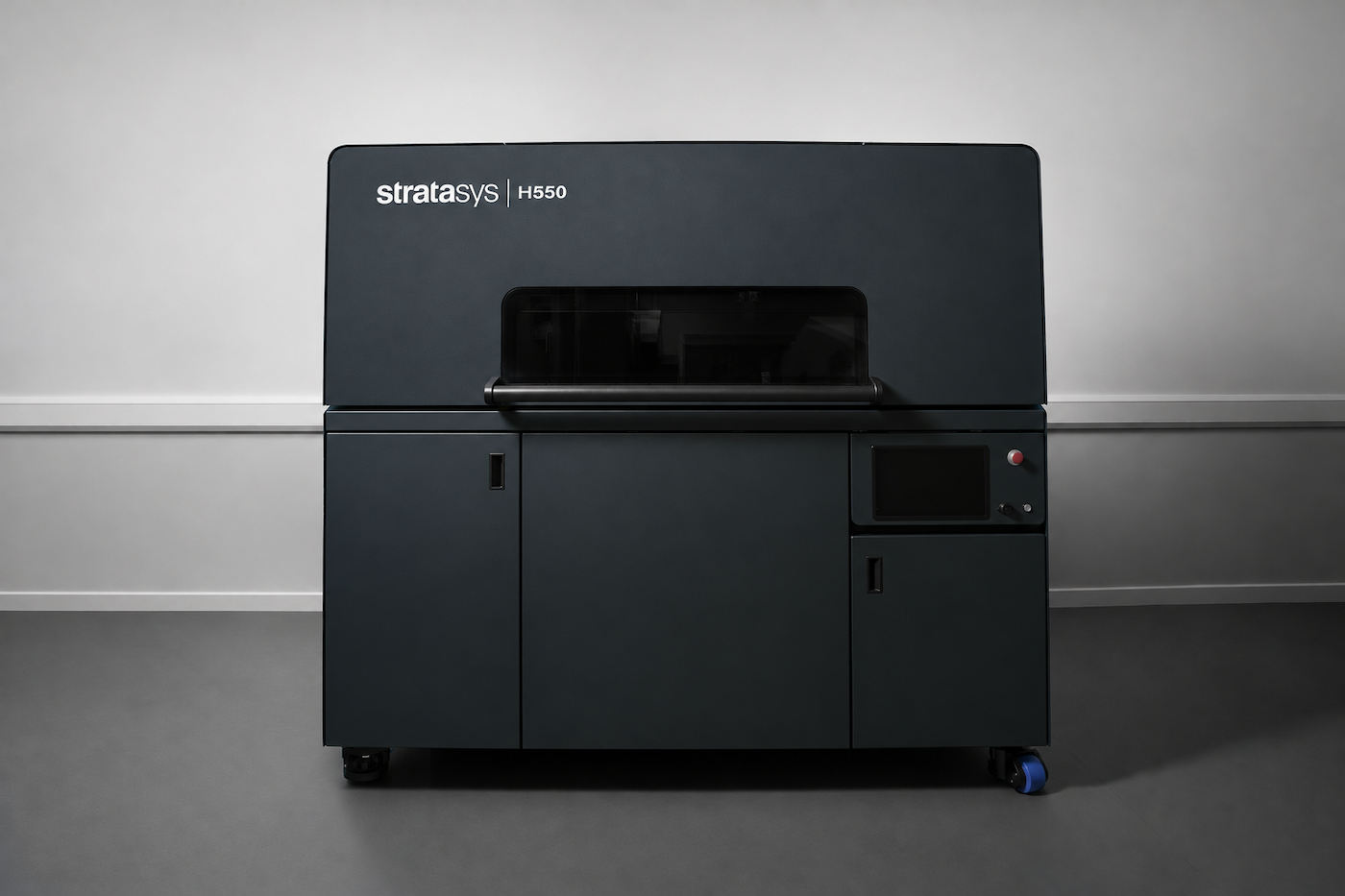
Speaking to TCT ahead of the launch, Neil Hopkinson, VP SAF, Stratasys, and inventor of the technology behind SAF, said, "Cost per part is really important and kind of a prerequisite. Once you've considered the cost per part, there are perhaps two other elements that we need to look at. One is repeatability. We're seeing more parts going into end-use applications, stuff that flies, drives on the road and so on. Naturally, what our customers need is a confidence in the properties of the part, the accuracy of its strength, etc. for that to be consistent. So that remains, I think, our core strength in the powder bed fusion area. And then finally, and particularly as aerospace and defence grows, it's actually the size of parts we can make. The biggest pushback we've had with H350 has been, if I want to make a part of this kind of size, I can't with the H350. And that's this irrefutable truth. So what we can do now is we can make parts which are longer than other mainstream print and fuse options on the market."
Rounding out its offering, Stratasys has also launched PowderEase T2 which automates part breakout, powder retrieval, sieving and dosing and is designed to support up to six H550 systems running the same material. The production workflow, according to Stratasys, requires under 30 minutes of total operator time per build.


