You could hold the Singapore Grand Prix at Changi near the airport. There is land out by the airport, the logistics would be simpler, the drivers would barely notice, and nobody anywhere would watch it.
What makes Singapore one of the best nights of the season is that they close the city and run the race through the middle of it. Floodlights on the water. The skyline leaning over the pit straight. Barriers threaded between office towers that have no business being that close to a racing car. The corners themselves are nothing special. The setting is the entire point.
I landed ten days after this year's race and the city was still taking it apart. Grandstand scaffolding half down around Marina Bay, debris fencing stacked along the pavement waiting for lorries, the racing line still painted onto roads that had gone back to carrying taxis. A few minutes' walk from all of it, at Suntec Convention Center, the additive manufacturing industry was quietly making the same argument about itself.
The Global Additive Manufacturing Summit (GAMS) 2026 and the relaunched Industrial Transformation Asia-Pacific (ITAP) have moved back into town. In July 2027, ITAP goes to Marina Bay Sands. The industry is moving into the neighbourhood the Grand Prix had only just finished packing away.
Out of the shed and back into the city
For the past few years this show meant Singapore Expo, out by Changi. ITAP ran there in 2024 and 2025, and on paper it is the right answer. You land, you are on the show floor within half an hour, the hotel shuttle is waiting, and for an event pulling delegates in from across the region that matters.
It is also a hall next to a runway. The day begins when the doors open and ends when they shut, and the only thing within walking distance is another hall. Downtown, you finish a session and you are in Singapore, rather than in an exhibition centre that happens to be in Singapore, and the conversation carries on into the evening because there is somewhere for it to carry on to.
That sounds like a soft point and it isn't. The argument running through both events this year was that additive has to stop talking to itself, and the single biggest lever a conference holds over that is where it puts people after six o'clock. Suntec felt different from the last few outings. Marina Bay Sands next July should push it further again.
The industrialisation session
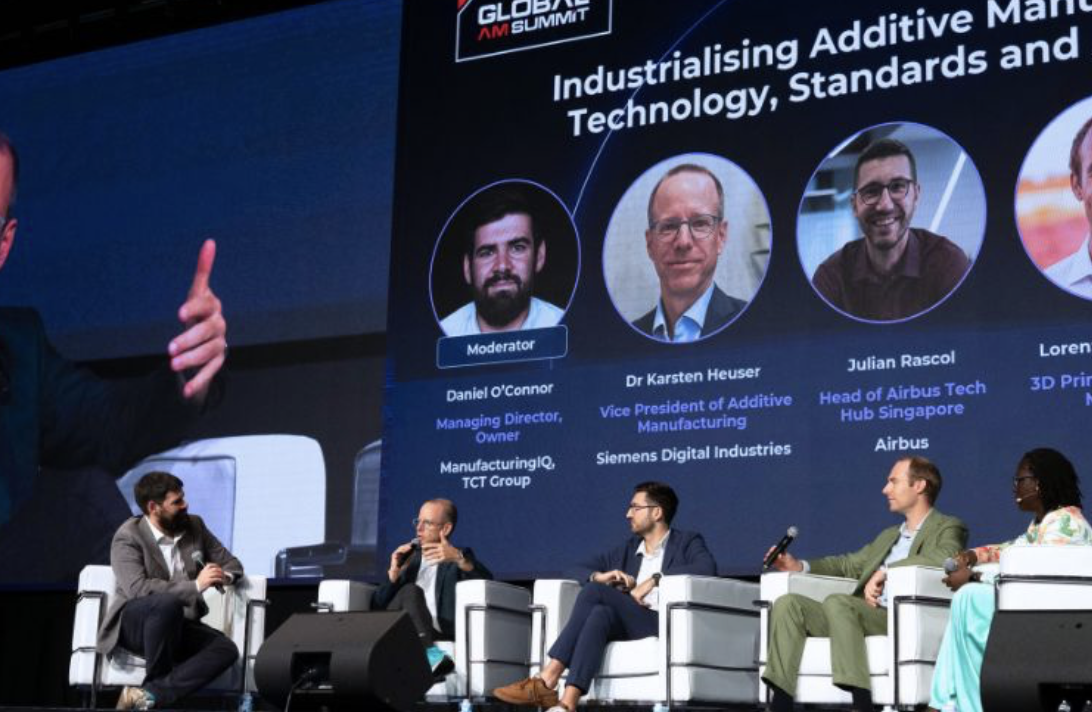
I moderated the session on industrialising additive manufacturing, which ran four short talks straight into a panel. Dr Karsten Heuser, vice president of additive manufacturing at Siemens Digital Industries. Julian Rascol, head of the Airbus Tech Hub Singapore. Lorenzo Gasparoni, 3D printing programme manager at Alstom. And Dr Naomi L. Nathan, head of the healthcare division at Mobility Goes Additive.
Four sectors, and broadly one story. The printing works. Everything around the printing is what is holding it up.
Heuser's framing was the one that set up the rest. Additive spent about a decade believing it was going to disrupt the supply chain, he said, and it didn't. "If Airbus is owning the application, or if Adidas is selling shoes, or if Apple is selling iPhones, they don't own machines for additive. They don't purchase powder." What actually worked was less romantic: existing suppliers, the ones already good at casting for a particular industry or already good at injection moulding, bolting additive onto what they do. "Foxconn is not probably known so much about delivering aircraft parts, but Foxconn is probably the biggest producer for Apple. Why should this change?"
Rascol gave the clearest numbers of the day. Airbus has around 10,000 metal AM parts flying. It produces about 5,000 a year, and wants roughly 20,000 a year inside five years. What is stopping it is not printer capacity. It is that a certified part needs a business case, which means it needs to be either high volume or genuinely critical, and the critical end is exactly where the technology is least mature. There is a second brake too, and it is a blunt one: the machines are not standardised against each other, so you cannot assume the same build on a different machine gives you the same part.
Gasparoni had the numbers that make the commercial case. Alstom has printed around 250,000 parts, saved €46 million, mostly through inventory reduction via its digital warehouse, and saved more than 250,000 days of lead time, which on a railway means trains in service rather than trains waiting. The goal is to get 20% of the bill of materials printable.
His Singapore example was a nice one for the room. A metal impeller for a traction converter, previously welded and riveted together, reprinted in 316L on laser powder bed fusion. It came out cheaper, more stable, easier to balance, easier to clean, and it vibrated less, which mattered because the vibration had been damaging the electronics sitting next to it.
But rail has no standard for certifying printed parts. Alstom controls the process to ISO/ASTM 52920 and then certifies part by part against its own rules, printing test specimens with every batch. A single metal validation specimen runs to around €1,000, and they print more than three. "In some countries," Gasparoni said, "the trust in additive manufacturing is very low."
Dr Nathan's case was that healthcare is the hardest version of the same problem. Her map of the barriers put the technology at the bottom of the list. The real obstacles are regulatory approval, reimbursement, business models, and quality and skills. The industrialised examples exist, and no two of them got there the same way: Stryker with over a million printed knees after twenty years of process validation, Materialise approving a family of devices rather than individual parts, Lima Corporate going into the hospital itself. The US only created billing codes for 3D printing last year. Across much of Europe there is still nobody to send the invoice to. Spain has hospitals running hundreds of projects with no reimbursement route, and the Netherlands has just issued a national guideline that says as much out loud.
Standards, and the UK turning up as a model
Standards were where every sector converged, and the UK came up in a way I was not expecting.
Dr Nathan made the point that the industry's real job is to be in the right rooms with the people who already write healthcare regulation, rather than inventing its own forum. Her evidence was two days old. The UK had just confirmed it will accept CE-marked medical devices in Great Britain indefinitely. The commitment still needs legislation, which the government says will be in place before 30 June 2028, when the first of the existing transition deadlines runs out.
I suggested from the chair that she was being generous to us. The UK has its own UKCA mark and that route stays open, but around 90% of devices on the British market already carry CE, and the honest reading of the decision is that after Brexit we did not have the capacity to run a parallel system and have quietly accepted somebody else's. Generous or not, the effect is the same, and it points at something bigger. If more of the world adopted shared standards rather than near-identical competing ones, a great deal of duplicated work would simply stop existing.
Nathan also had the line that should worry anyone in this industry who thinks the argument is won. She spends a lot of her time with health ministers and European commissioners, and the reaction she still gets is on 3D printing is: "Oh, I thought we made toys."
AI, and the question nobody quite answered
AI ran through the whole day, and the panels were far more positive about it than the wider conversation outside this industry. The useful framing was practical rather than existential. Additive has always had more variables than anyone can track by hand, and the thing that has changed is the ability to process the data coming off a build.
Kitty Wang, CEO of SynaCore gave the sharpest example. One of its customers prints blades, and had sensors in its machines, full design and measurement data, and three years of failed prints sitting on shelves. Collecting the data was not enough on its own. Fed into a closed-loop digital twin, distortion the customer had been fighting for years was brought inside 200 microns in three rounds, without anyone touching the printer.
On my panel, Heuser described AI as a co-worker rather than a replacement: something that turns a four-day hunt for a root cause into an hour, and that starts predicting failures once it can see across the data silos a company usually keeps separate. The human still signs the part off. Rascol drew the line harder. Airbus has been using AI in one form or another for about 40 years, he said, but large language models are a different thing, and in safety-critical processes they are not going anywhere near production. "There's no pathway to certification of such AI."
What nobody really dealt with was dependency. The question was put to the morning panel by Joris Peels of AM Research, more or less directly: what happens to your business if you lose access to the AI you rely on? The answers were a claim that more than 80% of AI content now uses open models, which went unsourced, and a reasonable but general point that entrepreneurs have always managed dependencies by building in redundancy. Open weights still have to run on somebody's compute, and that is the harder dependency to route around.
Then the conversation moved on. For a summit themed on resilient industries, on a day otherwise full of tariffs, export controls and where parts get made, that was a gap.
Nobody is at the centre of the universe
The most useful thing said all day was also the least flattering to the industry hosting the event.
"Don't be arrogant and put yourself in the centre of the universe," Heuser said. "We are just one step in a bigger production chain." There is no additive part anywhere that does not involve another manufacturing process at some stage, and the pitch to customers should be cost, price, quality and lead time, the things they already buy on, rather than a disruptive new technology.
You could see the same thinking elsewhere in the programme. Moveon Technologies builds the bulk of its injection mould tools by precision machining and then fits printed porous inserts where conventional vents clog, plus printed conformal cooling that follows the shape of the part. Michael Agam of Tulip Interfaces put it plainly: additive and subtractive "will always be living alongside each other."
Rascol had the last word on my panel and it was the line of the day. "It's irrelevant to say it's additive. It's a manufacturing technology and you should use it as such."
What Singapore signed
The same argument about alliances came up, with a warning attached. "Sometimes we tend to form another alliance, which is probably another silo of nice people having an exchange with each other," Heuser said. His advice was to go where the alliances already are, in casting, in automotive, in aerospace, in standards. Nathan agreed from the healthcare side: "We don't need to reinvent the wheel, but we need to tap into what is being done and bring our evidence along."
Singapore spent the summit doing exactly that. NAMIC, the National Additive Manufacturing Innovation Cluster, announced three partnerships:
- Bavaria Makes: a four-year MoU with the Bavarian alliance whose founding members include Siemens, EOS, Oerlikon and TU Munich. Heuser, who signed it the day before, said it connects Bavaria's 150-plus active AM companies with Singapore partners, with student, masters and PhD exchange built in.
- A production chain: a five-year MoU between A*STAR's Additive Innovation Centre, Forefront Additive Manufacturing, GD Precision and ATC Globe Holdings, covering design through to production-ready part.
- ASTM International: a five-year extension of a partnership that has already produced four international standards developed in Singapore.
Not one of them is about buying machines. They are about qualification, supply chains and standards, which is precisely what the people already producing at scale spent the day asking for.
The setting is the point
ITAP's relaunch is built on the same premise as everything said on stage, moving manufacturers out of pilots and into production. The full-scale event returns to Marina Bay Sands from 20 to 22 July 2027.
Every speaker in my session said a version of the same thing. The printer was never the hard part. What decides whether additive industrialises is everything arranged around it: the standards, the suppliers who already know how to certify, the regulators, the health ministers who still think we make toys. On its own the technology is unremarkable. It only means anything in relation to what surrounds it.
Which is roughly what Singapore worked out about its Grand Prix. The circuit is a few kilometres of ordinary public road. Run it past the airport and it is a fast car on a Sunday. Run it through the middle of the city after dark and the world sits up.
The industry gets to the bay first next July. The grandstands go back up a few months after it leaves, for much the same reason. You could hold either of them out at Changi. It just wouldn't mean very much out there.
ManufacturingIQ's Daniel O'Connor moderated Industrialising Additive Manufacturing: Technology, Standards and Adoption at GAMS 2026.