

In 2017, Mimaki unveiled its 3DUJ-553 full-colour 3D printing system. And, by Mimaki USA's 3D Segment Manager Matthew Stark's own admission, the technology hasn't changed all that much in the near decade it's been on the market.
But much has. The applications that Mimaki is looking to enable, for one, and the congestion of the market in the Western world for another. And then there's AI, data management, and the passing of time.
In a recent conversation, Stark took it all on to reflect on a decade of full-colour 3D printing, consider where the technology is having an engineering impact, and ponder how the sub-sector will mature.
TCT: If you look back at the trajectory of the full-colour 3D printing market, has it panned out like you and the company anticipated it would?
MS: No, not at all. The 3DUJ-553 was released in late 2017, and the company’s idea in the beginning was to create a possibility for full-colour 3D signage. There’s a street in Osaka, Japan, that has these gigantic mechanical signs – the big crab sign, the running man sign – and Mimaki’s dream was to make signs like this – such as a full-colour human that was so realistic you couldn’t tell the difference – with a quick click of a button.
But we realised the weight of an object that size and the cost of an object that size were way more than we were expecting. If your object weighs 20 kilograms and it’s 100% ink, well, 20 kilograms of ink is not cheap. That was what turned the focus to products that are worth their weight or more in ink.
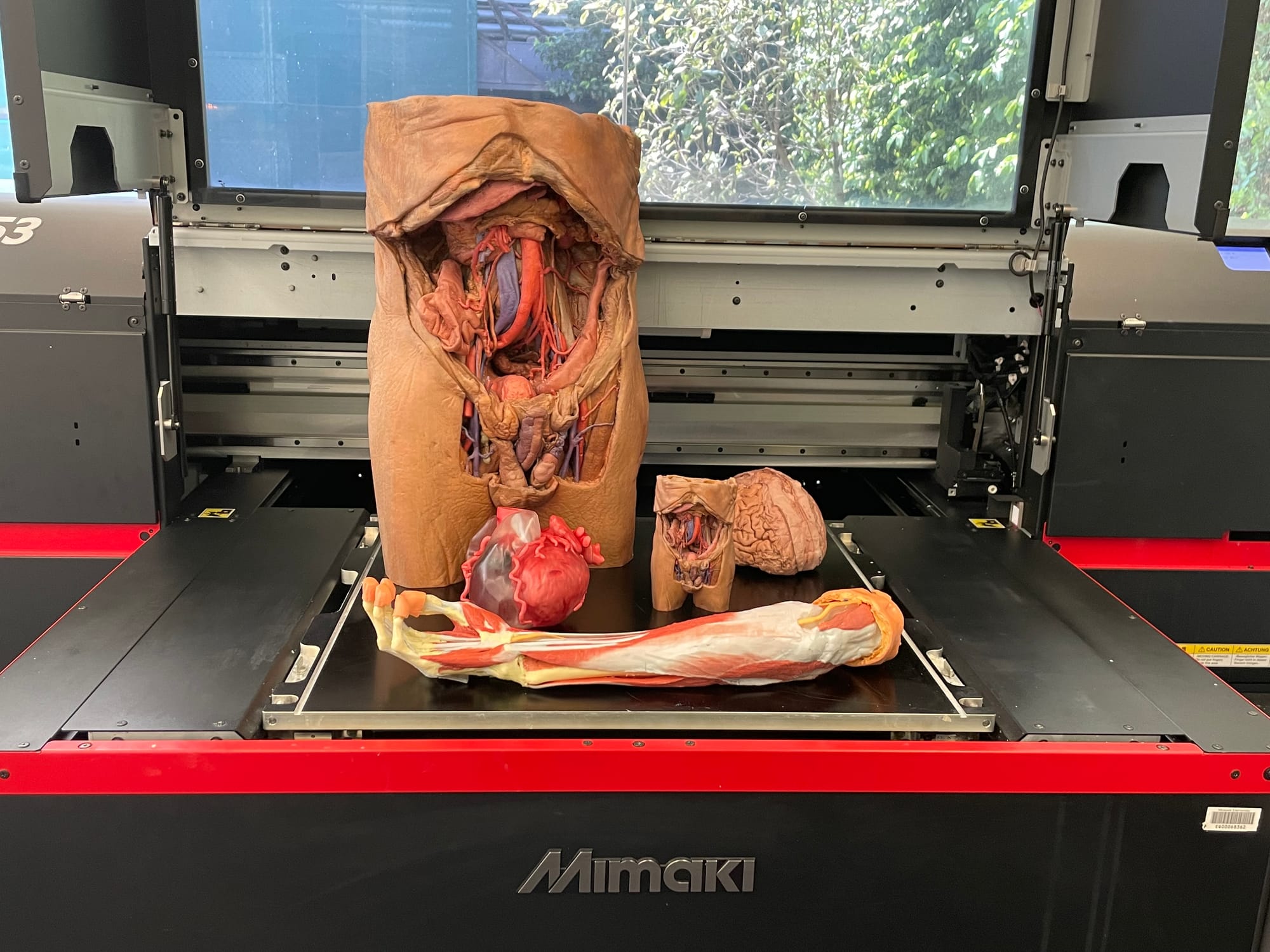
That’s one of the reasons why Stratasys has been focusing on the medical industry, because there’s [almost] no price for a medical model. We’ve seen a huge uptake of that industry on our side as well. On the prototyping side, you can’t put a price on the speed that you can get a realistic prototype out of our machine versus printing it on another machine, sending it to China where it gets painted or mocked up, and then getting it back in a month. It’s changed a lot of workflows.
TCT: So, how else is the technology being used?
MS: We’ve got a couple of shoe companies that we work with that have dramatically changed how they make mock-ups. We also have some furniture companies that do it as well with small-scale furniture. FunKo, they’ve had our printer since we came out with it, and they don’t just print full colour FunKo pop models, what they'll do is still print it in the same colour that their injected moulded plastic is from China and then they'll take that and they'll paint it and they'll make sure that the paint fits well with the injected moulded plastic and it all looks really good. They also do the full-colour models as well, and they take them to different toy shows around the country, don't tell anybody it's 3D printed, and just show them what's coming out next year.


