

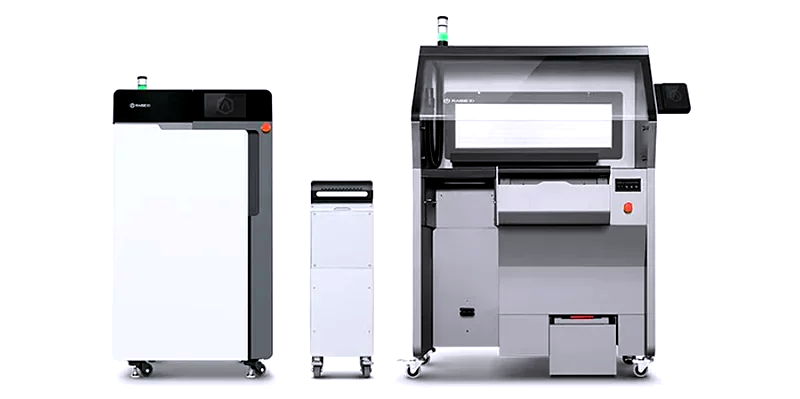
Raise3D has launched the T450 and large-format T700 FDM 3D printing systems ahead of Formnext 2026.
The T450 and T700 machines share the same tech platform, are both equipped with an actively heated build chamber and feature build volumes of 450 × 350 × 400 mm and 700 × 500 × 1,000 mm, respectively.
Both systems are supported by a 4MD CoreXY system with four frame-mounted motors, designed to reduce vibration, surface ringing and the risk of layer shifts, and the TwinFlow high-flow extrusion technology, which feeds two filament paths into one nozzle, reaching up to 600 mm/s and 80 mm³/s under the reference test conditions[1], and switches to two materials for soluble supports or dual-colour parts. Air Flow Manager 2 adjusts the chamber by material, holding up to 70°C on the T450 and 60°C on the T700 for large ABS and nylon parts, and switching to directed cooling with an automatic top vent for lower-temperature materials such as PLA.
Other features include a 420°C fibre-ready nozzle and a 120°C build plate; camera monitoring; spaghetti, flow and run-out detection; power loss recovery and emergency stop; RFID material identification; mesh levelling; and ideaMaker support.
Per Raise3D, the T450 is suitable for the printing of jigs and fixtures, casting patterns, large prototypes and production aids. The T700, meanwhile, is better suited to large tooling, patterns and other large-format applications.
Raise3D CEO Edward Feng said: "Larger build areas open up applications that were previously limited by size. A scoliosis brace is one of them. It has to be printed in one piece, because a brace that is split into sections and bonded back together does not have the strength a brace needs to hold the spine. Adolescent idiopathic scoliosis affects around 1 to 3 per cent of teenagers, and a build area that is too small only covers a child's torso. On the T450, an adolescent brace fits inside the 450 × 350 mm build area with room to spare, so it comes off the machine as a single part. The same reasoning applies to tooling, patterns and production aids."
Another application example that Raise3D has provided is cell transport trays in power-battery manufacturing. According to the company, production time fell from about 40 days to 10 days, and tray weight from about 8 kg to 2 kg, reductions of approximately 75% in both. The gain came from the combination of build area, extrusion throughput and material choice, which is the combination the T Series is built around, Raise3D says.
The T450 is priced at US$4,999 in the United States and €4,999 in Europe; the T700 at US$15,999 and €15,999. T450 deliveries begin by the end of December 2026, with the T700 expected by the end of January 2027.
Alongside these machine introductions, Raise3D has also engineered a 100 mm build-height increase for its RMS220 selective laser sintering (SLS) printer, enabled by a software update, and introduced the B520 automated sandblaster for polymer powder bed parts. It follows a $15 million funding round completed earlier this month. Raise3D says it will use these funds to implement further upgrades to its product portfolio, as well as hardware-software integration, application development, and expansion into new applications and markets.
Raise3D's RMS220 SLS printer now offers a build volume of 220 × 220 × 450 mm (approximately 21.8 L), up from 220 × 220 × 350 mm (17 L). The additional 100 mm of Z height increases build height and build volume by approximately 30%, and is enabled through a software update on existing machines, without a hardware change.
The taller build space allows suitable components that previously exceeded the 350 mm height to be produced in a single build and provides more room for nesting.
The B520, meanwhile, is an automated sandblaster for polymer powder bed parts. Its enclosed workstation combines automatic blasting, air blow-off and ionisation, and a manual mode allows operators to reach deep recesses and shielded areas. Suitable parts can be processed as a programmed batch. The independent system supports the RMS220 as well as third-party SLS, MJF, SAF and HSS equipment, and its standard and large baskets have internal volumes of 24.8 L and 75.5 L, respectively.
The RMS220 update widens what can be built in one cycle; the B520 addresses what happens to those parts afterwards.
 Sam Davies
[1] The reference test conditions for TwinFlow™'s maximum volumetric flow of 80 mm³/s: Raise3D Hyper Speed ABS V2 filament, 250°C nozzle temperature and a 0.4 mm nozzle, printing a single-wall smooth structure. Actual performance depends on material, nozzle, layer height, model and print settings.


