

For a CEO of one of the original companies in the industry, Brigitte de Vet-Veithen is very open to sharing what you might call ‘unpopular opinions’ about 3D printing. The primary one being that Materialise isn’t a 3D printing company at all.
The Belgian firm, founded in 1990, holds a unique position in the additive manufacturing (AM) space. Its output is part-industrial, part-healthcare. Its AM software products – including – including CO-AM platform, next generation build processors and flagship Magics build preparation software – are the industry standard and used by some of its biggest competitors. It offers high-end manufacturing services of complex parts at scale. Today, we’re meeting in Leuven where the company has gathered several hundred professional users of its tools for 3D planning and printing operations in hospitals daily.
So, if not a 3D printing company, then, who is Materialise?
“If you asked 200 people at this event, they certainly wouldn’t answer that we are a 3D printing company,” Brigitte tells TCT. “Because at the end of the day, the technology doesn’t really matter for them. What matters to them is the solution that we bring. In the industrial areas, are we a 3D printing company? No, we’re an aerospace company. We bring solutions to the aerospace world.
“We should stop talking about 3D printing as this wonderful technology. Let’s start talking solutions for our customers.”
Brigitte’s view comes from experience. When she took over as CEO from co-founder Fried Vancraen in 2024, she did so after spending almost a decade at Materialise Medical, a division focused on 3D technology-enabled personalised care. Brigitte joined back in 2016 with, admittedly, little knowledge of this thing we call ‘AM’.
“There’s more similarities than I ever thought,” Brigitte says, reflecting on how her time in the medical world helped inform her understanding of AM’s potential in other key industries in which Materialise operates. “If you look at the aerospace industry, as an example, it’s highly regulated. We in the medical field had to deal with regulations. In aerospace, we’re doing exactly the same. We had to convince regulators in the medical field 10 years ago that AM was safe. Lattice structures make a huge difference in the medical field; they also make a huge difference in the aerospace field. So, there’s a lot of similarities.”
Brigitte believes 2026 signals a new dynamic for AM. A big driver is the rise of affordable, higher-quality printers, and the impact their accessibility has had on what she repeatedly refers to as the ‘mainstreaming’ of the technology. The most recent figures from CONTEXT, which report that more than half of 3D printer hardware revenues from Q1 2026 came from printers priced below $2,500, certainly supports that theory. The cost of a printer is no excuse anymore, says Briggite, but that affordability doesn’t just take the form of cheaper desktop polymer extrusion systems from China. It’s in the likes of Formlabs’ lower cost desktop SLA and SLS systems, which have now produced more than half a billion parts, and HP, which introduced its sub-$60,000 Multi Jet Fusion system at RAPID + TCT earlier this year. It was at this same event just one week earlier, where Brigitte says the maturity of the sector was palpable as the topic of ‘scaling’ dominated the floor.
“I think all of what we saw leads to what I would call the maturation of the industry.”
Materialise has long been invested in powering that maturation in the ways perhaps only it knows best. Its CO-AM platform, launched in 2022 as an open software environment designed to ‘industrialise AM’, was a first of its kind effort to demystify the complexity of 3D printing at production level. Open to anyone, CO- AM could also be viewed the manifestation of a decade long push for collaboration.
“We are really trying to address the fragmentation that we have in the industry,” Brigitte explains. “When you look at the workflows of our customers from A to Z, they still have to upload, download, upload, download files and data throughout the process. That’s really complicated. Sometimes the formats don’t even agree with each other. The objective that we have for CO-AM is to make all that easier and provide a workflow eventually for our customers that is more seamless, less hassle, less manual interventions and enhance more control over your process.”
In November, Materialise launched a trio of updates to cement CO-AM as a foundation for a connected manufacturing environment. Underpinning new CO-AM Professional, CO-AM NPI, and CO-AM Enterprise offerings is CO-AM Brix, a low-code, node-based tool that lets users automate and optimise 3D printing workflows by tapping into the thousands of algorithms that Materialise has built over the last 35 years. Users can access those algorithms, even bring in any other algorithm base, and build their own workflows in a simplified way.
“You can’t get more open than that,” Brigitte says. “You can access all our algorithms, and you essentially can bring in any other algorithm library that you have and that you want to benefit from.”
Openness is a conversation Brigitte wants to turn up the volume on. Attendees at the Materialise World Summit back in 2017 might recall when the company teased ‘a new innovation’ called “Materialise 0.1” in an elaborate stunt, which included ‘live video footage’ of then-CEO Fried transporting the mystery product directly to the event. “Materialise 0.1” was ultimately ‘revealed’ to be everyone in that room: the partners and collaborators in Materialise’s orbit. A theatrical choice, for sure, but there’s nothing gimmicky about the company’s approach to collaboration. In 2024, Materialise established the Leading Minds consortium with founding members including Stratasys, EOS, and Nikon SLM Solutions to develop a ‘common language framework’ for the AM sector.
“Stepping into my new role, I figured what we knew in medical wasn’t present everywhere yet,” Brigitte explains. “I saw that fragmentation, I saw the issues that our customers had with the different languages that we use. How many ways can you find to talk about SLS technology? So, it starts there. Leading Minds really was born out of a perspective that I took where I felt that we really needed to step up our game to make our customers’ lives easier and that could only happen through collaboration within the industry.”

The initiative is built around three pillars: a common language, education, and awareness creation, banding together as an industry to address barriers facing customers and presenting as a united front to new ones who haven’t yet bought into AM’s advantages.
“It’s a lot stronger when we join forces and we speak as the additive industry, not trying to sell one particular technology, but showcasing what additive can do in general.”
Brigitte accepts that progress has been slower than expected. Every company has different ways of working, different approaches to ‘openness’. But it was never expected to be an overnight job – it’s about laying the foundations for the long-term and taking clear actionable steps.
“I wish every machine manufacturer would do the same with parameters,” Briggite says of the need for more companies to open up in a similar way as it has done with CO-AM. “Because there are still areas where there are easy wins. It looks easy to me. It’s not easy for the companies, I absolutely appreciate that, but it’s what the industry will need to make a meaningful step forward.”
This openness is why Brigitte is comfortable answering the question she claims comes her way the most – why are you enabling your own competition? Because Materialise is its own case study. Often, the software tools it develops in-house to support the manufacture of personalised medical devices or aerospace parts are then fed back into its software offering for use by other customers, and yes, competitors.
“We know the problems that users run into because we are manufacturing ourselves,” Brigitte explains of what she feels is Materialise’s strength. “Sometimes it means on the short term we are enabling our own competition and we’re making our own life a lot more difficult. But again, we are not here with a short-term perspective. I think that’s part of why for 35 years we’ve built such a strong foundation.”
A healthy outlook
Fried Vacraen and Hilde Ingelaere founded Materialise with an ambition to enable a healthier world. Healthcare accounts for around half of Materialise’s revenue today and if you’re looking for proof of AM’s real-world impact, you don’t need to look too hard. Take, for example, bioresorbable tracheal splints for newborns born with a disease that causes their trachea to collapse. Together with biomedical engineers at the University of Michigan Health, Materialise developed a 3D printed splint that resorbs over time, completely removing the need to be tied to a ventilator for their first two years of life.
“When you see the difference our technology can make,” Brigitte starts, “the first baby we treated, baby Kaiba, is now turning 15. The boy is running around leading a healthy and happy life. Those are wonderful heart touching stories.”
Prior to meeting in Brigitte’s office at Materialise’s HQ, we’d met a week earlier in Boston, a hub for medtech, where Brigitte joined a panel of AM industry CEOs to talk about how AM is transforming point-of-care. When asked what applications keep her returning to work every day, Brigitte shared how Materialise’s technologies are providing care to people impacted by the war in Ukraine through cranio-maxillofacial work for trauma patients and supporting Ukrainian medical and clinical engineers from its office in Kyiv.
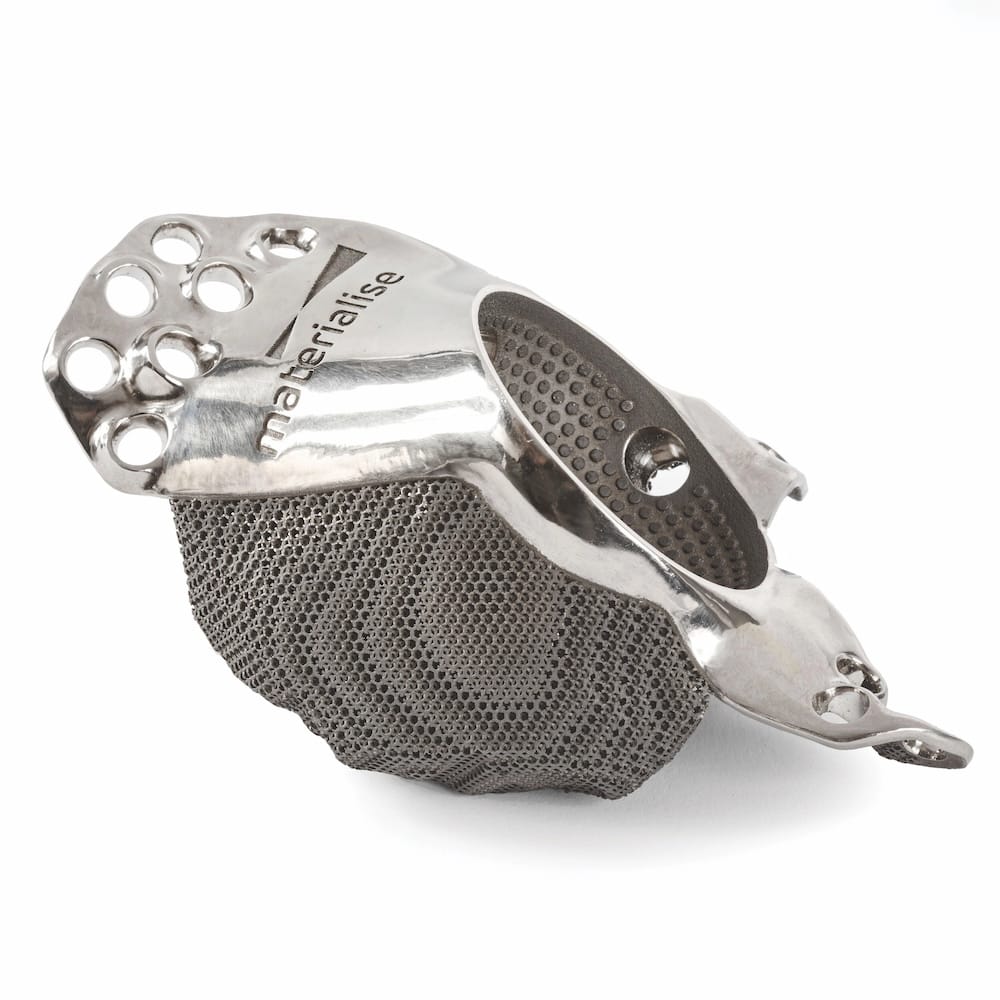

From left: Materialise aMace customised hip implant and cranio-maxillofacial solutions.
But this unrelenting conflict has given rise to another important industry for Materialise, and it’s one that the company, and Brigitte herself, had to navigate thoughtfully - defence. In a conversation on TCT’s Additive Insight podcast last year, Brigitte shared her view that the industry should stay away from the printing of weapons, but that defence presented a ‘difficult ethical dilemma’ for AM because of the clear value it can offer to our most critical geopolitical challenges. Today, the context has tipped to a point where those uncertainties have essentially helped to build certainty in additive and, Brigitte argues, it would now be unethical to sit out.
“Integrity and ethical standards are really important to us,” she elaborates. “So when the environment changes in a way that it becomes an ethical duty to contribute, then obviously you can count on us. And that’s what happened in the defence industry.”
Brigitte wants to stress that there are several layers to defence, one being security. In 2022, Materialise acquired Identify3D, which developed software to encrypt, distribute, and trace the flow of digital parts across complex supply chains. That software now forms part of Materialise’s defence offering as a secure way to share files and protect IP.
“There’s so much valuable technology that we bring to make sure that people around the world are safe,” Brigitte explains. “Our mission is to create a better, healthier, and safer world. As long as it fits in that mission, you can count on us, and that’s kind of the lens that helped me navigate the decision.”
There are other areas, like energy and semiconductor, that are proving increasingly valuable. These are not new industries for AM, but the difference today, Brigitte says, is the arrival of scale.
“Finally, we are just one of the manufacturing technologies that allows users to do other things. Not the same but other things. Personalisation, lattice structures, lighter parts, all of that. It’s great that we are just another technology. Because that is also for me, a sign of the maturation of the industry and that we’ve achieved mainstreaming of additive.”
But just because you can, doesn’t mean that you should.
“Not everything that is valuable in terms of AM applications is something that we find important and we do. We want to focus on areas where we can make the biggest difference.”
Built to last
Materialise has weathered every storm the AM industry has faced – the hype cycle, ‘a 3D printer in every home’, the SPAC era. Its success is largely, Brigitte believes, down to that long-term perspective. But there’s also something else.
“We’ve never believed in the hype,” Brigitte says. “We’ve very often been the ones that said, ‘Everybody’s shouting this, but here’s a different perspective’. The hype that everybody was going to have a printer at home? Fried said from early on, it’s never going to happen. He made himself very unpopular.”
The company is taking the same approach to the inevitable integration of AI. It believes there is value – think practical advantages in healthcare where AI can help take out the grunt work in routine tasks like segmentation or speed up processing of scan data to help make more intelligent decisions. It is, however, being cautious not to repeat old industry patterns of overpromising.
“While everybody thinks it’s going to change our lives dramatically tomorrow and we are going to be able to do what we do with 30 or 40% less people, AI is going to enhance what humans do but it’s not going to enable us or others to do the same thing with 40% less people. That’s not the perspective we take.”
The AI industry could maybe learn a few things from AM’s trajectory. But who does Brigitte learn from? Her husband and children work across scale-ups, healthcare and AI, each very different ecosystems, and that, Brigitte says, keep her fed with new ideas and parallels for AM.
“We can think that AM is very different from everything else,” Briggite says, “but actually, it isn’t.”
And while some cheerleaders in the AM industry might have you believe the storms have finally calmed, Brigitte takes a different view.
“We are still going to see, certainly this year, an uncertain environment around us and that will keep a lot of companies from making big investments and big decisions. And while in some cases that benefits us, it still means that the macroeconomic climate is not the most ideal. Are we going to see valuable applications scale at this year? Absolutely. Are we now going to go through another hype cycle? No, I don’t think so.”
Brigitte describes herself as an optimist by nature. She believes, as a business leader, you have to be, and credits the people at Materialise for fuelling that optimism by keeping at the forefront of innovation. But equally important, particularly at what remains a challenging period for the AM sector, is finding the line between optimism and pragmatism, and showing rather than telling.
“I think that’s where the spirit of Materialise helps,” Brigitte explains. “We’ve never over-hyped the technology. We knew about the power of the technology, but we always chose a way to demonstrate what it can do rather than talk about what it can do.”
Materialise plans to keep on demonstrating. Brigitte teases incoming healthcare applications and “major steps” in the aerospace and defence industry. A strong balance sheet also means it’s in a position to pursue an “aggressive” M&A agenda. What that looks like is not for today’s conversation, it could be an acquisition or it might take the form of a partnership. As Brigitte concludes, that message of openness comes through one last time.
“I think everybody should stay tuned and also come with ideas and possibilities.”


