

The additive manufacturing (AM) industry has long been very interested in revolutions. Industrial ones, digital ones, slow ones. 3D printing was supposed to be its own revolution altogether: a new technology that would democratise manufacturing and enable anyone to make anything from the comfort of their kitchen counter.
Given you likely didn't 3D print that coffee cup in your hand, you don't need me to tell you, that didn't quite happen.
But it's not unusual for revolutions to have an unsteady start. Take the spinning jenny, for example - a machine that played a major role in the industrialisation of the textile industry. Invented by James Hargreaves in 1764, this multi-spindle spinning system could spin eight threads simultaneously, reducing the amount of work needed to produce cloth. The machine was great for productivity but, as skilled hand spinners saw a drop in yarn prices, their livelihoods undermined, they revolted, broke into Hargreaves' house and forced him to leave town. Hargreaves ended up moving to Nottingham and making jennies in secret. By 1770, the machine could spin 16 or more threads at one time, and signalled a shift for the entire textile industry from cottages to factories.
At TCT 3Sixty last week, a new jenny - or rather, JENI - was being positioned as a machine for the fourth industrial revolution, and a fully autonomous, digital alternative to injection moulding.
It is not, per manufacturer Photocentric, a 3D printer.
Well, it kind of is, or more accurately, a modular 3D printing platform which can house multiple LCD-based printers to produce parts at scale. The last system Photocentric sold featured 11 modules and over 300 printers, and, according to Kevin Martin, Technical Sales Engineer at Photocentric, is highly competitive with injection moulding, and highly customisable.
"You effectively have nodes inside each module and you can decide whether they're going to be a printer, wash, rinse, cure or anything else you want," Martin explained. "You create a file which will be your slice files for the part, but also describe how it goes through all the other processes so you can accurately control timings, traceability, everything else. You can feed the whole system with one resin, or you can have different resins for different printers. It will know. You can run the same job continuously, and it will just fill up the printers as it needs to. Or you can run a specific job and say, "I want 10 of these, two of those, one of those.""
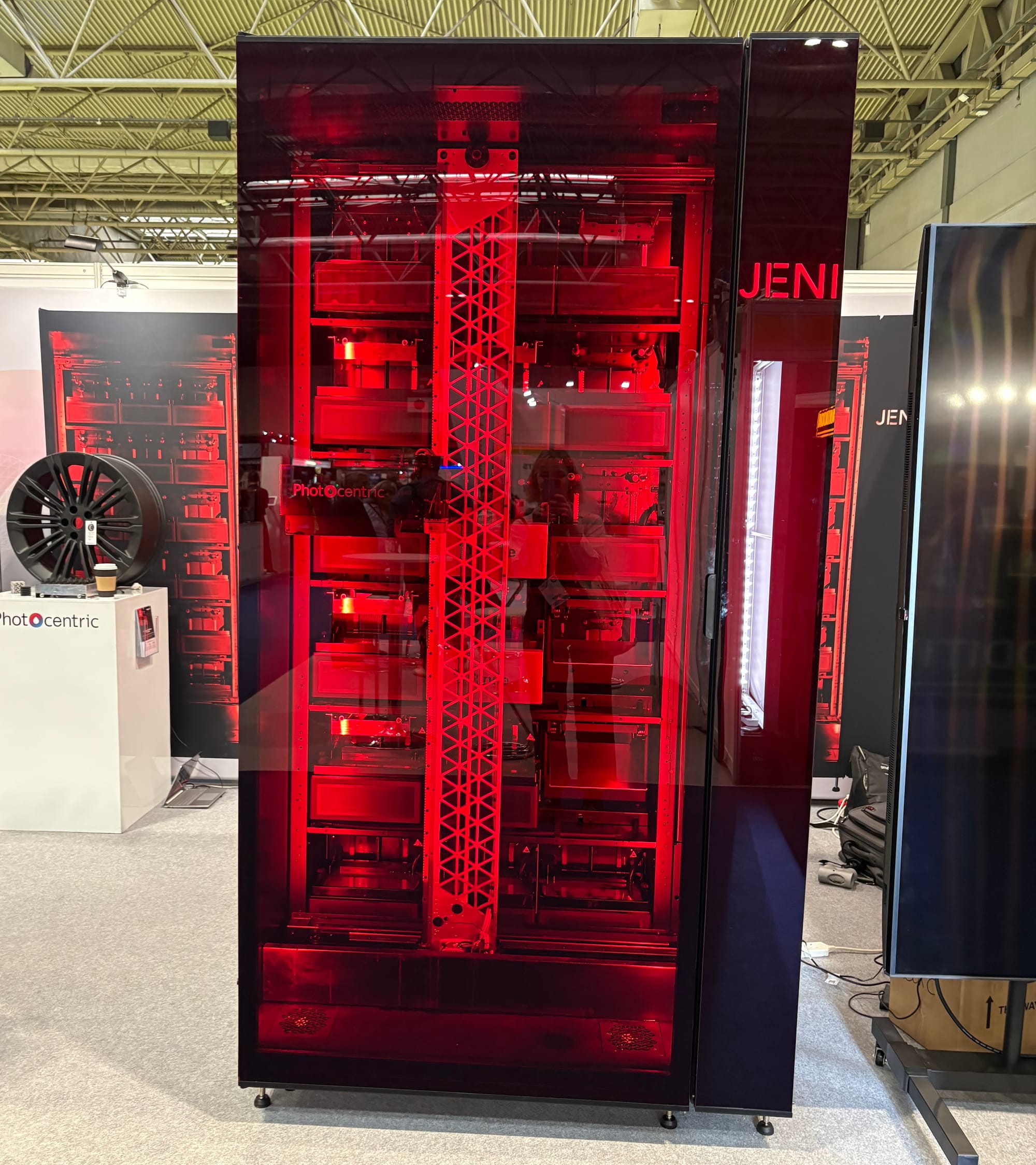
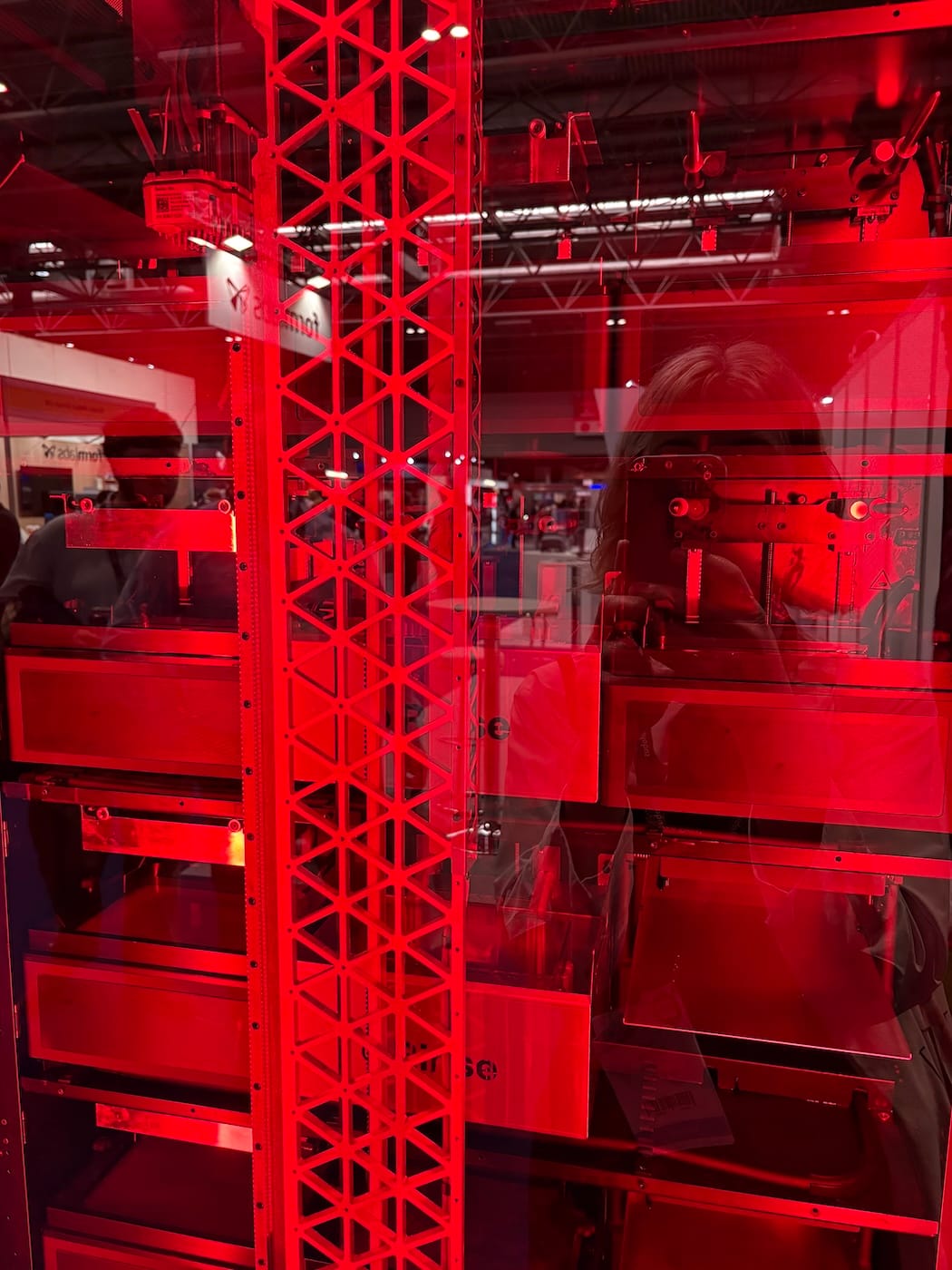
JENI at TCT 3Sixty.
TCT got an initial look at the JENI back in 2023 during a visit to Photocentric's UK facility. It was officially unveiled a year later, and by April 2025, the first unit was installed at a US production site for a multinational manufacturing business. But the real driver for the JENI came during the pandemic when Photocentric mobilised a print farm consisting of its LCD Screen technology to produce 350,000 face shields per week for the NHS. At that time, the company was making thousands of spacers for face masks, firstly with printing, but had also placed an order for an injection moulding machine tool. When the tool arrived, Martin recalls, it was so fast, the print farm was switched off.
"Before it arrived we'd made four and a half million parts," Martin said. "But we found the quality was varied - different shifts, different people made different parts effectively because it was manual. [JENI] takes all of that out of it. You don't have to handle chemicals. It's all done within the machine. Everything can be tracked. The quality is consistent. Every platform that comes out is going to have consistent quality. So we have dealt with that, scaling, taking the manual part out of it. It's all safer. It's quicker."
JENI aims to deliver on the promise of additive manufacturing at scale. Described as 'injection moulding without tooling', it's ideal for mass producing customised consumer products, electrical connectors, clips - essentially, any plastic component that you need to make a lot of.
"They've got parts of different sizes, relatively quick prints," Martin says of an unnamed JENI user operating in the consumer products space. "They are fundamentally an injection moulding company and this is replacing injection moulding tools at their facility. They're not going to get rid of injection moulding, but for certain applications this is going to take over."
On the show floor in Birmingham, I watched JENI's high speed gantry whizzing around from print to post-processing nodes, all connected by high-speed robotics. It's not an 'off-the-shelf' system. Each node is hot swappable so users can mix and match their equipment to their application. If you need more post-processing capabilities or want to replace a printer, you just lift it out of the back, place a new one in, and the machine will know. JENI is said to deliver a platform of parts every 20 seconds, can process around 1 tonne per day, and run multiple products in multiple materials.
"The original spinning jenny allowed one person to make multiple yarns at the same time, which allowed the cloth industry to flourish," Martin says of JENI's namesake. "That changed the world, basically. We're hoping that this will do something similar, as in mass producing the parts, replicating the parts quickly. It's the right tool for the right job but if you pick the right parts, we can make them cheaper, quicker."
Photocentric has already demonstrated that potential with part volumes in their thousands. In one example that Martin shared, JENI was able to manufacture 300,000 PCB standoffs, small plastic parts which are used to provide precise positioning and separation for circuit board components, in just four hours.
"You couldn't even design the tool in that time, let alone go and get it made and start making parts," Martin said.
There are around 15 JENIs out there already, each averaging 5-7 modules, and customers - those who know what injection moulding quality is, according to Martin - keep coming back for more. I couldn't help but wonder, should those at Interplas next door, where injection moulding is one of its biggest segments, be quaking in their boots?
"It's going to have its place," Martin said. "We're never going to replace making plastic cups. At least I don't think so. But for the right parts, parts with geometrical complexity, where you need a lot of parts on the platform, we are competitive."


