

Researchers at the U.S. Department of Energy’s (DOE) Oak Ridge National Laboratory (ORNL) have developed a new hybrid additive manufacturing (AM) process for nuclear reactor components and other energy applications.
The process, which combines polymer 3D printing and electroforming, has been developed in partnership with A.J. Tuck Company. It is said to simplify the delivery of complex, leak-free hot isostatic pressing (HIP) cans for advanced nuclear energy systems.
A polymer mandrel is first 3D printed and placed in an electrolyte bath to build up a dense metal nickel shell at approximately 2–3 millimetres thick. The polymer form is then dissolved with acid and the remaining hollow structure is filled with metal powder, sealed and processed using HIP. The process is said to streamline the traditional method of powder metallurgy hot isostatic pressing (PM-HIP) and enable greater design flexibility, while also lowering material costs and post-processing requirements typically associated with direct metal 3D printing.
“This project shows that electroforming can successfully produce leak-free HIP cans for advanced nuclear energy applications,” said Vanshika Singh, ORNL research associate staff scientist. “This approach could make it easier to produce these components in the U.S., reducing supply chain challenges for advanced nuclear energy systems.”
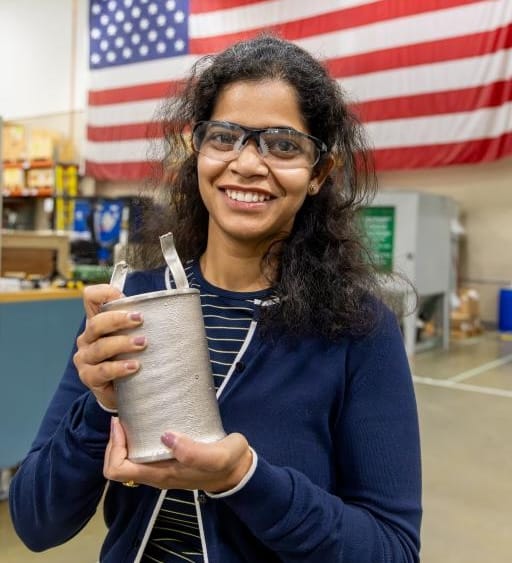
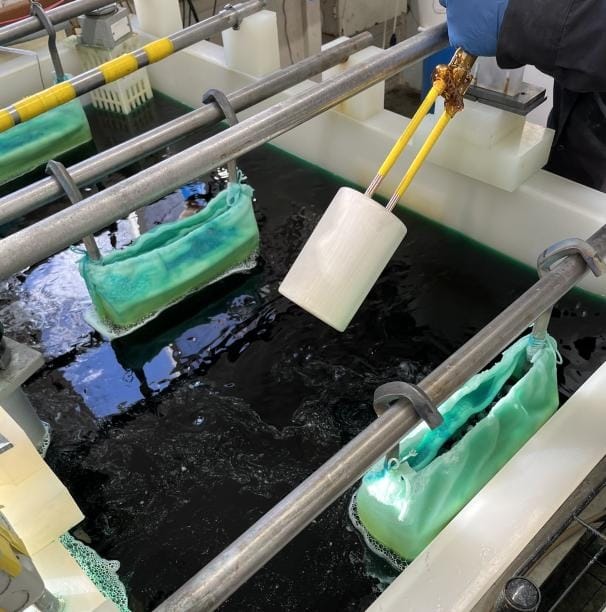
From left: Vanshika Singh, ORNL research associate staff scientist, and electroforming process.
The technology is expected to be well-suited to a range of energy applications that require large, high-precision metal components, including reactor pressure vessels, valves and turbine systems.
In the first phase of the project, the team used electroforming to produce five leak-free cylindrical HIP cans measuring 6 inches tall and 4 inches in diameter. The team also developed an integrated port design that eliminates the separate welding of process tubes, resulting in a more robust and streamlined approach.
The second phase is now underway, and will see the team applying the process to a more complex geometry such as an impeller or a valve relevant to nuclear energy systems.


