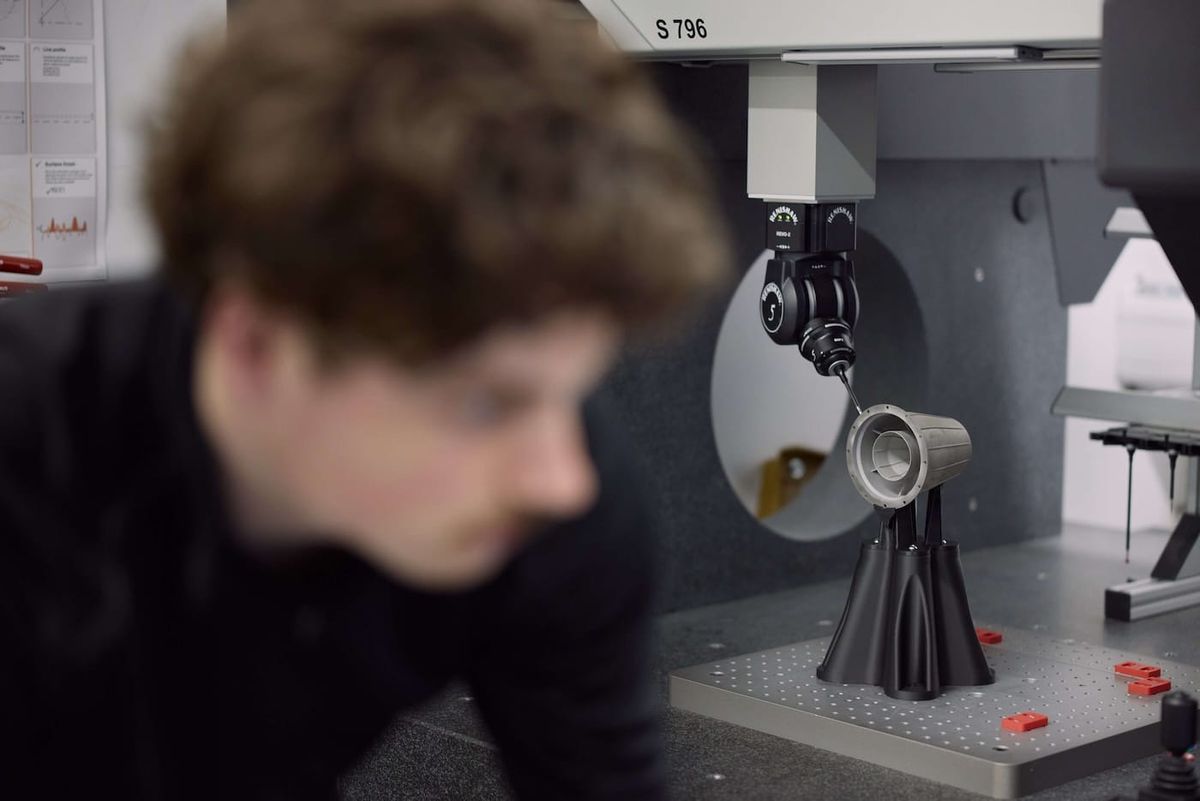
A UK-based defence programme has successfully designed and delivered a new family of turbojet engines in less than six months.
The project was undertaken by the Ministry of Defence's Strategic Capabilities Office with advanced alloy development and production specialist Alloyed, and aims to establish sovereign propulsion capability for future UK-built defence systems. The family of digitally manufactured turbojet engines will range in use from small drones to larger aircraft.
“Taking a jet engine from concept to flight-ready in just a matter of months shows how defence and industry can work together to deliver capabilities at the speed required by today’s world," Minister for Defence Readiness and Industry, Luke Pollard MP commented. “The threats we face demand the ability to produce cutting-edge technology on demand and at scale – this programme delivers that, combining sovereign manufacturing, digital engineering and industrial innovation to ensure our Armed Forces retain an operational advantage, while delivering good jobs for working people here in the UK.”
The programme is being supported by MOD investment and matched funding from Alloyed, and has created more than 60 engineering and advanced manufacturing jobs in the UK, with a further 45 roles to open over the next 12 months.
A 300N-class engine has already completed flight testing and is now in serial production in the UK, while a larger 1100N-class engine has reached flight-ready status in less than seven months. The work is said to have established a digital design and modelling approach that enables new propulsion systems and engine variants to be brought into production in months rather than years. The modular architecture also allows future improvements to be introduced rapidly without extensive redesign.
Michael Holmes, Chief Executive Officer of Alloyed, commented, “Working alongside the Ministry of Defence has enabled Alloyed to bring to bear its world-leading metals technologies to mature and demonstrate advanced propulsion systems at remarkable pace while building a lasting capability in the UK. This programme shows the power of combining defence expertise, digital engineering and industrial innovation.”
Earlier this year, Alloyed also secured £1 million in funding from the Aerospace Technology Institute (ATI) Programme to accelerate the development of a nickel-based AM superalloy that could be used to build the next wave of gas turbines for aerospace propulsion and industrial power generation. Alloyed believes there is “huge demand” for these kinds of materials, particularly as modern aerospace components require more intricate geometries combined with material properties that can survive the high temperatures and harsh conditions of combustion.
 Laura Griffiths