A apartment block has been constructed in France using COBOD International's concrete 3D printing technology, three months faster than conventional building methods.
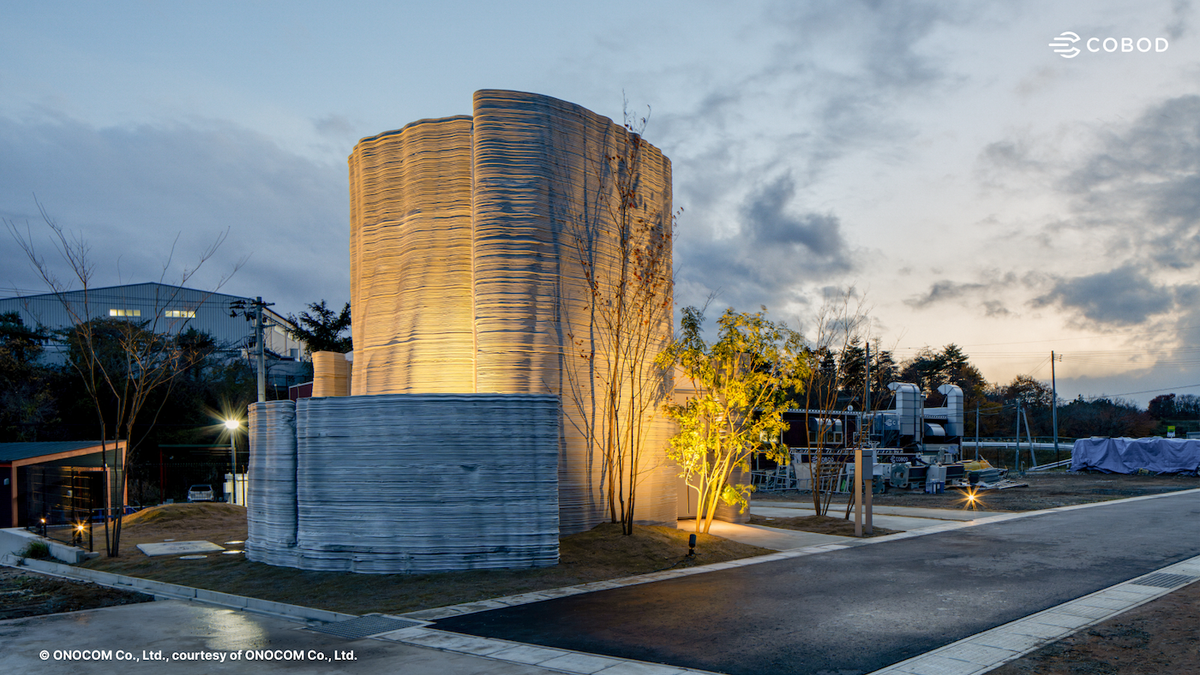
'ViliaSprint' is multi-family residential building consisting of 12 social housing apartments across three stories. It follows a similar project completed in Japan earlier this year, which resulted in the country's first government-approved two-story 3D printed reinforced concrete house.
The load-bearing structure and all walls were printed on-site by by PERI 3D Construction using the COBOD BOD2 gantry system with printable concrete reinforced with synthetic macro fibres and formulated within the CO₂-reduced ECOPact range.
The building, developed by Plurial Novilia, was printed in parallel with a near-identical building that was made using conventional methods on the same site. Results confirmed the shell time reduction and highlighted additional workforce benefits, with only three site operators required versus six for the conventional structure. The building was completed ahead of schedule - three months faster than conventional construction - with 34 effective printing days versus 50 originally planned.
"The result shows vividly what is already possible in 3D building printing today, faster construction, fewer workers, and fully load-bearing structures. This is an important milestone and motivation to push this technology further," said Dr. Fabian Meyer-Brötz, Managing Director of PERI 3D Construction.
According to COBOD, the curved façade and rounded floorplan are only economical because of 3D printing, while on-site concrete production further reduced transport emissions. The optimised form also saved approximately 10% of concrete volume. The time savings were said to have been boosted by an optimised sequencing of prefabricated floor slab installation that halved the number of times the print gantry needed to be repositioned.
The building integrates perlite insulation, timber balcony structures, 500 m² (5,400 sq. ft.) of photovoltaic panels, and a hybrid gas/heat pump system by Atlantic Systèmes, achieving around 60% energy self-sufficiency in compliance with France's RE2020 2025 targets.
Plurial Novilia is now planning a follow-on project using two 3D printers to build a 40 apartment building. The target is to reduce print time by a factor of four and bring costs in line with conventional construction.
In a recent conversation with TCT, Zoë A. C. Knudsen, Head of Products and Communication, COBOD International spoke about the maturity of 3D printing in the construction industry.
"The key value lies in automating the structural phase of construction," Knudsen said. "By combining digital design with automated material deposition, it becomes possible to build complex geometries more efficiently while also reducing costs. When applied to the right use cases, the technology can deliver productivity gains as in faster project completion, and more efficient and sustainable material use."
 Laura Griffiths