

UltiMaker has signed a Memorandum of Understanding (MOU) with Singapore-based MedTech startup Bioactivx to co-develop a scalable, on-demand medical printing solution for regenerative wound care.
The partnership follows the opening of Bioactivx's medical-grade filament production and cleanroom print farm facility and its obtainment of HSA approval for its flagship Bioactiv Matrix product. Bioactiv Matrix is a 3D printing-enabled synthetic skin substitute for severe burns that uses no animal materials and requires no special storage
Bioactivx has developed the Bioactiv Matrix to accelerate wound closure and promote scar-free healing. To bring the product to market at scale, the company has built an end-to-end digital manufacturing process that utilises a proprietary active-ingredient filament in-house and a fleet of UltiMaker 3D printers within a certified cleanroom.
This process operates under ISO 13485 certification and has received HSA approval for end-use medical implant manufacturing. Regulatory submissions for the Bioactiv Matrix in countries and regions such as USA, EU, Australia and the rest of ASEAN are ongoing.
Under the newly signed MOU, UltiMaker and Bioactivx will jointly develop a scalable, deployable printing solution aimed at bringing wound care production closer to the point of need. Their aim is to enable faster access to treatment within the critical "golden period" following injury, by reducing dependency on traditional cold-chain logistics and centralised manufacturing.
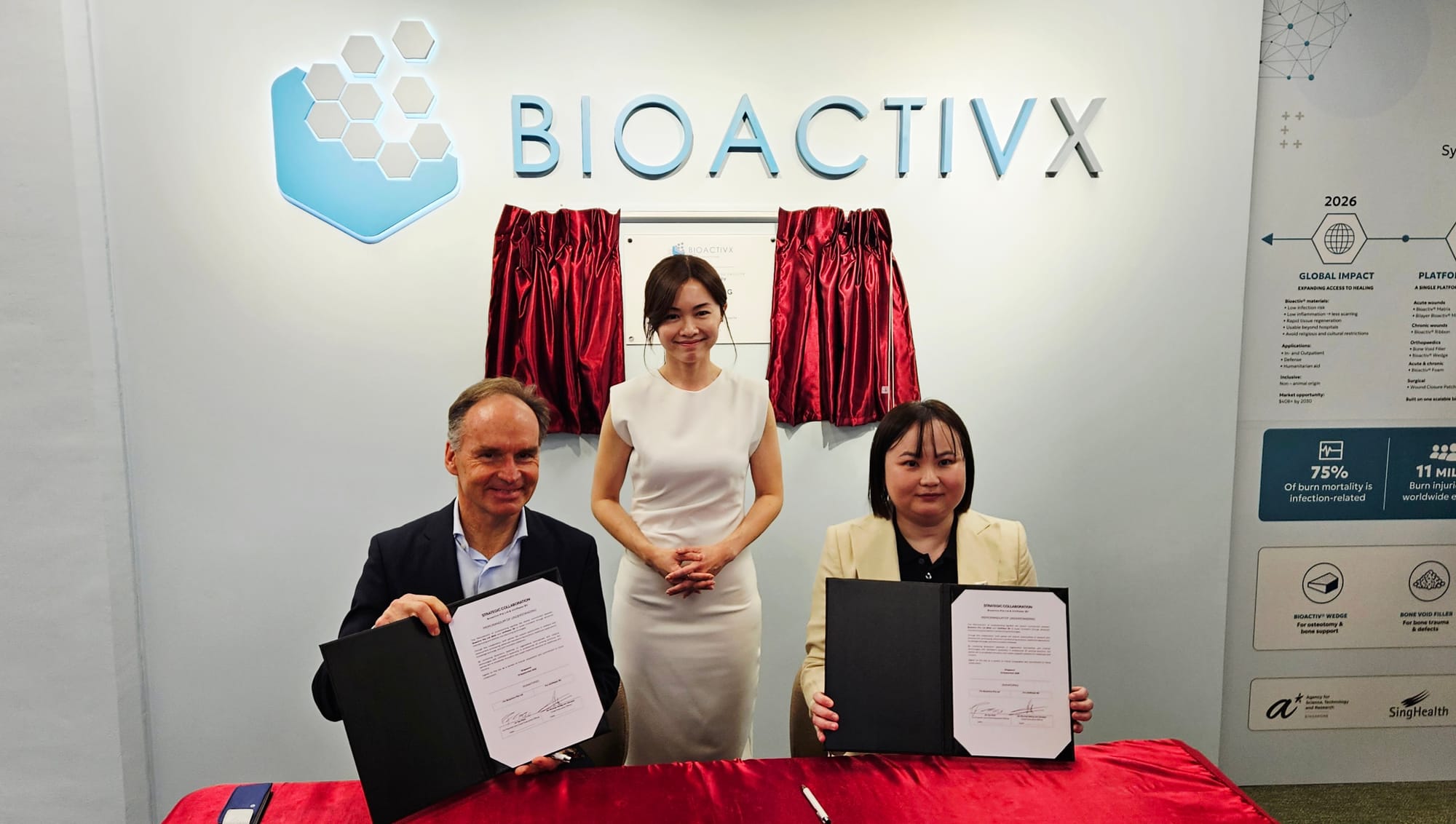
"We chose UltiMaker because of its reliability, ease of use, and open architecture," said Dr Teo Peili, CEO of Bioactivx. "That openness was essential – it let us develop and fine-tune our own proprietary print process rather than working around the limitations of a closed system."
"Bioactivx's certification and regulatory approval is a powerful proof point for the medical 3D printing industry," offered Mr. Michiel Alting von Geusau, CEO of UltiMaker "It demonstrates that with the right process and quality controls, 3D printing on UltiMaker platforms can meet the exacting standards required for certified, end-use medical devices – not just prototypes.
"This collaboration is about more than one product. It's a blueprint for how distributed, on-demand 3D printing can transform medical manufacturing – making critical treatments faster to produce and easier to deliver, wherever they're needed."
"This is just the starting point," added Dr. Teo. "Our vision is a future where advanced, scar-free healing is available to every patient, wherever they are – and UltiMaker is a key partner in making that possible."
Singapore’s HSA is classified as WHO maturity level 4 for medical device regulations, indicating extremely high standards for medical device approvals.


