

Photocentric has spun out its CosmicMaker space business as it aspires to become the 'go-to solution for manufacturing parts on the moon'.
The launch of CosmicMaker Ltd. comes off the back off a series of successful demonstrations of its CosmicMaker 3D printer concept on three parabolic flights earlier this year. The printer was tested on Novespace’s Airbus A310 Zero G flying out of Bordeaux where three identical printers were tasked with printing throughout the flights in all conditions between 2g and 0g.
The UK company, based in Peterborough, patented a 3D printing process for use in space using LCD screens in an enclosed chamber back in 2020. It has since received support from the UK Space Agency via ESA’s BSGN program, and won three grants to manufacture and validate the CosmicMaker 3D printer.
The CosmicMaker is based on Photocentric's LCD printing technology, which has has evolved from the launch of a low-cost LCD screen-based desktop printer back in 2014 to the development of an automated, multi-printer system designed to rival injection moulding. The machine is low mass, lightweight and has low energy requirements, and is said to be a capable of printing in plastics, ceramics, metals and composites.
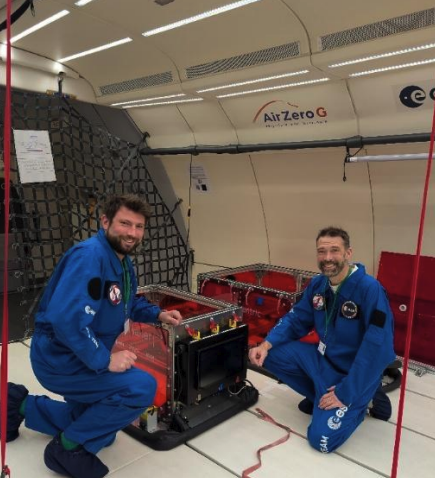
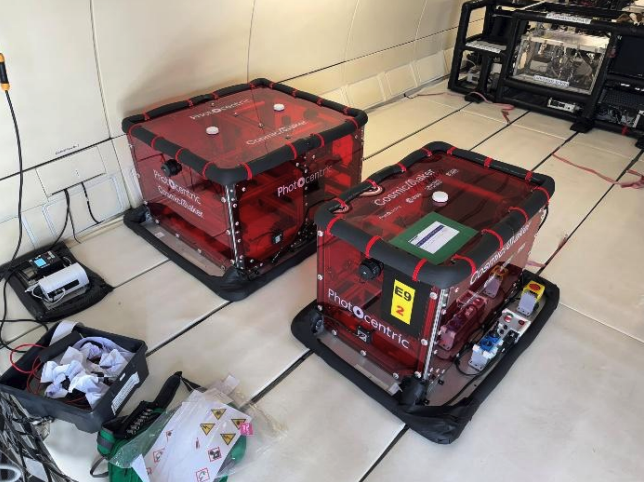
Test parts were printed in silicon carbide, alumina, and two different types of thermoset plastic. Photocentric has described the results as 'dimensionally accurate' and says the particle-rich ceramic slurries were able to print with better particle distribution in the 22 seconds of 0g and worse in the 2g sections as a result of the lack of gravity removing segmentation from the denser particles. The process is also said to remove the need for additional supports. The company believes the CosmicMaker printer to be one of the few machines that operates better in space than it does here on Earth.
Photocentic now plans to incorporate centrifugal resin recovery systems and a robotic system to create a hands-off process.
Last week, TCT shared how Photocentric's JENI system, also based on its LCD printing technology, is aiming to deliver on the promise of additive manufacturing at scale. Described as 'injection moulding without tooling', the modular system, made up of a customisable configuration of 3D printers and post-processing units, is ideal for mass producing customised consumer products, electrical connectors, clips - essentially, any plastic component that you need to make a lot of.


