

When I was seven, I desperately wanted a Sindy camper van for Christmas (Note, not a Barbie motorhome - apparently, I was a contrarian child). Every night for about two months before, I remember I would go to bed excited about this mini purple 4x4 with a roof that converted into a jet ski, hoping it would live up to the hype I had created in my head from the encouraging blurb inside the Argos catalogue. For additive manufacturing enthusiasts, Preparing for Formnext at this time of year is a little bit like that.
For the last two months, we've had teasers of new toys ahead of 'the big day', and conversations between industry colleagues including the go-to, 'So, what days will you be in Frankfurt?' asked as presumptively as 'So, what are you doing for the holidays?'. The dark nights, the new machines nestled under cloth like presents, and the anticipation of what we might find underneath. It really is a kind of Christmastime for the AM world.
This year, there were plenty of surprises to take note of and, as ever, TCT tried to get to as many as we could. Here, we're bringing you along with us on a quick walking tour of the show floor and 12 new pieces of 3D printing hardware.
Nikon SLM Solutions MACHX
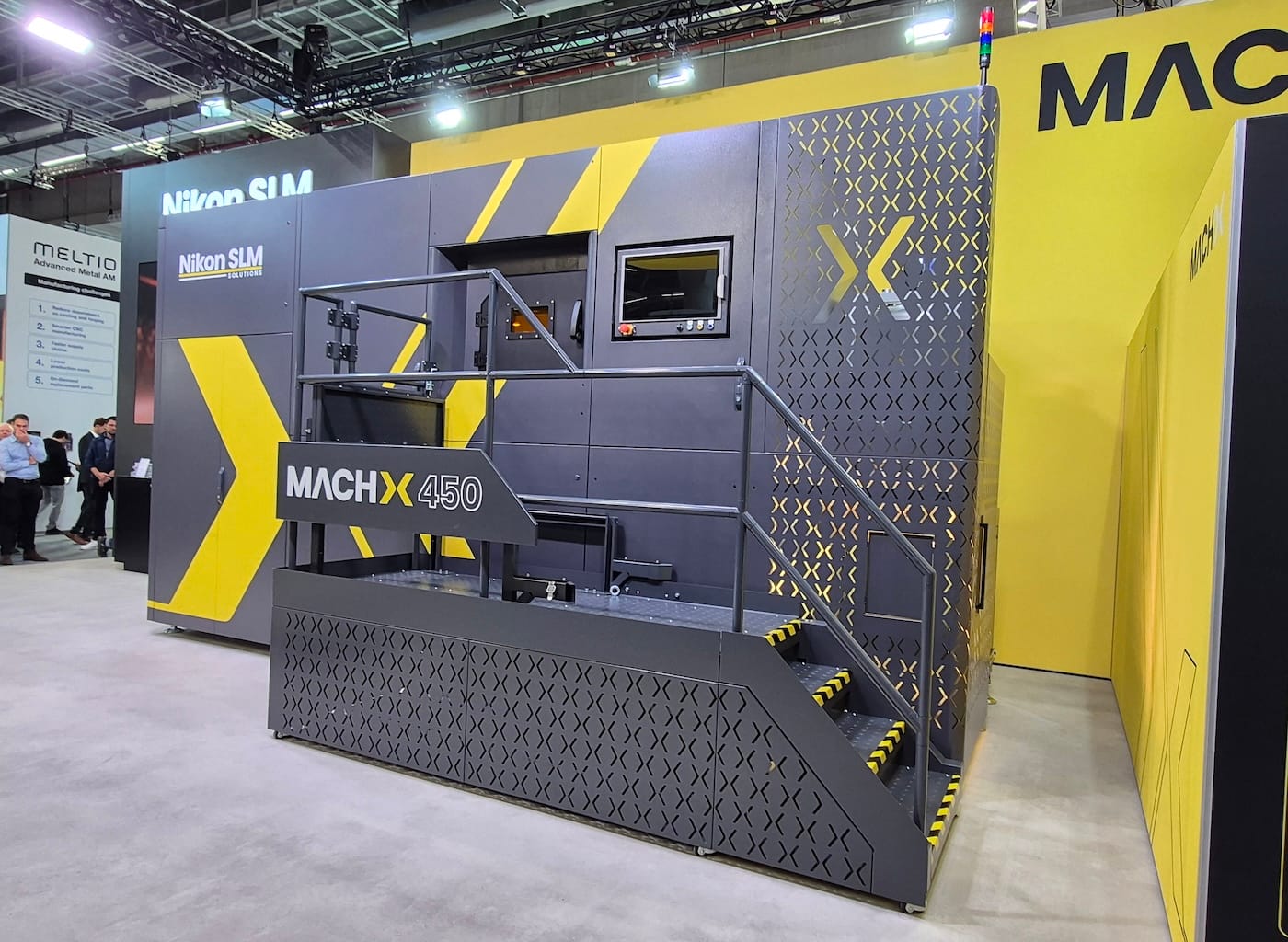
We already knew a lot about MACHX from our Senior Editor Sam Davies conversation with Nikon SLM Solutions' outgoing CEO Sam O'Leary for our latest cover story. However, not even TCT had been privy to what the actual machine looked like until the curtain was removed on day one in Frankfurt.
MACHX takes on speed, reliability and scaling with three different build envelopes within a compact footprint - the idea being that manufacturers can start with a single system and scale. The largest variant, for example, places around 200 litres of build volume in approximately 13 m² of floor space. Interfaces for automated material handling and shared depowdering allow several systems to work as one production cell, and an optional cylinder exchange minimises changeover times by preheating the next cylinder outside the build chamber while the current job runs. And it's already got its first customer after German engineering firm GERG GmbH placed a multi-unit order.
 Sam Davies
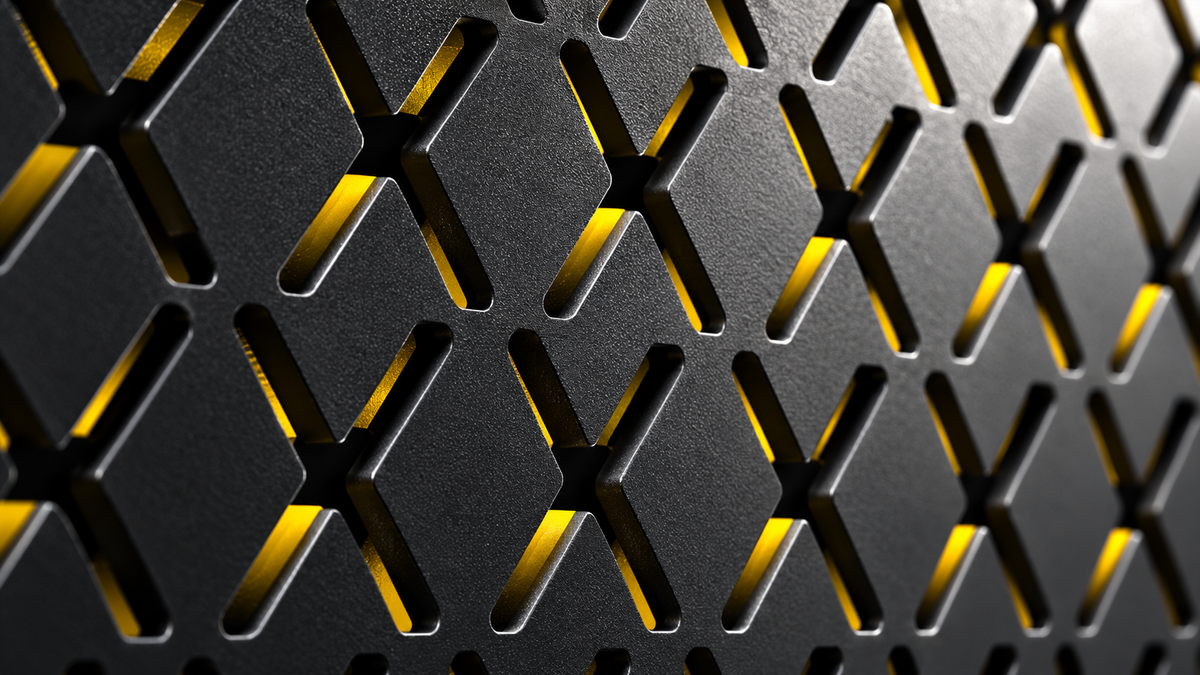
As O’Leary told TCT ahead of the unveiling, "The future will be built through engineering that makes advanced manufacturing dependable and economically useful."
Solukon SFM-AT850
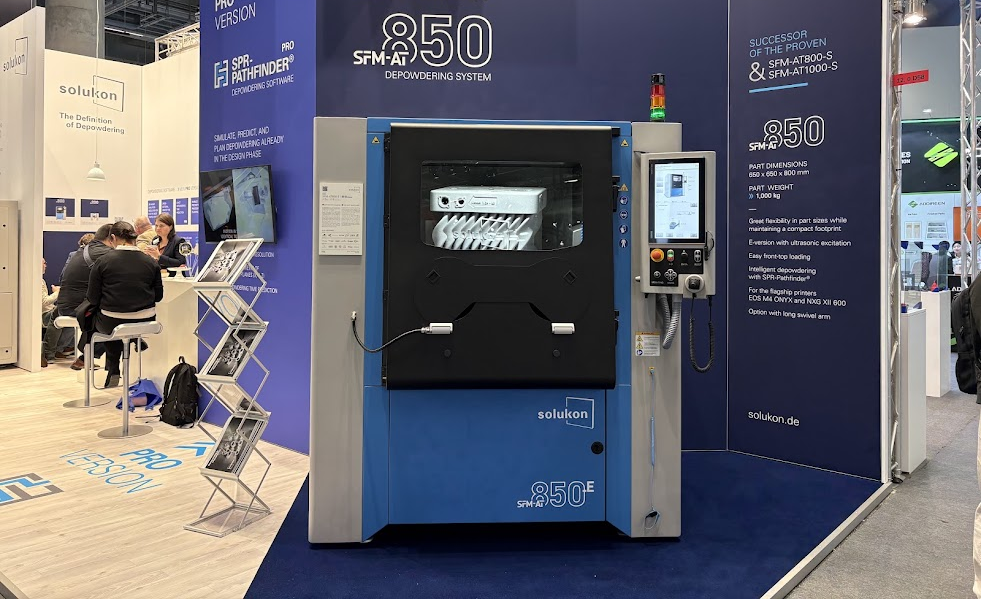
For AM to really scale, complex parts need a place to go after printing. Across the hall, Solukon introduced its latest depowdering system, promising 'a new benchmark' for the automated depowdering of complex metal 3D printed parts.
The SFM-AT850 can accommodate parts weighing up to 1,000 kg, an increase of 700 kg and 100 kg, respectively, compared with the predecessor models, with dimensions of up to 650 × 650 x 800 mm. Similar to the MACHX, footprint has also been considered here as the machine's overall dimensions are smaller than those of the SFM-AT800-S.
With the SFM-AT850, Solukon has optimised the chamber volume to make it an ideal complement to large-format flagship printers, such as the EOS M 4 ONYX and the NXG XII 600 from Nikon SLM Solutions.
EOS HELIOR
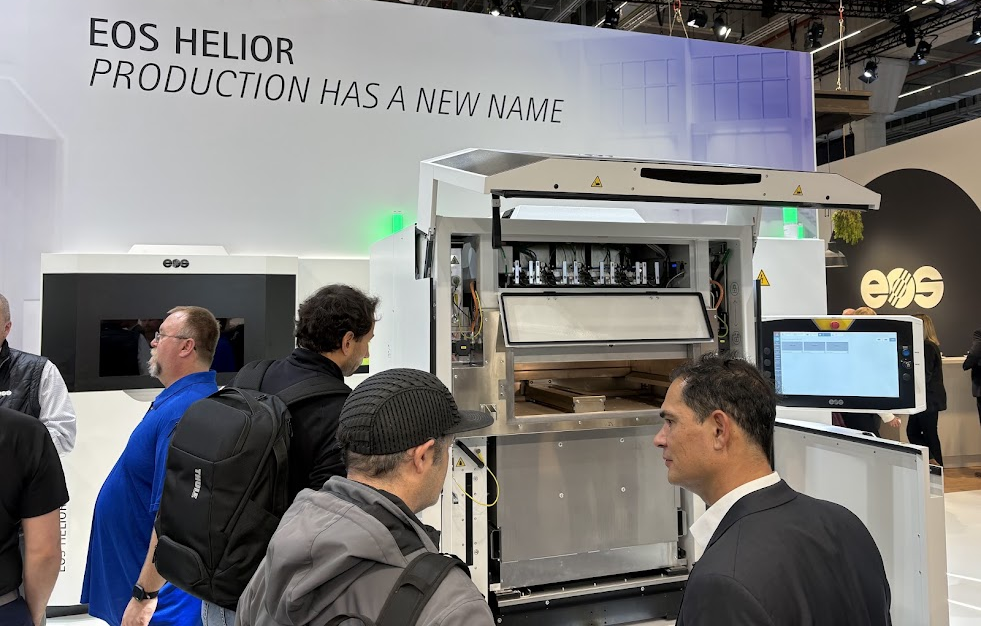
In polymers, economics and increased build sizes were the order of the day with EOS leading the launches on day one.
The EOS HELIOR is the company's biggest polymer system to date with a 700 x 380 x 580 mm build volume and three 70W lasers. It is being targeted towards manufacturers producing parts at high volumes and has been developed with input from such companies including FKM Additive Manufacturing, Prototal Group, Materialise, Shapeways and Formrise.
The machine promises up to 80% higher throughput with 154 liters at 10% packing density in a 24-hour build cycle and up to 80% reduction in post-processing effort.
Stratasys H550
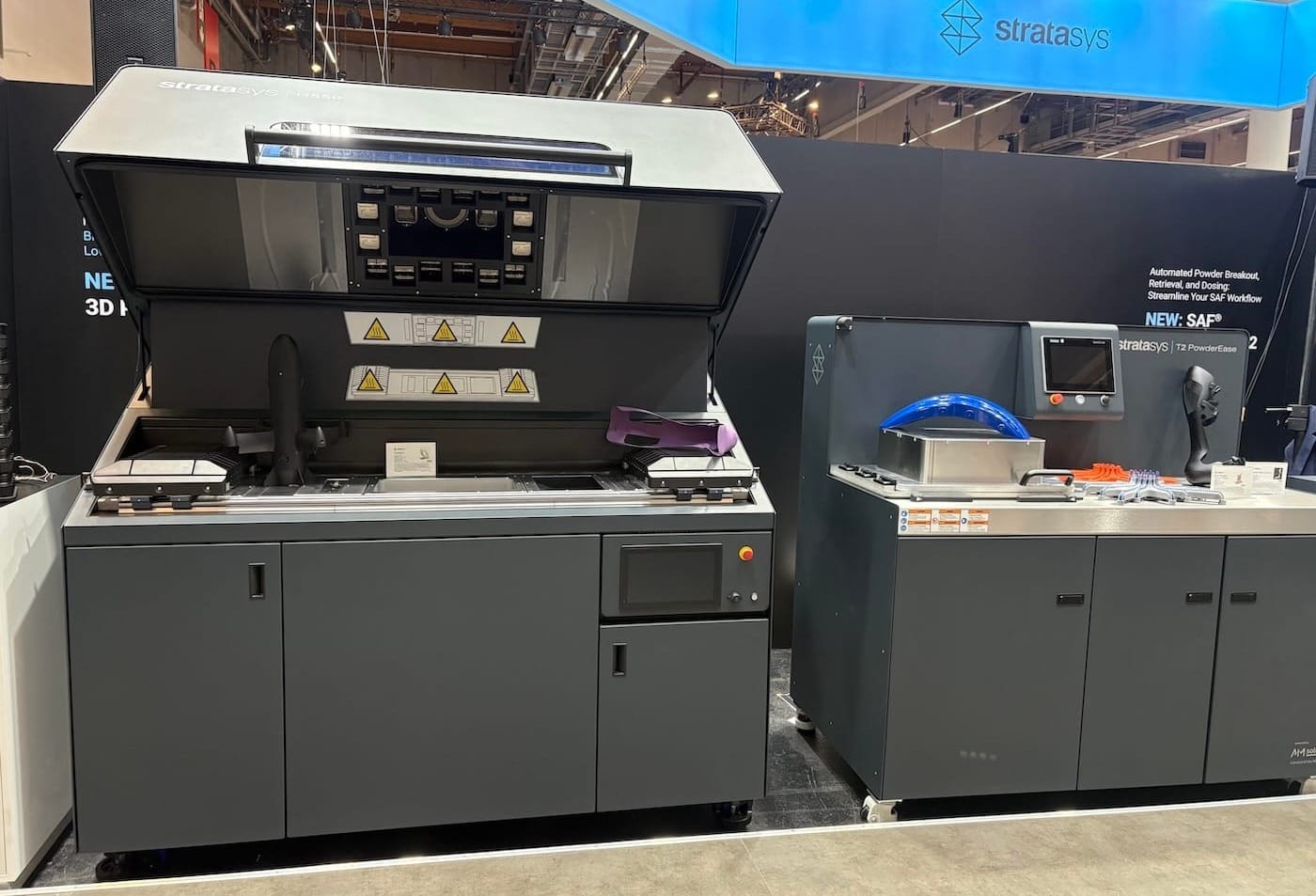
It was a similar message over on Stratasys' booth where the polymer AM pioneer introduced a new addition to its SAF line-up.
The Stratasys H550 tackles one of the key demands from current and would-be SAF users with an increased build space of 34.2-litres and 450mm long. The printer aims to provide "the best available combination of part size, throughput and economics" for larger parts or larger volumes of smaller components.
Stratasys says it is addressing total cost of ownership with up to 30% reductions compared to current comparable print-and-fuse systems, and faster time to part compared to comparable SLS systems.
ATLIX xBUILD 3000 with DHR automation
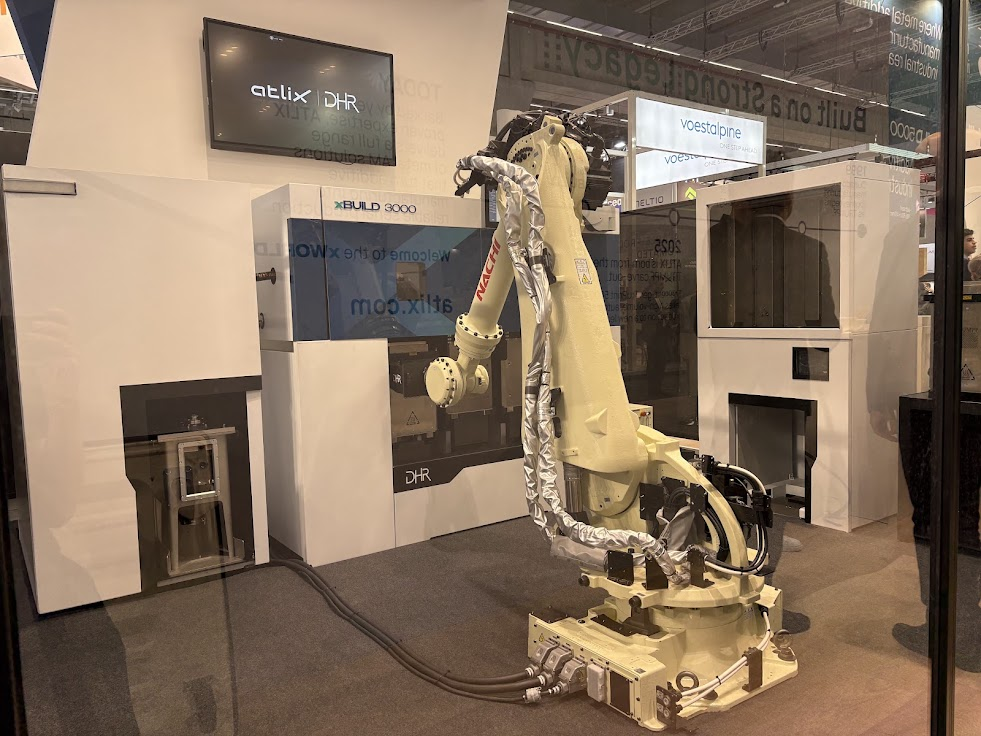
Following a post-TRUMPF acquisition rebrand in September, ATLIX brought its full xBUILD offering to Frankfurt, including a new automation concept.
Visitors could peek into a clear production cell featuring an xBUILD 3000 3D printer and industrial robot for continuous production. The concept is a collaboration with DHR Engineering and sees a robotic arm take care of cylinder loading and unloading, supply cylinder exchange, recovery container transfers, and powder refilling, to deliver what ATLIX claims to be up to 98% machine utilisation.
Automation was a major trend at Formnext way back in 2017, where numerous manufacturers showed demonstrations of 3D printers hooked up to pre- and post-processing steps via Automated Guided Vehicles (AGVs). We didn't really see these concepts realised back then but over the last decade, automation and robotics technologies have continued to mature. In a press release, ATLIX noted that this 'is not a finished product, but a starting point to open the conversation with manufacturers' so we will be curious to see how this is picked up by real-world manufacturers, particularly after the company announced a multi-machine sale of its xBUILD 5000 systems to BMW, citing ambitions for 'unattended, continuous operation.'
AltForm ZENIT Modular Cell
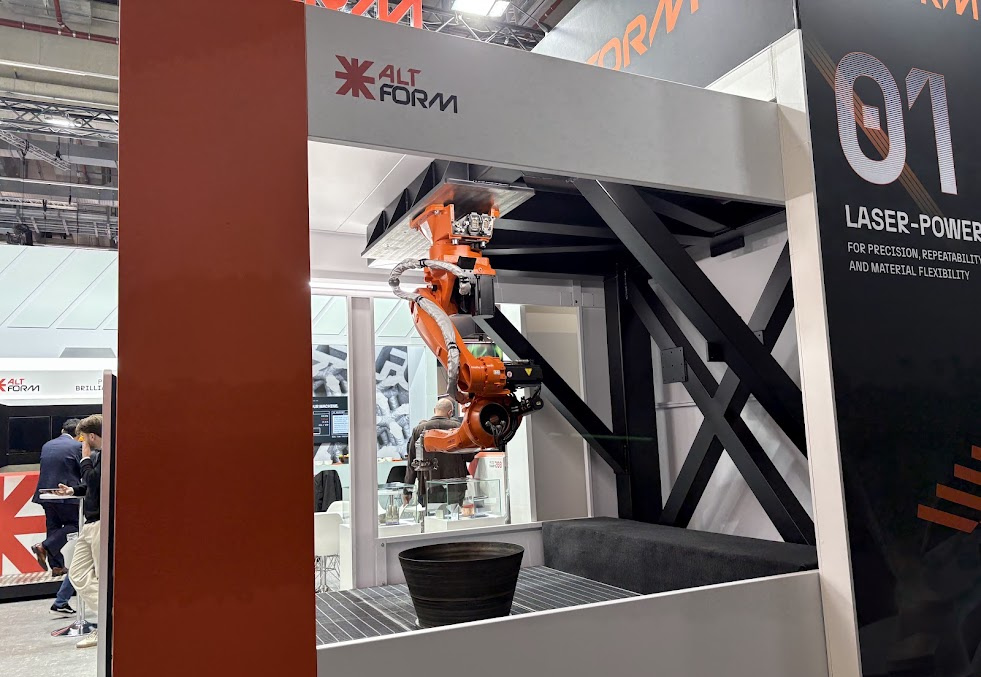
In fact, there were a lot of robots around. AltForm, formerly Prima Additive, premiered the ZENIT Modular Cell for Directed Energy Deposition.
It comes in three configurations, ranging between 2 x 2 m and 4 x 4 m build areas with up to four robots working simultaneously for bigger or multiple parts. AltForm says it has been designed for use with reactive materials, and there's an inert chamber option for working with titanium and aluminium alloys.
Again, it's a system that's designed to scale with demand, which can be done by adding more modules.
Admatec Admaflex Discovery
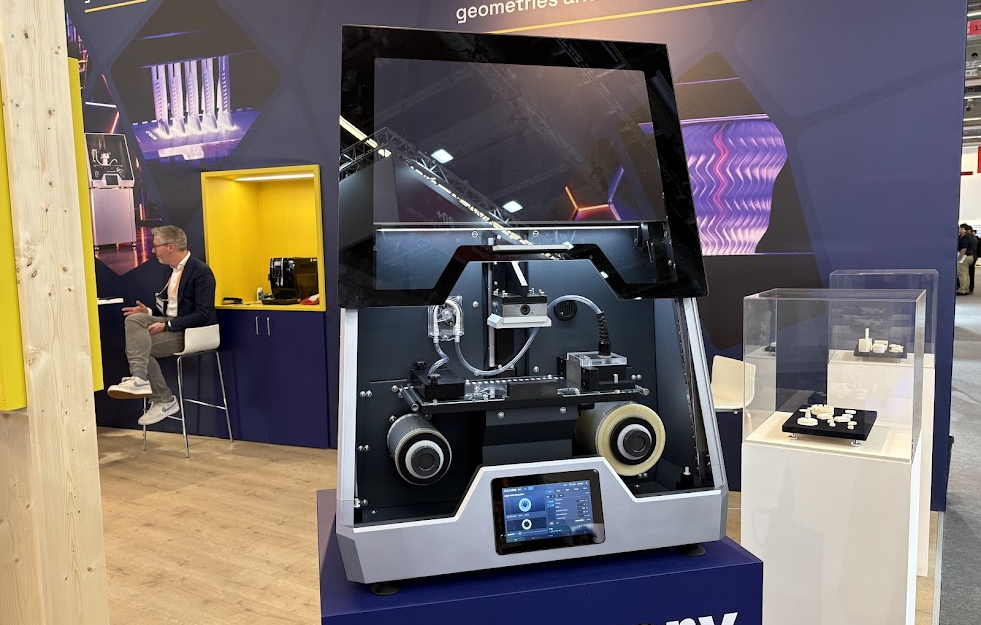
It's been quite the journey for Admatec Additive Solutions. A decade ago, at TCT Show, the company launched its first printer promising a cost-effective solution for ceramic 3D printing. The company was later acquired by Nano Dimension in the early innings of the seemingly never-ending saga that was Nano's bid to become ‘a leader in additive manufacturing’, but was ultimately shuttered last year as the company announced the closure of 'non-core product groups'. That, however, would not be the end for the Admatec as, just two months later, the company was restarted by former director and co-founder Michiel de Bruijcker alongside Ceramic Injection Moulding (CIM) specialist Formatec. You still with me?
And now, here at Formnext, the company introduced the compact Admaflex Discovery system priced at $92,500 for newbies to ceramic printing, such as universities and academic institutions, but is also said to be suitable for those working in industry. The technology is said to be expandable into a ‘larger and more powerful form factor’ and is expected to open up opportunities for applications across jewellery, dental, and hospital environments.
3DCERAM CLP50
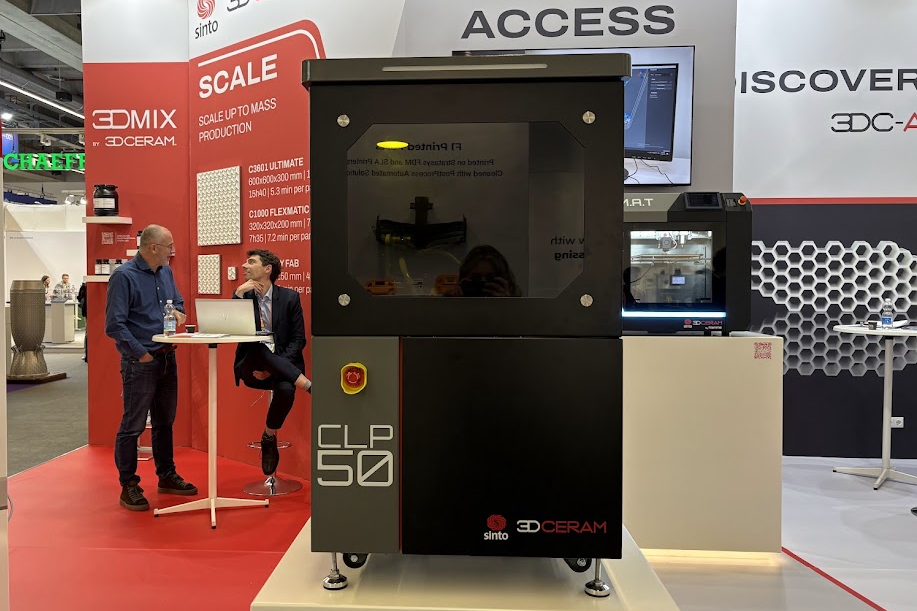
And there were more desktop-friendly ceramics as 3DCERAM introduced its own compact 3D printer.
The desktop-sized CLP50 is a top-down digital light processing (DLP) system features a build volume of 96 × 54 × 100 mm, and provides a lateral resolution of 50 µm and a layer thickness of 10–200 µm, with build speeds up to 400 layers per hour.
The machine is similarly targeted at universities and ceramics part manufacturers, and is an open system so users can also develop and work with their own ceramic formulations and process parameters.
3D Systems MJP 300
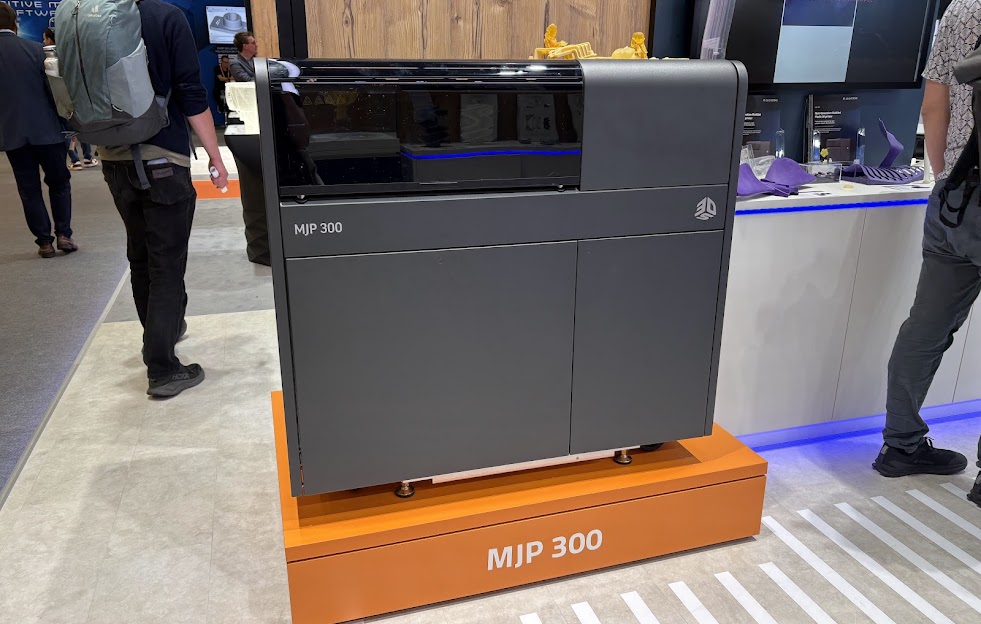
While most of the attention around 3D Systems was focused on the presence of its founder Chuck Hull in Frankfurt (Sam sat down for a chat with 'the godfather of 3D printing', which you can read soon), the company did launch a new multijet system.
The MJP 300 multijet system is targeted at 'faster and easier operation' for the rapid production of plastic parts, with additional build modes also allowing users to prioritise sharper and smoother parts over speed.
With a build volume of 294 x 211 x 144 mm, the area can be divided into three lanes, enabling small or tall parts to be grouped in a single lane for 'maximum production speed without sacrificing quality.'
Inkera C1
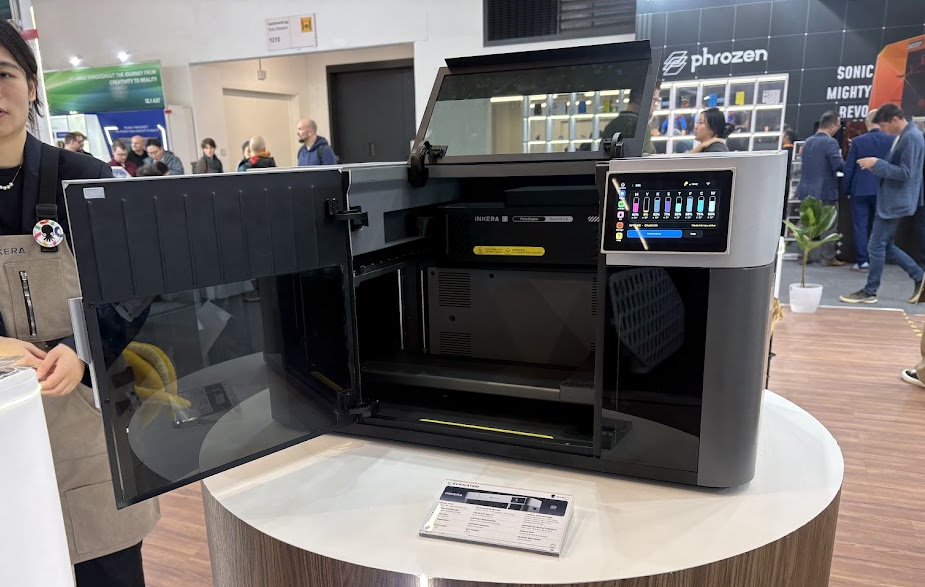
And from the more consumer-oriented end of the show, Inkera introduced its first product, Inkera C1.
It's a desktop full-colour UV 3D printer with a build area of 200 × 150 × 120 mm and claims to tackle 'cost, footprint and process complexity' of full-colour material jetting. The C1 features eight material channels and is said to be capable of producing more than 10 million colours.
I didn't actually see the C1 printing live but it's a really nice-looking machine and has the feel of a regular paper inkjet printer, even down to the touch screen interface which tells you where your ink levels are up to. Pricing is yet to be announced but sales are expected to begin Q1 2027.
Raise3D T450
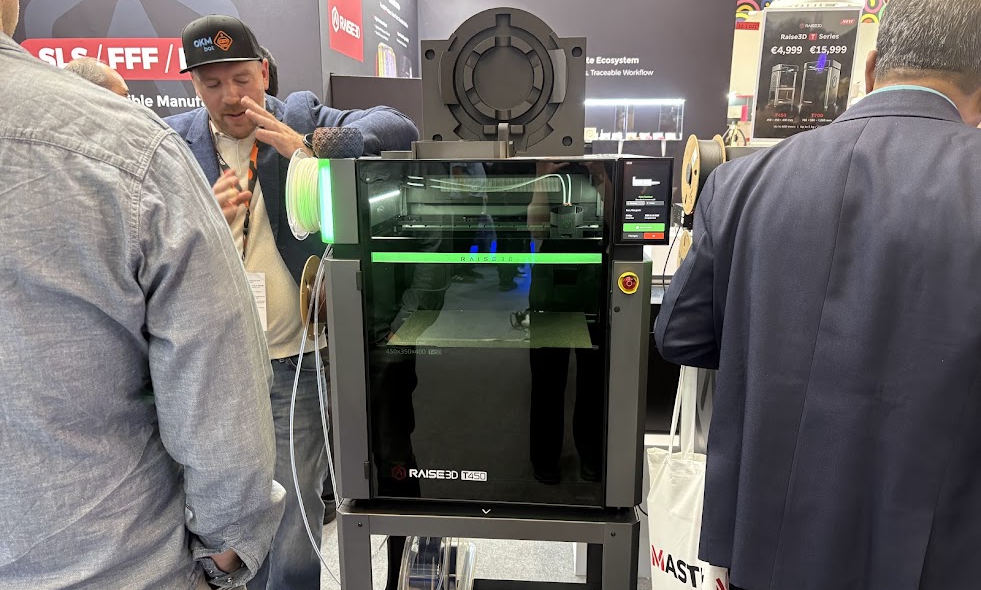
In FDM, Raise3D launched the T450. The company also introduced the large-format T700 but I couldn't get past other visitors to get a photo - you can see a hint of it there in the background, however.
Anyway, both are equipped with an actively heated build chamber and 420°C fibre-ready nozzle, and the smaller T450 shown here offers a build volume of 450 × 350 × 400 mm.
Both are supported by a 4MD CoreXY system with four frame-mounted motors, designed to reduce vibration, surface ringing and the risk of layer shifts, and the TwinFlow high-flow extrusion technology, which feeds two filament paths into one nozzle, reaching up to 600 mm/s and 80 mm³/s under the reference test conditions, and switches to two materials for soluble supports or dual-colour parts.
BigRep PELLEX 750
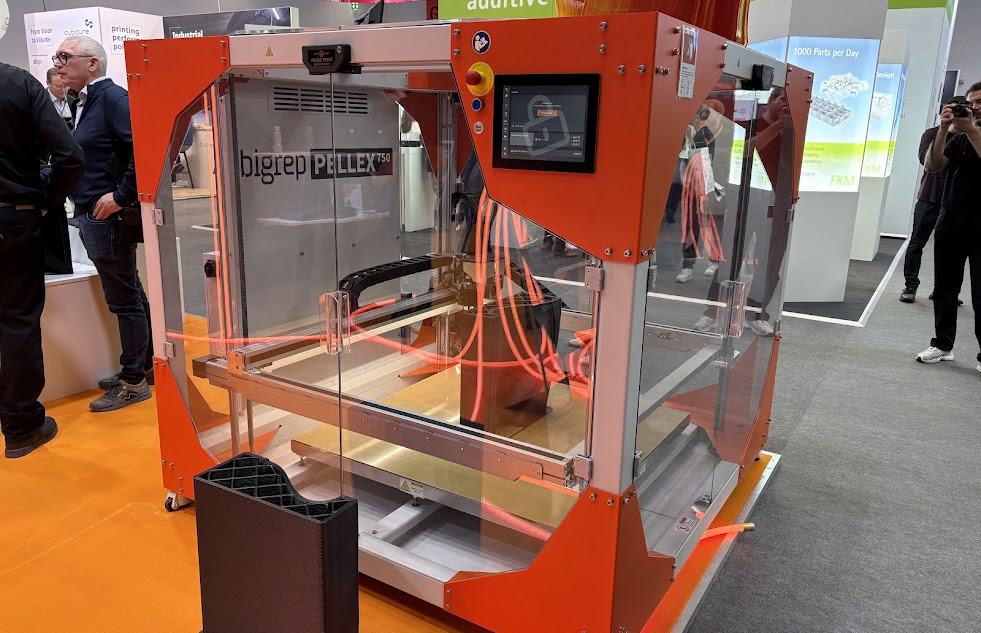
You can't really miss that flagship orange of the BigRep ONE on a trade show floor but this year, the large-format 3D printing company brought something new to its signature 1-metre cubed platform.
A year on from announcing a collaboration with Massive Dimension to develop a large-format pellet-based system, BigRep unveiled the PELLEX 750.
It's based on the same technology as the BigRep ONE but equipped with an MDX pellet extruder and 750-litre build volume to produce large parts with speeds up to 4000 g/h. I saw a couple of large part samples on the booth including colourful pieces of furniture and a wind turbine blade mould, which was printed in Airtech Dahltram T-100CF in just under 5 hours.
 TCT Team
Some honourable mentions (i.e., the stuff I didn't get a photo of...)
- Lithoz's new "Performance Pack" tuning kit add-on, which is designed to boost light intensity and resolution for its CeraFab System S65 and S65 Medical printers, expanding the capabilities of Lithography-based Ceramic Manufacturing (LCM), particularly when it comes to dark ceramics.
- Powderbed Core 1 was introduced as an off-the-shelf control solution for laser-based AM, and based on Autodesk Fusion and 3MF toolpath extensions. There was a lot of attention on this online ahead of the doors opening with the founders claiming that hooking up one of these boxes to a machine's lasers and optics can provide substantial benefits to R&D costs.
- Farsoon Technologies' four-laser Flight HT1002P-CAMS large-format polymer powder bed fusion system, which features a 1,000 × 500 × 650 mm build volume to accommodate bigger parts such as automotive ducts and interiors.
- Mimaki's new 3DUJ-553MkII full-colour printer which offers a 1.4 times larger colour gamut for 'more vivid and more realistic' models and prototypes - think wood, leather and carbon fibre textures - at a lower production cost.


